

To shoot a basketball correctly, you need a balanced base, proper hand placement on the ball, your shooting elbow under the ball, and a smooth follow-through.
That’s the short version.
Below, I’ll walk you through the full 10-step shooting technique, the most common shooting myths that are ruining players’ form, when you should (and shouldn’t) change a player’s shot, and shooting drills to build a repeatable technique.
Quick Reference: The 10 Steps
- Shot Preparation – knees bent, target hands, mentally ready to shoot.
- Hand Placement – shooting hand under/behind the ball, balance hand on the side.
- Balanced Base – feet slightly narrower than shoulder-width, dominant foot slightly forward.
- Feet Direction – slight turn to relieve shoulder tension (11 o’clock for right-handers).
- Consistent Shot Pocket . same starting point every time for rhythm.
- Eyes on the Target – pick a target and be consistent with it.
- Wrinkle the Wrist – bend the shooting wrist back for power and backspin.
- Elbow Under the Ball – form an ‘L’ shape for a straight shot.
- Balance Hand – for stability only, no force on the shot.
- Rhythm Shot + Follow Through – bring it all together, hold the finish.
Now let’s break each one down.
How to Shoot a Basketball in 10 Steps
Step #1 – Shot Preparation

Being a great shooter starts before you receive the ball.
This step is overlooked by most players and coaches, but it can be the difference between having time for a clean shot and getting your shot blocked by a closing defender.
“You don’t shoot fast. You get ready to shoot fast.” — Don Meyer
Three rules to make sure you’re prepared to shoot on the catch:
a. Start with your knees and hips slightly bent.
If you catch the ball with straight legs, it takes extra time to bend before shooting. That’s too slow.
b. Show target hands.
Showing your hands to the passer tells them exactly where to deliver the ball – right to your shot pocket.
c. Be mentally prepared to shoot.
You’ll never be more open than the moment you first catch the basketball. As long as you’re within your range, be ready to let it fly.

Step #2 – Hand Placement on the Ball
When you catch the ball or raise up into a shot, your hands need to get to the right spots immediately.
Your shooting hand goes under/behind the basketball. Your balance hand goes on the side. The thumb of your shooting hand and the base of the thumb on your balance hand should form a ‘T’.
All finger pads and hand pads should be touching the basketball. The only area not touching is the small gap in the middle of your palm.
Your fingers should be spread comfortably wide. Too close together and you lose control. Too far apart and it feels unnatural.
These adjustments need to happen instantly on the catch. If you’re still fiddling with your grip while the defender closes out, you’ve already lost the advantage.

Step #3 – Balanced Base
“The key to being a good shooter is balance. Everything follows balance” – Larry Bird
Most players think shooting is all about the upper body. It’s not. Great shooting always starts with the base.
Three things to get right:
a. Feet slightly narrower than shoulder-width apart.
Too narrow and you won’t have a solid base. Too wide and you won’t get enough lift.
b. Dominant foot slightly in front.
For right-handed shooters, slide the right foot forward. This improves balance and works with the turn (next step) to release tension in your shoulder.
c. Weight equally distributed on each foot.
Don’t lean to either side. Your weight should be centered.

Step #4 – Feet Direction (The Turn)
This could have gone in the balanced base section, but it’s important enough to deserve its own step.
When shooting, your feet should be turned slightly.
Right-handed shooters: feet pointing at about 11 o’clock.
Left-handed shooters: feet pointing at about 1 o’clock.
Here’s why this matters:
Stand at the free-throw line with all 10 toes pointing directly at the rim. Now try to line up your shooting elbow with the basket. Feel that tension in your chest? That’s your body fighting its own alignment.
Turn your feet slightly and that tension disappears. Your elbow and shoulder line up with the rim naturally, without forcing anything.

Step #5 – Consistent Shot Pocket
The shot pocket is where your shot begins, the area you bring the ball to before going up.
For most players, this is around the lower chest or stomach, either centered or slightly to the shooting hand side. Every player needs to find what feels comfortable for them.
The key word is consistent.
Each time you catch the basketball to shoot, bring it back to the same spot before raising up.
This does two things:
1. It ensures you’re shooting the same way every time.
2. Starting from a low shot pocket gives you much better rhythm as you go up.
Will there be times in a game where you can’t return to your shot pocket?
Sure. But you’ll shoot better when you do.
Step #6 – Eyes on the Target
A while back I asked 15 shooting coaches which part of the rim they encouraged players to focus on.
The answers were all over the place.
- Center of the front of the rim
- Center of the back of the rim
- The first loop in the net
- The entire hoop
And yet every one of them developed great shooters.
What does that tell us?
There isn’t one “correct” target. What matters is consistency.
Pick a target, stick with it, and let your shot develop around it.
Front-rim shooters and back-rim shooters are aiming at targets 17 inches apart trying to achieve the same goal. If you’re constantly switching between them, you’ll never build the muscle memory needed to be a consistent shooter.
Pick one and commit.
For more on this topic, check out our article on what part of the rim to aim at.
Step #7 – Wrinkle the Wrist
Shooting with a straight wrist is one of the most common problems for young players.
When the wrist stays straight, the ball gets pushed toward the rim (flat shot) instead of being shot up and through the rim.
The fix is simple.
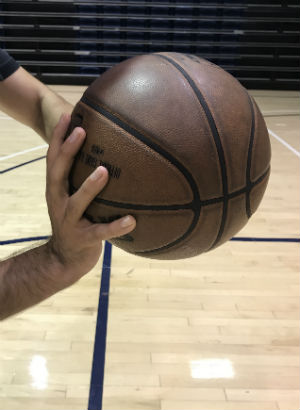
Bend the wrist of your shooting hand back as far as comfortable – usually just before 90 degrees.
This gives extra power and creates the backspin you need for a soft shot.
Here’s the visual cue: when your wrist is bent back correctly, you’ll see small wrinkles in the skin on the back of your wrist. If you don’t see wrinkles, you’re not bending back enough.

Step #8 – Elbow Under the Basketball
When you raise up for the shot, the elbow of your shooting arm should be directly under the ball.
This means your upper and lower arm form an ‘L’ shape, and your wrist is bent back (Step 7).
When the elbow is under the ball, the shot travels in a straight line to the rim with good backspin.
When the elbow flares out? Shots miss left and right because the ball isn’t being pushed straight.
(If a player keeps flaring their elbow, check their feet first. A lot of the time, the flare happens because they’re not turning their feet [Step 4], which puts tension on the chest and forces the elbow out.)

Step #9 – Balance Hand
The balance hand is the non-shooting hand. Some people call it the “guide hand,” but I don’t love that term because this hand should never guide the basketball anywhere.
Its only job is to stabilize the ball on the shooting hand until the point of release.
When the shot is taken, the balance hand should:
- Release flat off the side of the basketball
- Apply zero force to the shot
- Stay still and not push the ball
If the balance hand isn’t flat on release, it usually means the player has pushed the ball with their thumb – which is one of the most common shooting problems at every level.
Step #10 – Rhythm Shot + Follow Through
This is where it all comes together.
Shooting with rhythm means multiple things happening simultaneously:
- The ball lifts up from the shot pocket.
- The knees and hips straighten as you rise into the air for power.
- The shooting elbow extends once the ball passes shoulder height.
- Near the peak, the wrist snaps toward the rim so your fingers point down.
- The balance hand releases flat.
- The last two fingers to touch the ball should be the index and middle fingers.
- Your body drifts slightly forward as you land — a natural “sway.”
Hold your follow-through until the ball hits the rim. This gives you a chance to evaluate your form and builds the consistency of your release.
(When practicing, look up after each shot and check your hand position. Were your fingers pointing at the rim? Was your balance hand flat? This self-check is how you build awareness of your own mechanics.)
The BEEF Method (and Why It’s Not Enough)
When kids first start learning how to shoot, one of the first things a coach will teach them is the BEEF shooting method:
- (B) — Balance
- (E) — Elbow
- (E) — Eyes
- (F) — Follow Through
Simple, easy to remember, and fine for absolute beginners.
The problem is that it’s too simple.
I still see way too many coaches using BEEF with older, more experienced players.
Once a player has the basics down, they need something more advanced.
We’re letting them down if our shooting instruction doesn’t grow with them.
5 Shooting Myths That Are Ruining Players’ Shots
Before we get into the specific myths, here’s how deep these go.
Steph Curry (the greatest shooter of all time!) created a MasterClass shooting course where he encouraged players to square their feet to the basket, avoid dipping the basketball, and only place the ball on their fingertips.
The problem with that?
We break down what Steph actually does when he shoots in a separate article… and it contradicts almost everything he teaches!
Steph never squares up. He always dips. He always puts the ball on his palm.
There are countless slow-motion breakdowns proving this.
So why does the greatest shooter of all time teach the opposite of what he does?
Because certain shooting instructions have been repeated for decades without anyone stopping to check whether they’re actually true.
Here are the five biggest offenders.
Myth 1: “Use more legs for power”
“Bend your legs more” is NOT always the answer.
The further a player squats before shooting, the less control they’ll have going up into the shot.
Players should bend a comfortable amount… no more.
If you watch the best shooters in the world, none of them are doing a deep squat before they shoot. A slight bend in the knees is all you need.
Myth 2: “Don’t let the ball touch your palm”
I’ve attended clinics where coaches told 12YOs that the ball shouldn’t touch their palm at all.
This is silly.
You’ll immediately end up with kids “pinching” the basketball, trying to figure out how to shoot when they can barely even balance the ball.
The ball should sit on your finger pads with a small gap between the ball and the center of your palm. Your palm can and should make partial contact.
What you want to avoid is the ball sitting flat on your palm with no finger pad involvement.
Myth 3: “Don’t dip the ball on the catch”
“Don’t dip the ball” is one of the most common phrases in coaching circles.
And it’s nonsense.
The dip (dropping the ball down to waist level before going up into the shot) creates rhythm and generates power. It gives you a consistent starting point.
Nearly every great shooter in basketball history dips every time they catch the ball to shoot:
- Steph Curry dips.
- Ray Allen dips.
- Kevin Durant dips.
- Steve Nash dips.
It’s mentally painful to think about the number of coaches who force players to stop this very natural, very effective habit. Doing so makes them shoot WORSE, not better.
Players: dip the basketball.
Myth 4: “Follow your shot”
When a player shoots with good form, their feet naturally drift forward slightly on the landing.
This “sway” is a sign of proper shooting technique… good arc, rhythm, and power.
When players are told to follow their shot, they ruin that.
Instead of the natural sway, they lunge forward off-balance, chasing the rebound before they’ve even finished their shot.
It throws off their technique and trains them to EXPECT a miss before the ball has even left their hand.
If you’re a parent on the sidelines… please stop yelling “Follow your shot!”
You’re making players worse.
Myth 5: “It’s too late to change their shooting form”
You can ALWAYS work on shooting mechanics.
NBA and WNBA players make small adjustments to their shot every single offseason.
They tweak their release point, adjust their balance hand, experiment with their shot pocket… constantly refining.
If the best players in the world still make changes, it’s definitely not too late for a 14-year-old.
That said, changes take time…
A player who commits to adjusting their shot needs to understand that they’ll shoot worse before they shoot better. The process requires patience. Weeks and months, not days.
Shooting Form Mistakes (and How to Fix Them)
1. Not Shooting With Enough Arc
If you have a flat shot, the ball has a much smaller window to go through the rim.
In 99% of cases, this happens because the player “pushes the ball out toward the rim” instead of “shooting it up and through.”
The fix?
Make sure you’re wrinkling your wrist (Step 7), keeping your elbow under the basketball (Step 8), and finishing with your elbow near your eyebrow on the release. If your elbow finishes at chest height, your shot is too flat.

2. Pushing With the Balance Hand Thumb
The traditional basketball shot is a one-handed shot.
The balance hand stabilizes until the release point, then the shooting hand does 100% of the work.
But many players use their balance hand thumb to add extra power. This is natural when they’re young and lack strength, but as they grow and get stronger, they need to transition away from it.
How to spot it:
If the balance hand isn’t flat on release, the player is likely pushing with the thumb. Their shots will tend to miss left or right because the extra thumb force pushes the ball off its straight line.
The fix?
Form shooting close to the basket with one hand only. Remove the balance hand entirely at first, then gradually add it back as a stabilizer with no force.
3. Fingers Not Spread Wide Enough
Young players often catch and shoot with their fingers too close together.
The closer the fingers, the less control they have.
The ball becomes harder to balance, harder to direct, and harder to release cleanly.
The fix?
During form shooting, stop and check each player’s hand position. Make sure fingers are spread comfortably wide on the ball. It only takes a few reminders before it becomes habit.
4. No Consistent Shot Pocket
Players who catch the ball and shoot from wherever it happens to land in their hands will never develop consistency.
The fix?
Every shot starts from the same spot. Bring the ball to your shot pocket before going up, every single time, until it’s automatic.
5. Straight wrist (no wrinkle)
A straight wrist means the ball gets pushed rather than flicked. The result is a flat shot with no backspin that hits the rim hard and bounces away.
The fix?
Check for wrist wrinkles before every form shot. If you can’t see wrinkles, you’re not bending back far enough.
Why Becoming a Great Shooter is Important
Hesitant about whether you want to spend the hours it takes to become a great shooter?
Here’s why it’s important that you do…
1. Increases Your Scoring Opportunities
Being a great shooter will increase your scoring from all areas of the court.
Not only will you make more shots from the perimeter, you’ll also be able to drive to the basket and score much easier than before.
“Why is this?”
When you’re a great shooter, the defense is forced to defend close to you on-ball and off-ball in order to prevent you shooting an outside shot.
This gives the defender a lot less time to react to a cut to the rim or a drive to the basket if you have the basketball.
2. Increases Your Teammate’s Scoring Opportunities
Great shooters don’t need to touch the basketball to help their team score.
By simply being a scoring threat from the perimeter, you will help your team’s offense by creating space on the floor.
Since a shooter’s defender is forced to play close to them to prevent the quick shot, it’s difficult for them to play help defense on the other offensive players.
This means that there will be more space inside to finish at the rim, more open cutters, more open driving lanes, etc.
3. More Points on the Scoreboard
At the end of the day, to win more basketball games, you need to put points on the scoreboard.
And improved shooting does that!
If a player is able to make 35% of their three-point shots, they’ll be more efficient than a player who makes 50% of their two-point shots.
This is the reason why we’re seeing more and more teams at all levels attempt more three-point shots as players become better shooters.
4. Proves You Work on Your Game
There’s one rule that will always be true when it comes to shooting…
Shooters aren’t born. They’re developed.
It’s impossible to become a great shooter without a championship-level work ethic and dedication to improve your game.
All coaches and recruiters know this.
Being a great shooter immediately proves to all watching that you have great attention to detail, you work hard, and that you’re disciplined.
These are all traits that recruiters are on the lookout for.
Shooting Drills For Perfect Form
1. Perfects
Start close to the basket (3 to 5 feet) with the ball in your shot pocket.
Focus on shooting each shot with perfect form.
The goal is swishes, not just makes.
Work through four distances:
- 3 feet — 10 perfect swishes
- 5 feet — 7 perfect swishes
- 7 feet — 5 perfect swishes
- Free-throw line — 5 perfect swishes
This is a great drill to begin individual shooting workouts with.
2. Spin Outs
This drill works on catch-and-shoot situations.
Spin the ball out in front of yourself, catch it with a hop or 1-2 step, and rise up into the shot with correct form.
Practice from both midrange and beyond the three-point line depending on age and skill level.
This is perfect for working on both footwork options… the hop and the 1-2 step.
3. Off-Dribble Form Shooting
Start several feet behind where you plan to shoot from.
Take 2-3 hard dribbles, then pull up for the jump shot.
The biggest focus: stay on balance throughout the entire shot. Shooting off the dribble is where form tends to break down, so keeping your base stable is everything.
After each shot, collect your own rebound and return to the starting position.
Frequently Asked Questions:
“How should I hold a basketball when shooting?”
Your shooting hand goes under and behind the ball with your fingers spread comfortably wide. Your balance hand goes on the side. The ball should sit on your finger pads with a small gap between the ball and the center of your palm. Your thumb and the base of your balance hand thumb should form a ‘T’.
“What is the shot pocket in basketball?”
The shot pocket is the area where your shot begins… the position you bring the ball to before going up into your shooting motion. For most players it’s around the lower chest or stomach area, either centered or slightly to the shooting hand side. The key is finding a spot that’s comfortable and bringing the ball there every single time you shoot.
“Should I use a hop or a 1-2 step when shooting?”
Both. Learn to shoot off both. There are times in a game where the hop is better and times where the 1-2 step is better. Players will develop a preference over time, and that’s fine… but they need to be capable of using both.
“What part of the rim should I aim at?”
There isn’t one correct answer. Some great shooters aim for the front of the rim, some for the back, some for the center, some for the first loop of the net. What matters is picking one target and being consistent with it. Constantly changing your target makes it nearly impossible to build muscle memory.
“Why is backspin important?”
Backspin creates a “soft” shot. When the ball has good backspin, it has a much better chance of hitting the rim and bouncing in rather than bouncing away hard. The backspin comes from snapping your wrist on the release and letting the ball roll off your finger pads.
“How many shots should I make per week?”
Depends on how good you want to be. A rough guide:
- Elite shooter: 1,500 makes per week
- Great shooter: 1,000 makes per week
- Developing shooter: 500 makes per week
That might sound low, but if you’re taking all shots from game spots at game speed, it adds up fast. And 200 focused, intentional shots are worth more than 500 lazy ones.
“How do I increase my range without losing form?”
Don’t change your shot pocket or mechanics to reach further. Instead, be patient. Range comes with strength, and strength comes with time… especially for younger players.
A 12-year-old who has good form from 12 feet will naturally extend their range as they grow. Changing a comfortable shot to chase distance is one of the most common mistakes coaches and parents make.
“What’s the right hoop height for youth players?”
The JR NBA recommends: ages 7-8 on an 8-foot hoop, ages 9-11 on a 9-foot hoop, and ages 12+ on a 10-foot hoop. A player who can’t reach the rim with proper form will compensate with bad habits – two-handed shots, pushing from the chest, heaving the ball. Get the height right and proper technique follows.
“Can I become a great shooter even if I’m not naturally talented?”
Yes. Not a single great shooter was born with the ability to shoot a basketball. Steph Curry, Ray Allen, Reggie Miller… they all started with zero shooting ability, just like everyone else. What separated them was thousands of hours of smart, focused repetitions. Any player willing to put in that work can become an excellent shooter.

A Special Note for Basketball Coaches…
If a young player is shooting with bad technique, it’s our fault.
Not any one coach specifically, but all of us as a whole.
We can’t expect 5 to 12-year-olds to know the correct way to shoot a basketball. It’s our responsibility to teach them correct form, use shooting technique drills in practice, and create an environment where good habits form early.
Two steps to developing great shooters
Step 1: Master the mechanics (coach’s responsibility).
Learn what great shooting form looks like and teach it to your players. Use the 10 steps above as your framework. This is one of our most important jobs.
Step 2: Lots of smart repetitions (player’s responsibility).
There simply isn’t enough time during team practice for players to get the volume of shots they need. On average, a player only shoots 25-30 shots in a typical team practice. The bulk of their development happens outside of practice on their own time.
But the reps need to be smart reps.
200 intentional shots – game shots, from game spots, at game speed – are worth more than 500 shots thrown up casually while chatting with friends.
Strolling into the gym and chucking three-pointers is not practice. That’s fooling around.
Conclusion
Even after all these steps, myths, and tips, here’s the most important thing to understand:
There is not one “correct” way to shoot a basketball.
Steph Curry, Dirk Nowitzki, Reggie Miller, Ray Allen, Klay Thompson… all world-class shooters with noticeably different techniques.
Use the 10 steps as a framework. Learn them, practice them, and then make subtle adjustments to find what works best for you.
The players who become great shooters aren’t the ones with perfect textbook form…
They’re the ones who find a comfortable, repeatable technique and then put in the hours to make it automatic. There’s no shortcut for that.
Photo and Video Credit:
A big thank you to Ryan Razooky for providing this blog post with images and videos of the different steps on how to shoot a basketball.
