
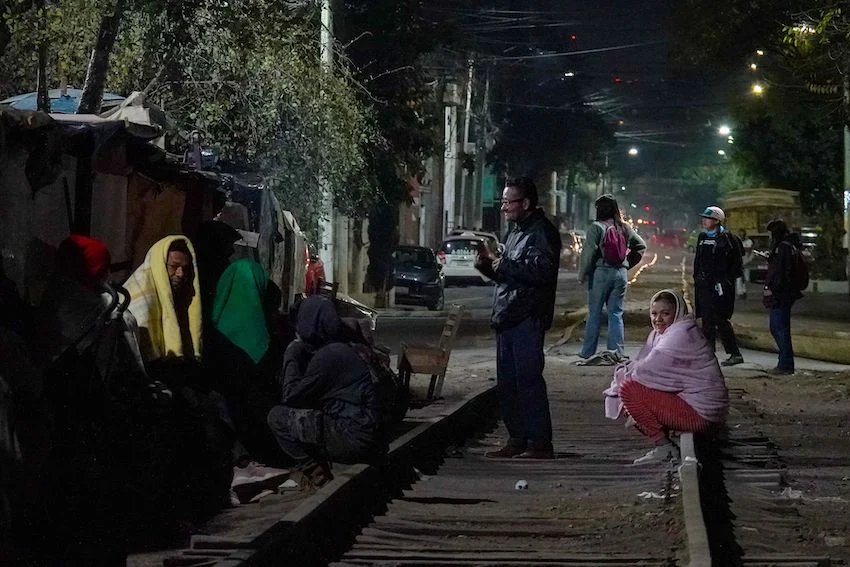
“They’re casting us aside to die. There’s no help; we can’t work because we don’t have papers. They don’t give us anything, nothing. … How are we supposed to eat, to pay rent?”
Those are the words of 58-year-old Harold A. (not his real name), one of thousands of Cuban nationals who have been deported to Mexico by the U.S. government since U.S. President Donald Trump began his second term in January 2025.
Human Rights Watch (HRW), a New York-based watchdog organization, recently spoke to Harold and 52 other third-country nationals who were deported from the United States to Mexico before being transported to the southern cities of Tapachula, Chiapas, and Villahermosa, Tabasco.
Those conversations inform “‘Casting Us Aside to Die:’ Cuban and Other Third-Country Nationals Deported from the US to Mexico,” a 66-page report published on Wednesday that HRW says “documents U.S. government abuses against Cubans and other third-country nationals deported to Mexico between January 2025 and March 2026.”
The report is also an indictment of the Mexican government, which HRW says has provided little if any support to deportees from the United States despite agreeing to receive them.
‘Trapped in a legal limbo’
In a press release summary of its report, HRW said that it found that, between Jan. 20, 2025, and March 9, 2026, U.S. authorities deported more than 18,000 people to third countries — i.e., nations that are not the deportees’ countries of origin.
HRW said that the U.S. sent nearly 13,000 of that number — around 70% of the total — to Mexico “under an undisclosed agreement between the two governments.”

“Cubans accounted for the largest group, with 4,353 deported to Mexico over the same period,” the organization said.
HRW asserted that the Trump administration has denied due process to thousands of Cubans it has deported to Mexico, among whom are many “older adults.”
It also said that the U.S. government has left many of those people “stranded without access to basic services.”
“… With no other recourse to obtain permanent residency in Mexico, many Cuban deportees, whose home government refuses to take them back, are trapped in a legal limbo,” HRW said.
“Since arriving in Mexico, they have received little if any government support, and many are without access to shelter, food, or health care.”
Alcira Silva Hava, a fellow in the refugee and migrant rights division at HRW and author of the report, said that “the Trump administration is using Mexico as a dumping ground for people it cannot deport to their countries of origin, including many Cubans who have been in the United States for decades.”
“The Mexican government is not offering them any way to obtain durable legal status outside of the asylum system, leaving many in limbo with no shelter, no medication, and at the mercy of criminal organizations,” she added.
‘None of the people interviewed were given the opportunity to challenge their deportation to Mexico’
In February and March, HRW interviewed 53 third-country nationals deported to Mexico by the Trump administration, including 41 Cuban men. The other 12 people HRW spoke to are from Haiti, Honduras, Nicaragua, Venezuela, El Salvador and Jamaica. In its report, HRW uses pseudonyms for all of its interviewees to protect their identities.
HRW said that “none of the people interviewed were given the opportunity to challenge their deportation to Mexico, violating their due process rights under both U.S. and international law.”
“U.S. authorities deported them without documentation, money, or personal belongings. Although Mexican authorities have agreed to receive Cuban nationals, they have left them in unsafe conditions, without access to shelter or health care,” the organization said.
“With no clear path to legal status, many have little prospect of improving their circumstances. Some have been forced to live on the streets, including in parks or outside hospitals.”
HRW said that “the deported individuals were sent to southern Mexico, where cities like Tapachula and Villahermosa have high levels of violence and paltry capacity to provide protection, housing, jobs and access to public services.”
“Most of those interviewed struggled to find non-exploitative work or health care. Older people faced the most severe consequences. Some were cut off from the medications they had taken for years,” the organization said.
HRW said that 55% of the 4,353 Cubans deported to Mexico between January 2025 and March 2026 “had a prior U.S. criminal conviction,” while 16% “had a pending charge but no conviction,” and 26% “had no criminal record at all.”
“Only 16 percent had a violent or potentially violent offense as their most serious conviction. The mass targeting of long-term Cuban permanent residents and their deportation to Mexico was not a U.S. practice prior to President Donald Trump’s second term,” HRW said.
Accounts of life in Mexico as a third-country deportee
Many of the deportees HRW spoke to in Mexico were transported by bus from the northern border to Tapachula and Villahermosa.
“You don’t know what it’s like to come all the way here [Tapachula] by bus from the United States,” said Harold, the 58-year-old Cuban national.
“It’s inhumane, I didn’t even know how to sit so [my body] wouldn’t hurt. My feet, my ankles, they were like this [gestures to indicate swollen]. [We had] nothing but bread and water,” he told HRW.
Javier, a 62-year-old deportee, told HRW that he had been living in a “little cave of sorts” near a gas station in Villahermosa.
“I’m sleeping on the street. Like a dog,” he said.
Fermín, another Cuban deportee, has been homeless since he arrived in Tapachula in February.
“For the most part, I don’t sleep. I haven’t slept in three days,” he told HRW. “I can’t find water, I don’t know where to get food. Nothing.”
Ruben, a Cuban deportee in Villahermosa, was homeless for 20 days before finding an apartment to share with other Cubans. “He expressed frustration at the absence of any governmental programs to house and support deportees,” HRW said in its report.
“Villahermosa does not have the infrastructure,” Ruben said.
“People are living on the streets. How am I supposed to integrate into society, if I don’t have [a place] to eat and sleep! Why bring so many people here, if they [the Mexican government] have nowhere to put them?”
HRW said that “Cubans’ lack of legal documentation affects every aspect of their lives in Mexico.”
“It significantly limits access to banking systems, particularly when individuals have had their phones taken away, cutting them off from mobile banking apps. In Mexico, a Unique Population Registry Code (Clave Única de Registro de Población, or CURP), a form of personal ID, is required to open a bank account. Without it, many deported individuals are unable to receive or manage funds independently,” the organization said.
HRW said that for deportees “who wish to make asylum claims, the process is arduous.”
“The Mexican Refugee Assistance Agency’s under-resourced bureaucracy is slow and saddled with procedural requirements that make it very difficult for people to access asylum or similar protection,” it said.
HRW also said that deportees’ lack of legal documentation “makes it difficult for Cubans and other third-country nationals to access health care in Mexico, which was especially harmful for those interviewed with chronic health conditions.”
“… Many interviewees said they were deported with a limited supply of the medications they use to manage their chronic health conditions and were concerned about how they would obtain more once it ran out,” HRW said.
Miguel Ángel, a diabetic Cuban deportee, told HRW: “I ran out of insulin… because it is very expensive, too expensive. … I had nothing to treat my diabetes for two days and by the third day my vision was failing me. When my blood sugar spikes, it takes a toll on my eyesight.… Of course, I’m worried. If I go blind here, who is going to take care of me? I don’t have family here. I don’t have anyone.”
Regarding deportees’ transportation to southern Mexican cities, including Tapachula, Villahermosa, Palenque, Chiapas, and Tenosique, Tabasco, HRW said it was told by one Mexican government official that “these transfers to the south are intended to make it harder for people to return north toward the U.S. border.”
HRW’s recommendations to the Mexican government
In its report, HRW makes numerous recommendations to the Mexican government.
The organization advises the government to:
- Ensure that transfers of third-country nationals from the United States only occur pursuant to a public, transparent agreement that stipulates strict adherence to due process and respect for international law.
- Comply with the requirement under the 2011 Migration Law and restart the issuing of the Humanitarian Reasons Visitor Card to people seeking asylum and to others who qualify under the law.
- Ensure that people deported from the United States have access to free, quality, and rights-respecting medical, psychosocial and mental health care and support services.
- Establish an effective pathway to permanent resident status for third-country nationals who were removed to Mexico pursuant to agreements with the United States.
- Ensure immediate access to the asylum system for deportees.
- Suspend or adapt reporting and check-in requirements that are impossible or unduly burdensome for people who are homeless, lack transportation, have disabilities, are older or have serious health conditions.
- Allow asylum seekers to relocate within Mexico when necessary for safety, health, family unity, shelter or access to services, including when remaining in the state where they filed their claim exposes them to organized crime, homelessness or other serious risks.
- Ensure access to emergency shelter, food, healthcare and essential medication for deported people, with particular attention to older people, people with disabilities, people with chronic illnesses, pregnant people, children and others at heightened risk.
- Adopt specific protection protocols for older people and people with serious medical conditions, including screening upon arrival, referrals to public health services, continuity of care and access to necessary medication.
- Increase funding and staffing for the Mexican Refugee Assistance Commission and relevant protection institutions, particularly in cities receiving large numbers of deported or transferred people, to reduce delays and ensure timely, fair and accessible asylum procedures.
Among a number of recommendations to the U.S. government, HRW says that it should “stop the removal of Cubans and other third-country nationals to Mexico in the absence of a formal, transparent agreement with the Mexican government that people transferred will have access to a full and fair process for determining a claim for asylum or equivalent protection, as well as a pathway to effective and durable legal status for persons who might not qualify as refugees but whose home country refuses to repatriate them.”
HRW advises the government of Cuba to “respect the rights of all Cubans to their nationality and to return to their country, as established under international human rights law.”
Mexico News Daily
