
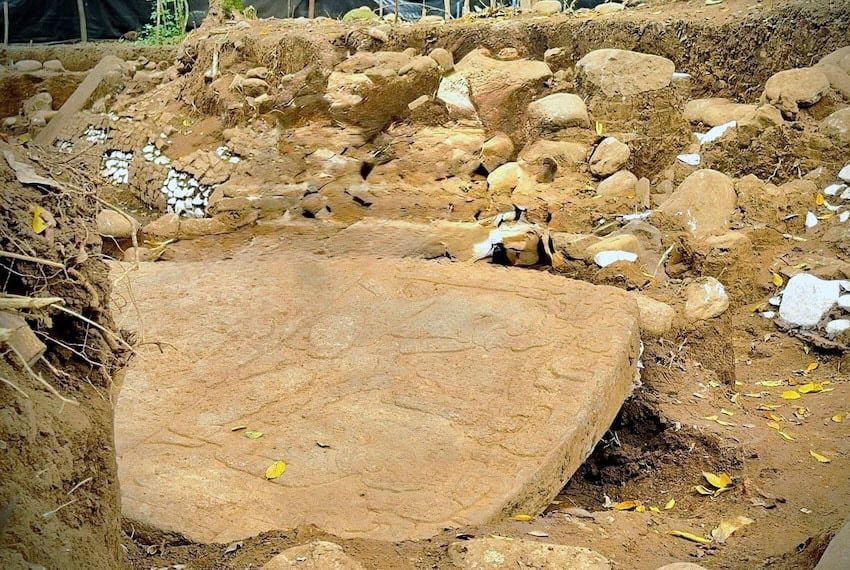
A civic-ceremonial plaza and a monolithic stele featuring atypical characteristics for the region were discovered in the area of Coatepec, Veracruz, in a find that could provide new clues about the societies that lived there prior to the Conquest.
Both the structure and the sculpture, which are reminiscent of those from nearby Maya settlements, were found in a good state of preservation.
The National Institute of Anthropology and History (INAH) said in a statement that the find offers the opportunity to explore a unique regional expression that has been little studied and that is challenging to connect definitively with the established traditions of the Gulf Coast.
In an interview with newspaper La Jornada, INAH archaeologists Lino Espinoza García and Alberto Vázquez Domínguez said that the settlement dates back some 1,500 years before the Christian era, coinciding with the beginning of the Campo Viejo settlement.
According to the archaeologists, “from that time onwards, there was a continuous population [inhabiting the area] until the colonial era,” which began in the early 1500’s.
The findings on the platform and the stela, however, could date back to the Protoclassic period, ranging from 200 B.C. to 200 A.D.
A discovery with features never seen before
The discovery occurred on a private residential property as part of an archaeological salvage operation led by INAH archaeologists in the San Lucas subdivision, near the Campo Viejo archaeological zone.
The findings consist of a platform — 30 meters long by 12 meters wide — built with white slabs and blocks of dressed limestone, with a texture similar to plaster, which would have been selected or worked to create a specific visual finish.
The ornamentation features square-like figures and circular stones on two of its sides, attributes that are not typical of the region and had not been previously recorded there.
The monolithic sculpture measures 1.88 meters high, 1.47 meters wide at its widest point and 0.68 meters wide at its narrowest. With a thickness that ranges from 22 to 25 centimeters, it features engravings alluding to a symbolic event in which two elite figures, seated and wearing elaborate attire, receive a fluid from a divine entity holding a vessel on a higher plane.
Lino noted that “the entire stele, made of andesite stone, references themes of fertility and cultivation of the land.”
Field excavations conclude this month, and specialists will proceed with laboratory analyses, which will extend until early 2027.
Mexico News Daily
