
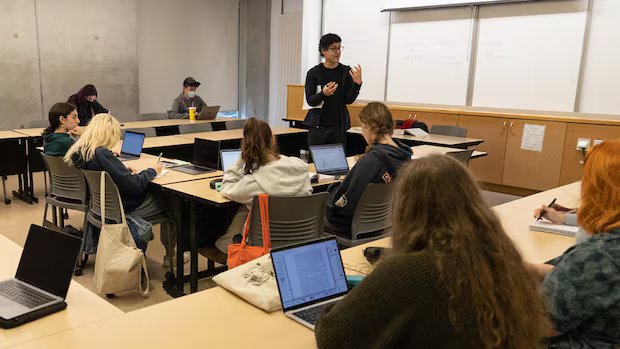
The idea of boosting young people’s critical thinking skills is receiving renewed attention amid the steady creep of generative AI into digital spaces already overloaded with information.
But how are we teaching students to think critically?
Some advocate being more explicit in how we guide students from elementary through post-secondary to practise and build this skill — and spell out why it’s necessary.
“Critical thinking is essentially about asking questions,” whether that’s while perusing an article or a social media post, said Louis Newman, author of Thinking Critically in College, from Los Altos, Calif.
“We’re gonna need critical thinking much more now than ever.”
Newman says that in post-secondary and sometimes in high school, we’ve traditionally taught this skill by assigning students readings, ideas or concepts to evaluate. This analysis is generally done in four ways: exploring the context, comparing alternatives, weighing evidence and considering implications or new applications. Rinse and repeat.
We assume students become more critical thinkers by osmosis, as “they sit in our classes, engage with us around the material that we’re teaching [and receive] feedback on the assignments,” said Newman, who is also a former dean of academic advising at Stanford University and a professor emeritus of Carleton College.
“There are certainly students who pick it up gradually over time, by kind of trial and error. But a lot of students don’t.”
Newman believes explicit instruction helps more students overall.
“You have to make it clear to students precisely what kinds of thinking they’re being asked to do, how well they did on it and where they could have done better,” he said.
One easy way to do that? When a student makes a salient query, instead of just noting “that’s a great question,” professors could explain precisely why it’s great, which gives clarity to the individual and encourages the entire class, he said.
Deep thinking with tech use
Teacher-librarian Diana Maliszewski, a Toronto educator at both the elementary and post-secondary level, believes critical thinking should and can be tackled in every class or course.
“We don’t want to accept things without consideration,” she said.
“Without labelling certain things as good or bad, we want to encourage students to think about all the materials [they encounter, but] we don’t want them to doubt everything,” she added.
The goal is to instill “a healthy skepticism,” so students are less likely to dismiss sources of information that differ from their own point of view as “fake news.”

Toronto teacher-librarian Diana Maliszewski outlines how she tackled artificial intelligence in a social studies lesson for sixth graders, who picked apart AI-generated photos of ‘a typical Canadian.’
While teaching a course for educators this summer, Maliszewski adjusted a previous assignment that called on participants to create a book display to promote a lesser-known author from an underrepresented group.
This time, participants were asked to create the display with Gen AI tools, but then also analyze it and submit a reflection about what was generated. Maliszewski shared some pointers on things to peruse, like the author’s photo or their book covers.
The update to the assignment was prompted in part after she received obviously AI-generated assignments in recent years. But it’s also an exercise in critical thinking.
Participants this summer expressed shock at what the AI generated: pleasing displays at first glance that, upon deeper inspection, reveal fabricated book titles, gibberish language, incorrect details, photos that weren’t of their chosen authors and images that reinforced ethnic or racial stereotypes.
Maliszewski points out that the exercise reveals both AI’s possibilities and limitations.
“AI is seen as a time saver, but we still need to be able to apply critical thinking strategies when we use it,” said Maliszewski. “It’s less about the tool, and it’s more about the thinking behind using the tool.”
Promoting deeper consideration about technology is also possible at younger ages. Maliszewski recently had Grade 6 students craft an internet meme — a witty image, short video or bit of text — about a global issue for social studies.
This meant teaching them what global issues are, as well as what memes are, before unleashing the youngsters to research and eventually produce a meme that each person then presented and discussed in class.
A written portion of the assignment was meant to demonstrate their understanding of the concept, while Maliszewski also conducted regular check-ins to assess students’ thinking process and progress.
“I was a little bit nervous that I was biting off more than I could chew,” she admitted. Yet the kids ultimately impressed her with nuanced memes about reactions to the COVID-19 pandemic, immigration policy and the U.S.-Canada tariff war.
Maliszewski is also very specific with assignment expectations and how she will evaluate work, including if and how exactly AI use is permitted. “There’s no guesswork in trying to figure out how you can pass this assignment.”

As Toronto students return to school, teachers are debating what role artificial intelligence should play in the classroom. CBC’s Ian Curran explores why educators are divided on how to approach AI this fall.
Valuing the process
Teaching math and science in the Western Quebec School Board as well as aspiring educators at the University of Ottawa, Tasha Ausman leans into emphasizing the messy, iterative and occasionally inconclusive process of learning, rather than just perfect answers.
For high schoolers, she’s had success with experiential learning. For instance, her lab procedures include a series of steps students must fulfill, with note-taking throughout. The goal is for students to see the value in every stage.
“I emphasize that wrong answers or different results from the peers around you are still answers… Negative data is still data,” she said.

“What we need to look at is their commitment to scientific inquiry, their engagement with the process. And if they get the right answer at the end and it’s two marks out of 40, that’s great. But if they lose those two marks, it’s not actually the point of the lab. The point was to do the entire process.”
She’s also slowing the pace with post-secondary students, including holding “laptops-closed” class discussions of pre-assigned readings. She’s trying to encourage engagement and healthy debate, as well as finding a way to more accurately assess students’ thinking.
“What I found last year was a little distressing, where students were using AI to quickly read the article and then semi-contributing to the discussion,” Ausman said. “You don’t know if they really know what they’re talking about or if they just learned it five minutes ago.”
Ausman is leery when students consult AI for “a one-size-fits-all summarized answer for absolutely everything.” She believes it fuels the notion that every question has an immediate solution.
Learning “is meant to be somewhat arduous. It’s meant to make you grapple with difficult information, words you don’t know, things you have to look up… I’m asking [students] to slow down a little,” she said.
“You have to ‘not get it’ and encounter difficult concepts, things you don’t agree with and argument-making. That’s not a one-paper exercise… It’s those messy, in-between spaces where new information and novel ideas emerge.”
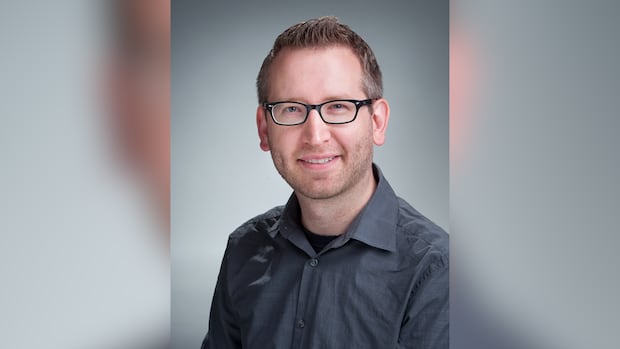
Joel Heng Hartse, who oversees a Simon Fraser University program teaching academic literacy to new students, talks about why he’s not looking for perfect papers.
Newman, the U.S. author and former professor, says school administrators also have a role to play.
As soon as students arrive on campuses every fall, he wants school leaders to send clear, consistent messages that the goal of education “is to learn well and think well.”
While some of the tiny details students learn right now may fade, Newman believes less likely to be forgotten is a strong foundation of analysis and evaluation, asking questions and seeking missing perspectives.
“That just becomes part of your intellectual hardware and you take that with you for the rest of your life.”
