
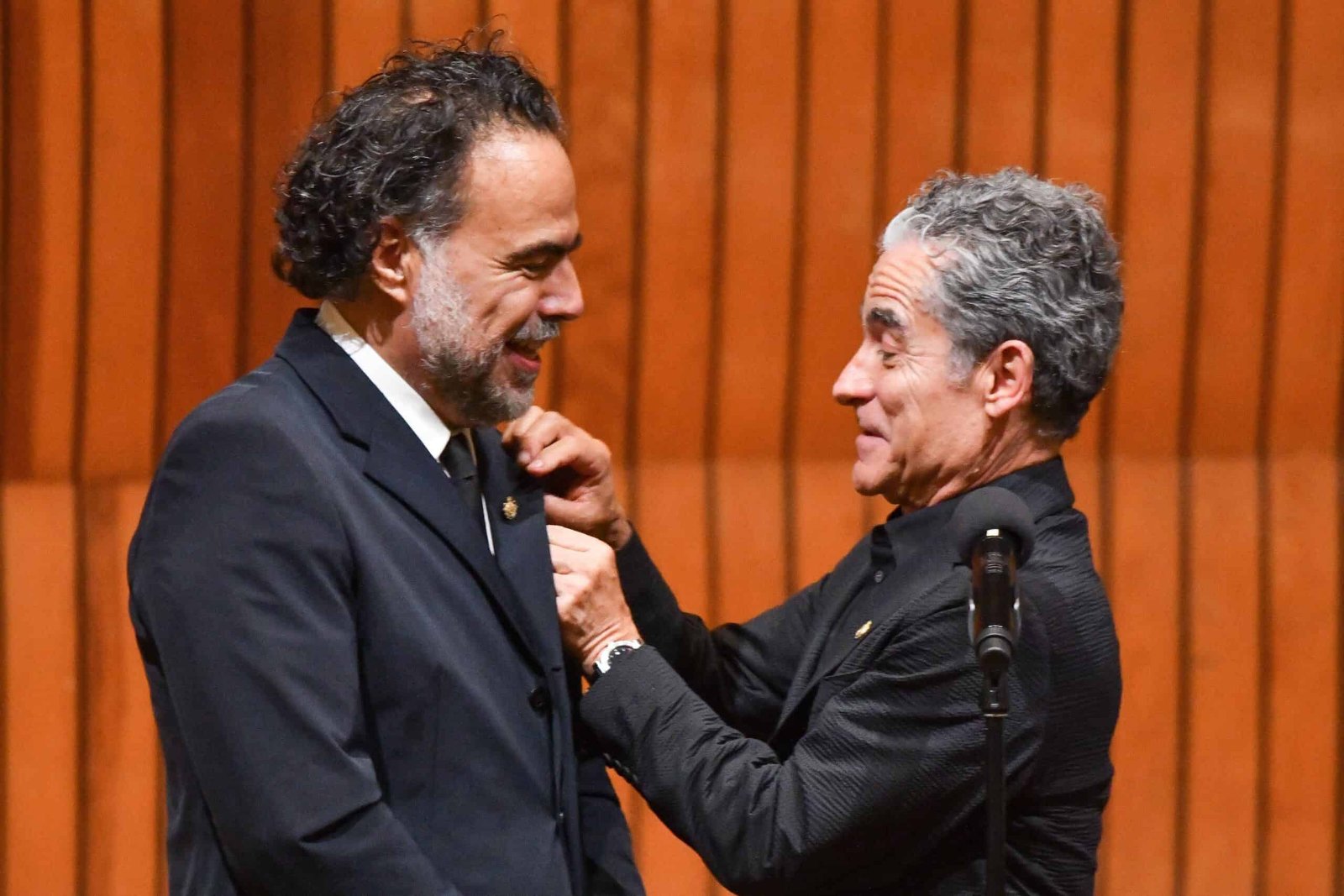
Mexico City native Alejandro González Iñárritu — director of “Amores Perros,” “Birdman,” “The Revenant” and other major works — has become the first filmmaker inducted into El Colegio Nacional, Mexico’s most prestigious intellectual institution.
The honorary academy, created by presidential decree in 1943, is an invitation-only hall of fame that brings together Mexico’s leading scientists, artists and humanists.
(Mario Jasso / Cuartoscuro.com)
At a ceremony Tuesday in Mexico City, the institution’s sitting president, Felipe Leal, said Iñárritu’s admission was “a long-awaited achievement for an artistic discipline that has contributed so much to Mexican and universal culture.”
In receiving the honor, the 62-year-old director — the first Mexican ever chosen to preside over the Cannes Film Festival jury — delivered a lecture titled “The Consensual Hallucination.”
Throughout it, he championed the visual power of Mexican culture, asserting that the nation’s cinematic history grew out of its pre-Hispanic worldview and its 20th-century muralist tradition — not just Hollywood techniques.
“Mexico is a visual powerhouse because our culture has always used images as a way to explain the world,” he said.
In a Q&A with the newspaper El País, Iñárritu took aim at how U.S. cinema depicts his country. Mexicans, he said, “grew up with American movies, television, art and music. So I do know that culture. They don’t know a damn thing about us,” he added, criticizing Hollywood’s long use of “sombrero-wearing, drunk, drug-trafficking” caricatures.

Iñárritu (who’s usually referred to by his maternal surname) has won five Academy Awards, including best picture, best director and best original screenplay for “Birdman” in 2015, and best director a year later for “The Revenant” — joining a short list of directors with back-to-back directing Oscars.
His filmography includes “21 Grams,” “Babel,” “Biutiful” and “Bardo: False Chronicle of a Handful of Truths,” a dreamlike epic that blurs the line between Mexico and the United States, memory and reality.
He is often identified as one of the so-called “Three Amigos” along with acclaimed Mexican directors Guillermo del Toro, 61, best known for his Oscar-winning fantasies “Pan’s Labyrinth” and “The Shape of Water,” and Alfonso Cuarón, 64, Oscar-winning director of “Roma” and “Gravity.”
Iñárritu is among 113 people who have received the lifetime honor from El Colegio Nacional since its founding 83 years ago. As of this year, 37 sitting members participate in the institution’s free lectures, concerts and symposia and provide material for published works.
Recent inductees include Pulitzer Prize–winning novelist Cristina Rivera Garza in 2023 and demographer Silvia Giorguli Saucedo last year.
The roster includes some of Mexico’s best-known figures in the arts and sciences, from muralists Diego Rivera and José Clemente Orozco to Nobel Prize–winning poet Octavio Paz and chemist Mario Molina, who shared the Nobel in 1995 for his work on the ozone layer.
In his remarks at the ceremony, Iñárritu also addressed migration, uprooted identity, Mexico’s culture of brutality and how the nation has “normalized” the crisis of more than 130,000 missing people.
He also warned that technology and artificial intelligence risk severing art from real life, insisting, “Art is not the result, it is the transmission of one human experience to another.”
With reports from El País and UNAM Global
