
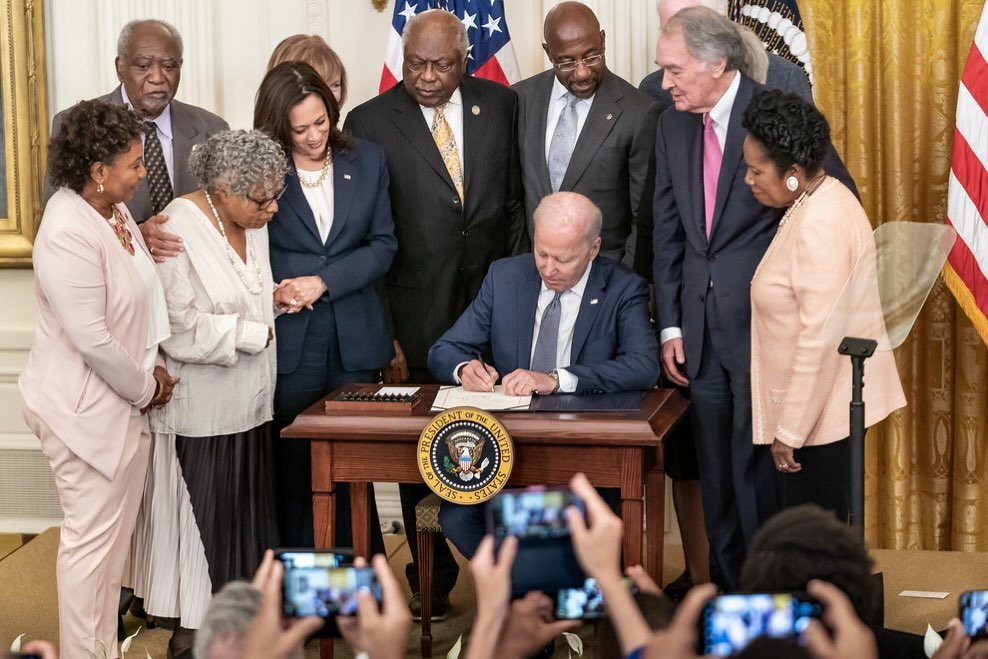
Joe Biden marked Juneteenth this Friday by looking back on one of his proudest presidential moments. Five years ago, he signed the law making Juneteenth a federal holiday. It was the first new federal holiday in the United States since Martin Luther King Jr. Day. This year, though, his message wasn’t purely reflective. It came with a warning.
Biden posted on Instagram to mark the occasion. He called the holiday’s creation “no symbolic gesture” and described Juneteenth as “a day that celebrates the end of slavery in this country. America’s original sin.”
From there, he turned his focus to the present. He wrote that there is “an effort underway to deny, minimize and erase America’s past.” He pointed directly to the removal of references to slavery from textbooks and classrooms, from museums and national monuments.
“America – we must recognize and honor this day,” he wrote. “Great nations face their past. They don’t try to ignore it or rewrite it or bury it. And America is a great nation.”
At 83, Biden is still one of the more prominent Democratic voices in public life. He left office in January 2025, having chosen not to seek re-election. Since leaving office, he’s spoken out selectively. He’s weighed in on healthcare, on democracy, and now on the teaching of history. The post fits a quiet pattern from his early post-presidency months. He keeps returning to issues he considers foundational, even without a platform to act on them.
The backdrop matters here. Over the past several years, debates over what schools teach about race and American history have played out in statehouses across the country. Several states have restricted or revised how slavery and racism can be discussed in classrooms. Statues and monuments have been removed, renamed, or relocated – often with communities deeply split over the decisions. Biden doesn’t name specific actors in his post, but the reference points aren’t hard to read.
Juneteenth itself marks June 19, 1865. That was the day enslaved people in Galveston, Texas, were told they were free. The Emancipation Proclamation had been signed more than two years earlier. The holiday has been observed informally for over 150 years, particularly in Black communities across the South. Biden’s 2021 bill elevated it to federal recognition.
The 2021 signing was notable for its bipartisan support. The bill passed the Senate without a single opposing vote. The House approved it 415-14. The vote was never really in doubt – a rarity for that Congress.
He closed Friday’s message by trying to anchor the holiday in something bigger. “Juneteenth is about the end of slavery,” he wrote. “It’s also about the unending work of rooting out racism and creating a more perfect union. It’s about living up to the sacred American creed: We are all created equal. There is nothing more American than that.”
For a former president still figuring out his post-White House voice, it’s a fairly direct statement. His supporters will share it. His critics will push back on his framing. The underlying debate about how America teaches and remembers its history isn’t going anywhere anytime soon.
