
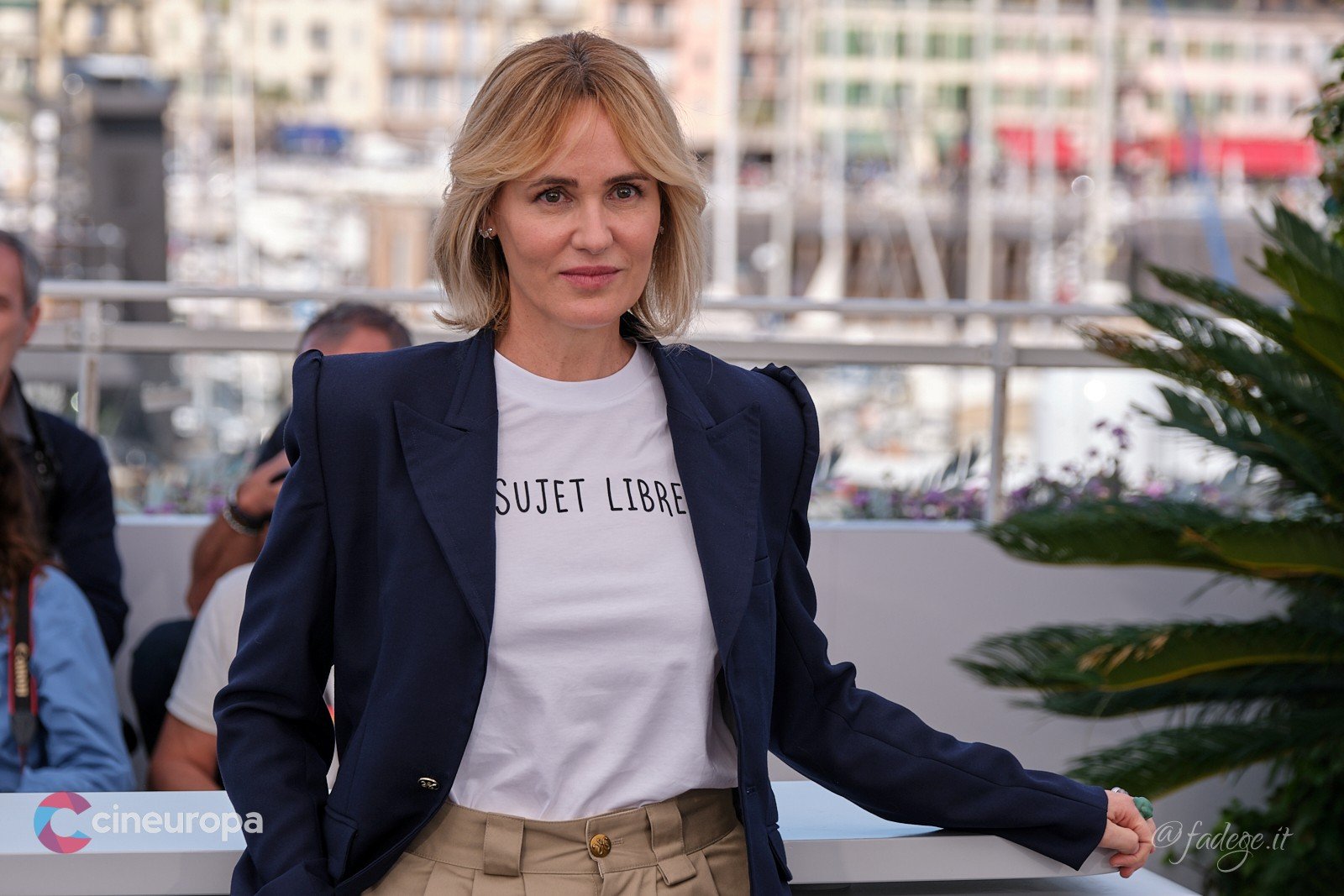
– CANNES 2026: The director talks to us about her adaptation of Annie Ernaux’s novel of the same name, in which she vividly captures both the young girl’s struggles and her journey as a budding writer
(© 2026 Fabrizio de Gennaro for Cineuropa – fadege.it, @fadege.it)
Discovered as an actress at a young age, Judith Godrèche has always been a writer: she published her first novel in 1995, made her first film in 2010, created a TV series in 2023, and wrote a literary work as vivid as it is intimate, Please tidy up before leaving the premises, which was released last January. For her second feature film, A Girl’s Story, presented in the Un Certain Regard section at the 79th Cannes Film Festival, she adapts the novel by Annie Ernaux, winner of the Nobel Prize in Literature, which itself revisits the traumatic episode that transformed the young girl of 1958 into a woman in rebellion, a free spirit, and ultimately, a writer.
Cineuropa: A Girl’s Story recounts a defining moment in Annie Ernaux’s life as a woman and the beginnings of her vocation as a writer. How did you strike a balance between the power of the text and your screenplay?
Judith Godrèche: Firstly, by spending a lot of time with Annie Ernaux; I wanted to try and see the world through her eyes. And then I started writing dialogue. I think I felt so close to the characters – they were so familiar to me – that it just flowed out. Adapting Annie Ernaux is certainly a challenge; people say her writing is flat, with very little dialogue. You have to create a lot to turn it into a screenplay. And then, quite simply, for me, A Girl’s Story is also the book that tells the story of how she becomes a writer; the book ends just as she is writing her first novel. I also wanted to tell the story of how this girl becomes a writer to show that you can go through terrible trials and still find your voice.
How did you find your way as a director through Annie Ernaux’s book?
Very early on, I started thinking about the point of view. I spent a lot of time wondering who the camera’s eye represented, but also who was watching this story unfold. And I didn’t want it to be me; I wanted it to be Annie, aged 17 and a half. I wanted it to be a dialogue between eras, focusing on the perspective of the girl from 1958. It’s very painful for Annie the writer to revisit this memory, and she tries as sincerely as possible to be that young girl again in her book. I wanted the camera to make this journey through time as well, for it to be in that exact spot, rather than it being my point of view. It’s a discussion we had at length with my director of photography. The actress had to be constantly in the frame, even during reverse shots. She is never seen from a third-person perspective, and above all, never from the perspective of H., the man who rapes her. Another question was how to show male violence from a feminist perspective. We also needed the set to be a safe space; we rehearsed a great deal, with and without the camera, created very detailed storyboards for this scene, and worked with an intimacy coordinator.
Is it an ethical and artistic challenge to depict this rape scene?
Yes, of course. First of all, how do you depict the shame and the lack of consent? Even Annie Ernaux, at the age of 80, is still trying to free herself from that sense of shame. It took her years to write that book, and even then, 60 years later, she still couldn’t bring herself to use the word “rape”. She only did so later. So, how do you film something that cannot be filmed? It is not a spectacular assault, it is a diffuse moment; how do you convey that sense of time and space being thrown into disarray, and the dissociation too? I wanted to show Annie’s inner life, how she stares at that lamp on the ceiling, that feeling of a moment that seems to go on forever, without filming the body, the nudity. Without it being voyeuristic, leaving no room for eroticisation. The camera placement was crucial; everything had to be exactly in the right place. And then what is really important, for Annie Ernaux, and for me in making the film, and more generally, is to show the rape not as a spectacular event like many films – often by male filmmakers – have done by showing a rape and then moving on to the rest of the story. No, I wanted to show its consequences. It is not a mere detail of the story.
(Translated from French)
