
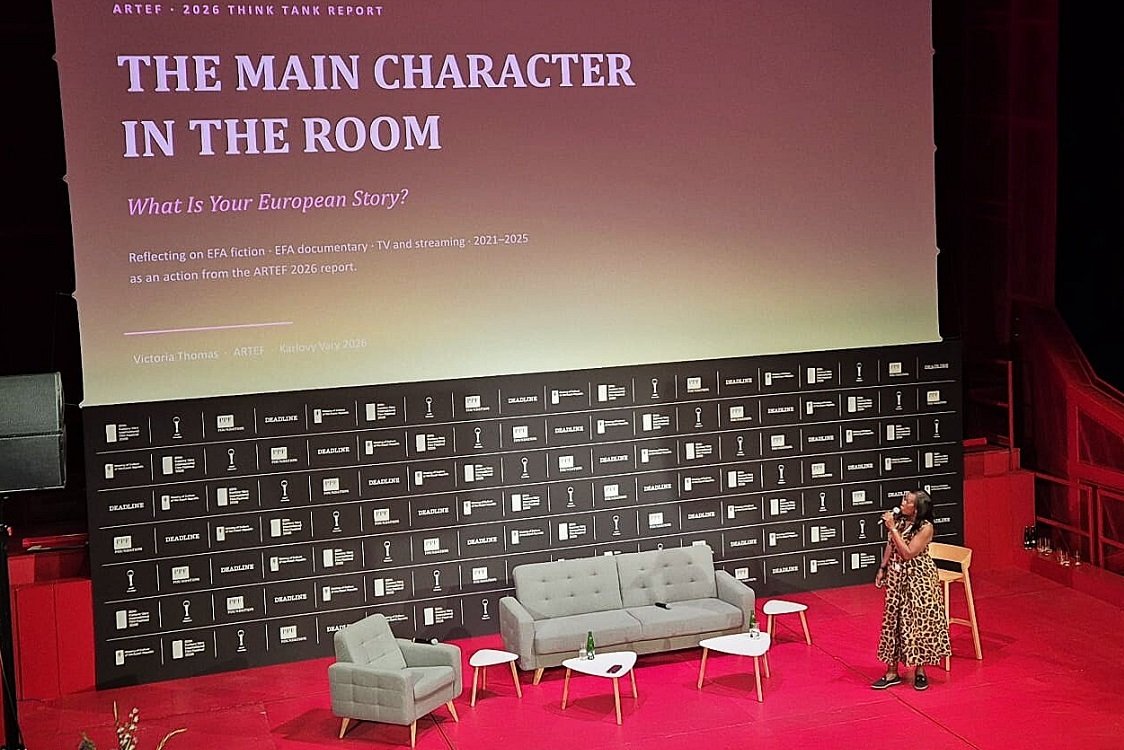
– Victoria Thomas used new ARTEF research to argue that Europe’s screen narratives are still shaped by old hierarchies — and launched Main Character to help locate the stories missing from view
Victoria Thomas during the panel
During Karlovy Vary’s industry programme, Victoria Thomas presented new findings from ARTEF’s 2026 Think Tank Report and introduced Main Character, a new pan-European initiative for unproduced screenplays designed to broaden the range of stories being developed across the continent.
Held under the title “The Main Character in the Room: What Is a European Story?”, the presentation asked whether the funding, development, festival, press and awards structures that define European cinema have kept pace with the social and cultural changes of the last seven decades. Thomas framed the question not as an abstract debate about identity, but as an industry problem: if writers say they have stories that are not being supported, and institutions say they want more varied stories but do not receive them, where exactly is the blockage?
Thomas began by situating ARTEF’s work within a broader discussion about Europe’s public film systems. “A lot of the systems that we use today in Europe for films, in pretty much every country, are backed by governmental and public funding,” she said. Many of those systems, she noted, were created after the Second World War and reflected post-war priorities. But the Internet, new modes of viewing and the evolution of contemporary European societies have radically changed how stories are penned, circulated and consumed.
The research grew out of a year-long series of ARTEF roundtables, launched at the BFI London Film Festival, with participants from across the value chain, including writers, producers, broadcasters, film funds, streamers, agents, awards bodies, journalists, academics, and festival programmers. Thomas stressed that the group did not ask participants to define “a European story”. Instead, the question was what kinds of stories Europe is currently telling about itself, and what kinds of stories the industry chooses to celebrate.
One recurring observation, she said, was the disconnect between creators and gatekeepers. Writers and producers complained that the same stories were repeatedly being told, while funders and institutions said they were open to different narratives but were not seeing them come through their pipelines. ARTEF’s response was to look at the stories that have actually been rewarded and widely circulated. “For us academics, we believe that the data doesn’t lie,” Thomas underscored.
The report examined five years of the European Film Awards, looking at fiction, Discovery titles and documentary, before comparing those patterns with TV and streaming. Thomas made clear that the sample was not exhaustive, but said it showed repeated absences and narrative habits. In the EFA fiction categories, France dominated: only 13 countries appeared across five years, leaving 39 European countries invisible, while 15 of the 25 nominated films were from France and three of the five Best Film winners were French.
The picture was broader in the Discovery category, where 29 nominated films represented 24 countries. For Thomas, this raised a key question about progression: if a wider range of countries and filmmakers appears at emerging-talent level, why does that diversity narrow at the level of the most celebrated European films?
Looking at fiction more closely, ARTEF found that many stories remained strongly local and introspective. When European films looked beyond Europe, Thomas said, they tended to do so through themes of borders, conscience, violence and the history of intervention. She also pointed to a striking representational pattern: actors of colour were most visible in stories about Europe’s borders or external relations, where they were often positioned as foreign. Europe’s internal diversity, including communities such as Roma people, remained largely absent.
Documentary offered a wider gaze, but with its own limitations. Across 25 films over five years, 26 countries were represented, again led by France, with more visibility for Central and Eastern Europe than in fiction. Yet many of the topics connected to those regions were still shaped by conflict, war or crisis.
The comparison with TV and streaming complicated the picture further. While the EFA sample was largely dominated by arthouse drama, streaming showed strong global demand for European content, particularly crime and thrillers. But here too, Thomas argued, similar hierarchies persisted. The most visible countries overlapped with those already prominent in film: France, Germany, Spain, the UK and the Nordics. Countries absent from celebrated cinema were also often absent from the most widely seen streaming content.
When Central and Eastern European or Balkan characters did appear in Western European crime series, Thomas said, they were repeatedly coded through criminal structures: “the Bulgarian trafficking network, the Albanian mob, the Romanian crew, the Serbian enforcer.” Her conclusion was that streaming expands the formal landscape, but does not necessarily break the narrative hierarchy. Central and Eastern Europe appears more often in documentary than fiction; when it appears, it is frequently historical, crisis-driven or pain-centred; and in streaming, it often appears through a Western European lens.
Thomas also outlined how different regions of Europe seemed to have been assigned recurring narrative questions. Western Europe was associated with power, institutions, authority and ethics. The Nordics were linked to intimacy, emotional inheritance and selfhood. Central and Eastern Europe was framed through survival, history, borders and post-war reckoning. Southern Europe was repeatedly tied to place, family and history.
She was careful to say that these stories should not disappear. The problem, rather, is when they become the default. “By all means, I’m British, I’m not from the monarchy, but I’m also not from Top Boy,” she said. “I’ve never lived in the castle, I’ve never lived in the hood, but my Britain is missing.”
Main Character is ARTEF’s attempt to respond to that gap. Thomas described it as an equivalent to the US Black List: an “annual list of unproduced screenplays, but specifically for European screenwriters”. The first open call launches on 15 July and will be open to unproduced fiction screenplays from across Europe. For the first edition, submissions must be in English, a limitation Thomas acknowledged while noting the practical constraints of launching the initiative.
The process will unfold in three stages, with anonymous entries to reduce bias and a different jury at each stage. The first stage will consider only the logline and short synopsis, before full screenplays are read. Twelve projects will ultimately be selected, with the list due to be announced early next year at Gothenburg.
“If you are a writer in the room or producer, I guess this is your time if you think your stories are not being told,” Thomas concluded. “The question is, what is your European story?”
