
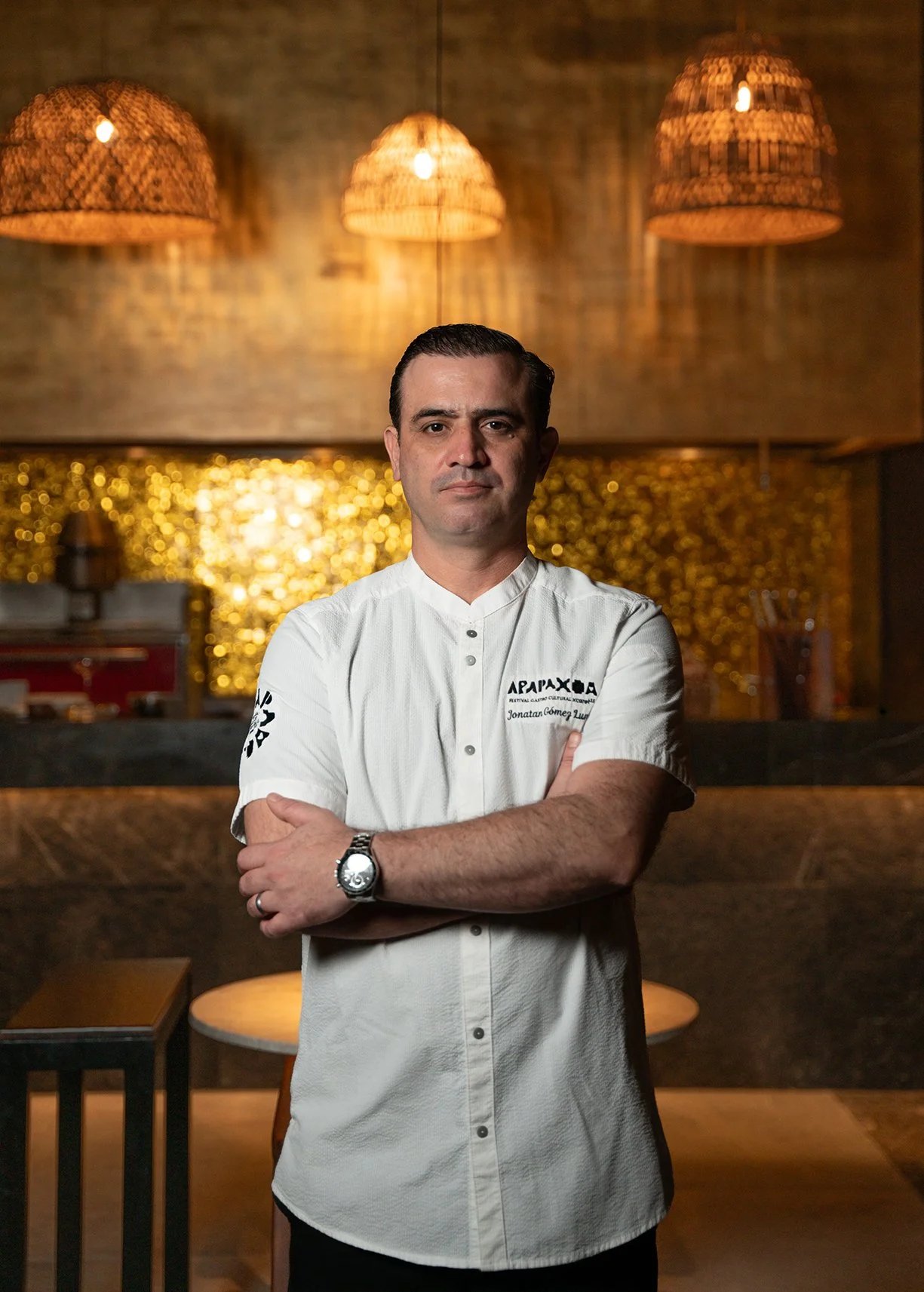
While I’m not convinced that an endless procession of dishes is the future I’m looking for, one has to respect the chef—part cook, part conjurer—whose succession of small illusions continues, against the odds, to enchant.
Four or five hours later, the curtain finally falls and we are released from this Sartrean spell. There is no dramatic grand finale, no catharsis—just a gentle return to the outside world. For a moment, I half-expect the guests to fly off into the sky on broomsticks, à la De Sica’s Miracolo a Milano. Instead, they wander out slowly into the caressing tropical night, dazed—but unmistakably quenched.
The following day, I was sufficiently recovered to be able to chat with the chef, trying to make sense of the whole thing.
Nicholas Gilman: Let’s start broadly. How has your cooking evolved since the early days of Le Chique?
Jonatán Gómez Luna: We have evolved a lot. At the beginning I was very young, and the cooking was overly mechanical—more methodical than flavorful. I was obsessed with perfection, with putting many techniques on the plate, and taste came almost as an afterthought. That changed quickly. I realized that I don’t eat that way. I grew up enjoying delicious food. So why wasn’t I cooking any? Now it’s the opposite—an obsession with flavor, supported by technique.
NG: With distance, is there anything from those early years that you wouldn’t defend today?
JGL: Yes. I took everything to the extreme. Too many hours, too much obsession. I put the restaurant ahead of my family. I was focused on being the best, and that made me neglect important things. That’s something I would change.
NG: For a long time, surprise and effect were central to your language. Has that disappeared?
JGL: No, but it has transformed. Before there was too much “smoke,” too much performance. Now it’s more about the ingredient, about where things come from, about having a clearer discourse. It’s still our style, but more mature.
NG: The earlier menus were very explicitly about “Mexico” as a whole; 32 courses for the 32 states. That seems less pronounced now.
JGL: Yes. Before it was very direct—we showed the whole country. Now it’s more personal. We’ve already traveled Mexico. Now we focus more on where we live. The Yucatán has incredible richness, and now the menu reflects that more clearly.
NG: There’s a lot of discussion now about fatigue with long tasting menus. And yet here we are with 27 courses. Is that a conscious decision?
JGL: Yes. It may be less fashionable, but for me it’s still the best way to express what I do. I work in sequences—five or six dishes at a time. That’s how I tell a story. If I reduce it to six or ten, I lose that. This menu has 18 new dishes—one for each year of Le Chique—and nine classics. Together they make 27. It’s a new cycle.
NG: How difficult is it to edit a menu like this?
JGL: Very. For these 27 dishes, there were maybe 60 ideas. Many sound incredible in your head, and then you cook them and they’re terrible. So you test, adjust, combine ideas. The hardest part is maintaining a thread, keeping the diner engaged.
NG: There also seems to be a shift toward lighter dishes—more seafood, more vegetables.
JGL: Yes. Before there was too much fat—foie gras, offal, heavy dishes. Now we balance it more. You eat a lot, but you feel good at the end. That’s important.
NG: And the move to this new space?
JGL: It’s a challenge. We’re still adjusting the choreography. But I’m sure this will be the best version of Le Chique. Everything is there—we just need to bring it all together.
