
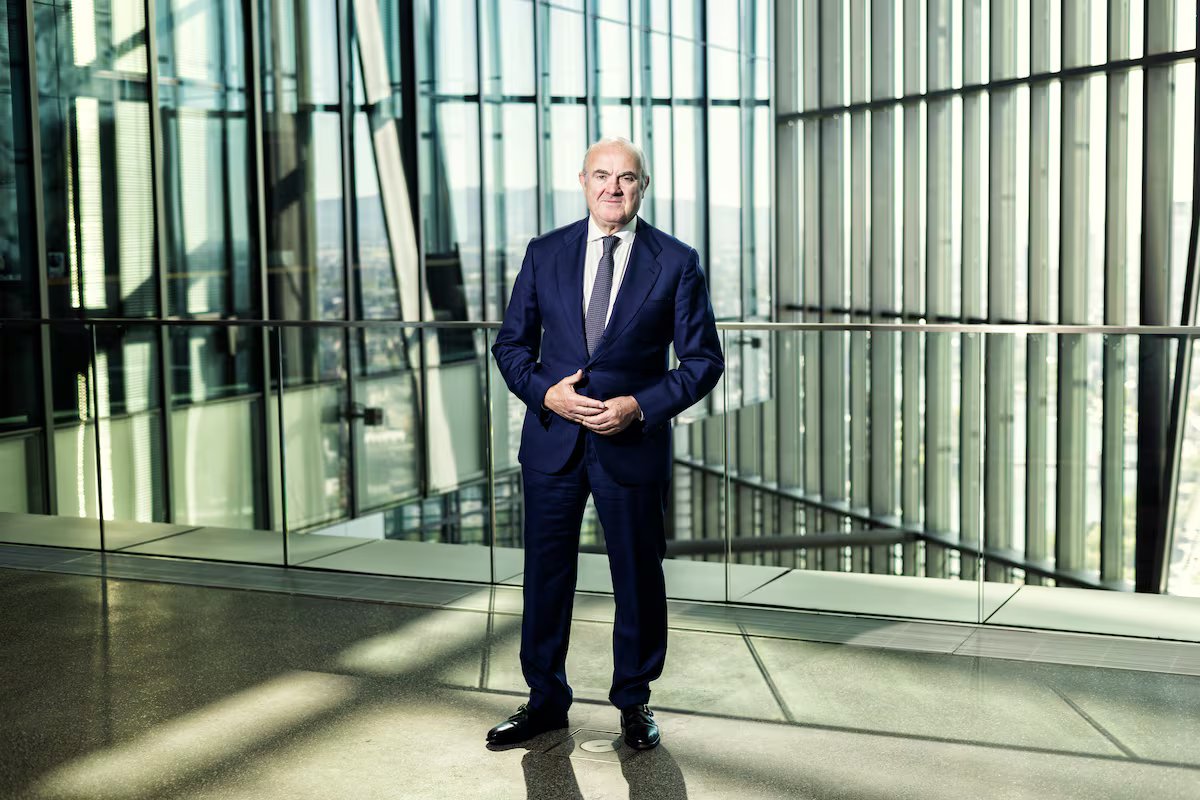
When he took over as vice president in 2018, Luis de Guindos, 66, faced what seemed like the most uneventful term in the history of the European Central Bank (ECB). “I thought we weren’t going to move interest rates, neither up nor down; they had been unchanged for a long time, and I thought they would stay that way,” he recalls now.
Over his eight years in the post, however, the world has endured the pandemic and the resulting shutdown of the global economy; the worst surge in inflation in 40 years, followed by a sharp rise in interest rates; Russia’s invasion of Ukraine; trade shocks from the United States; and now the energy shock stemming from the conflict in the Middle East.
A former economy minister under Mariano Rajoy (2011–2016), secretary of state under José María Aznar (2000–2004), and ex‑executive at Lehman Brothers, Guindos is the Spaniard who has so far held the highest position in Frankfurt. Last Thursday, after taking part in his final meeting of the ECB’s Governing Council, he spoke to EL PAÍS in his office on the 40th floor of the institution’s headquarters.
Question. The ECB has had to move much more than you expected when you took over as vice president in 2018. Would you say you arrived as a hawk [more orthodox] and have gradually softened your position? Was this out of conviction or due to the force of events?
Answer. I think I’ve been somewhere in the middle, in that Bloomberg classification of hawks versus doves [more inclined to be moderate], for example, I’m in the middle. Yes, I was more of a hawk before, in 2022. I was one of the first to argue that we would have to raise interest rates and that inflation was more persistent than we were saying. Then inflation reached 10% and fell to 2%. Now, at the end of my time here, I would say that I’m more on the side of prudence.
Q. What does the side of prudence mean?
A. The prudent side is that the current circumstances are very different from those of 2021 or 2022. Back then, in addition to the shock of the pandemic and the reopening of the economy, we had an extremely expansionary fiscal and monetary policy.
Q. Fiscal policy today is also expansionary.
A. But then the public deficit for the entire eurozone reached 7%, the ECB injected €2 trillion [$2.34 trillion] into the banks and bought bonds worth another nearly €2 trillion. And we had negative interest rates. The chain of shocks that led to inflation was very different from the current situation. Now we are in the midst of a geopolitical conflict, and we need to keep a cool head, which is why I completely agree with today’s decision [to wait before deciding on an interest rate hike]. It would be a mistake to apply what happened in 2021-2022 to the current circumstances, but there is also a tremendous level of uncertainty, and it is important to have consensus.
Q. What is your view of the Spanish economy in this environment?
A. There is a point that is sometimes forgotten in economics: when energy prices rise, the effect on inflation is reflected more quickly by the indicators than the effect on economic growth. In the first quarter data, both in Europe and in Spain, the war has not yet been reflected, but there are already leading indicators that the war will have a severe impact; for example, consumer confidence has suffered a very significant decline.
‘Spain is well prepared for the coming slowdown’
Q. Do you think Spain is overly optimistic?
A. Governments need to be optimistic, and it’s important to convey a message of optimism. Spain’s macroeconomic figures are good, although there are all the nuances: per capita income, productivity, the housing problem… And more effort could have been made in reducing the public deficit, but the Spanish economy has two very positive aspects: it has a financial system that is beyond reproach, and it is a competitive economy. It is well prepared for a slowdown that is going to be evident and clear, because Spain cannot escape the international economic context.
Q. Much of the uncertainty you mention has to do with Donald Trump. You began your term with the Republican in office and, against all odds, you are finishing it with him back in power. Do you believe, as Mark Carney said in Davos, that the old order is dead, or can it be repaired?
A. The world is very, very different from what it was eight years ago, without even having to go back much further. In Europe, we have finally become convinced that we need to be more autonomous, and that starts with defense, although it is spreading to everything. For example, everything related to technology, payment methods, the cloud, or artificial intelligence.
The rules that were in place are no longer in force. The world has moved away from the multilateral approach to problems that existed before; there were always some differences, but there was a general approach to cooperation. For Europe, this is a very important wake-up call.
The new U.S. administration represents a paradigm shift, not only because of tariffs, but also, for example, because of banking regulations and cryptocurrencies. Europe’s defense has been in the hands of the United States since practically the end of World War II, and that perception of protection that the United States provided us in defense is gradually disappearing.
Q. There is some consensus that the response should be a more united Europe, with a truly integrated single market, yet we continue to see many barriers. One example is cross‑border bank consolidation, such as the Italian bank UniCredit’s takeover bid for Germany’s Commerzbank. Technical obstacles are often cited — such as the lack of a common deposit‑guarantee scheme — but isn’t this really more a matter of political, nationalist resistance?
A. I am more concerned about the structural and political nationalism we now have in national parliaments, since we have always had those other national interests in specific situations. The main obstacle to European integration is the presence of populism at the national level and in the European Parliament itself. In Hungary, there was a populist force that has disappeared, but it seems to be emerging elsewhere in Bulgaria.
Regarding the specific operation, the ECB responded to the European Commission’s request for consultation regarding the banking competitiveness report, and we defend a very clear position: the eurozone must be a single jurisdiction for European banks with absolutely free flows of capital and liquidity. Each specific operation has its own nuances, but we have always been in favor of cross-border consolidation processes.
Q. Is the European Union prepared for eurobonds?
A. The first joint debt issuance was with the Next Generation funds, which had a very significant effect on economic sentiment at a very complicated time, marked by enormous distrust. In these matters, it is important to be pragmatic, but at the same time, to take steps in the right direction.
Q. How do you translate that?
A. For example, I believe that joint financing is crucial when it comes to defense spending. There’s a clear objective and a possibility because it’s a European asset. We have the Next Generation funds, which are already a step in the right direction. With defense, we can take another step forward, and that’s how we should continue progressing.
‘The level of bank concentration is quite reasonable’
Q. The United States plans to ease capital requirements for its banks, and this has prompted criticism from the sector in Europe regarding the rules of the game.
A. The capital of European banks poses no limitation whatsoever from the perspective of granting credit and financing the economy. We at the ECB are absolutely clear on this. We haven’t had any banking crises in Europe in recent years, and there have been some truly complex situations. Solvency is closely linked to the level of capital and liquidity of European banks; it’s one of the few structural advantages that Europe currently has, and I believe it would be a mistake to lose that advantage.
Q. Do you see consolidation processes as necessary in Spain, following BBVA’s failed takeover bid for Sabadell, or is it unnecessary in terms of strength?
A. I am in favor of transnational consolidation operations, not necessarily national ones, although in some cases, national operations must be carried out first before taking the transnational step. But I believe the current level of competition and bank concentration in Spain is quite reasonable.
Q. Do you think something like the European Central Bank and the euro could be created in today’s political climate?
A. The ECB is the most exemplary institution from the perspective of European integration. Monetary policy is common, and supervision is common. It is the institution that most clearly represents the advantages of European integration versus those nationalist, populist approaches I mentioned earlier. The ECB has worked. When inflation was above 10%, Europeans expected it to return to 2%. Why? Because of the ECB’s credibility.
‘The ECB Governing Council is more united than before, and that is Lagarde’s doing’
Q. Were those the most difficult moments of your term?
A. From an institutional point of view, one of Mario Draghi’s last Governing Councils as president [2019, when interest rates were cut by 10 basis points and bond purchases resumed] was very difficult because it revealed a significant internal division. Christine Lagarde has resolved that division and healed the wounds. Today, the ECB Governing Council is much more united than before, and that has been Christine’s doing. Afterwards, there were difficult moments, such as the pandemic, although I believe we reacted relatively quickly.
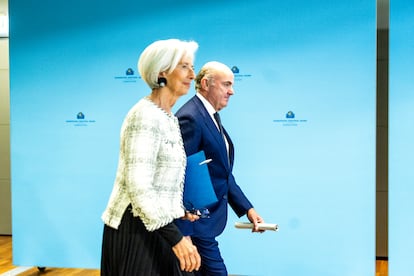
Q. From June, Spain will have no representation on the ECB’s Executive Board, and within a year and a half, three positions will become available, including the presidency. Is this the moment to go for the top job, or to make sure Spain secures another seat? Financial Times surveys point to Pablo Hernández de Cos — the former governor of the Bank of Spain, who is now president of the Bank for International Settlements — as the strongest contender.
A. The presidency would be the best outcome, without a doubt, but the essential thing is to have a position on the Executive Board. Spain is the fourth-largest economy in the eurozone, and I am convinced that it will get one. It is important to be on the Executive Board. Although we must always maintain a European perspective, we are all influenced by national experiences.
Pablo was a good governor, although it was Luis Linde and Fernando Restoy who carried out the entire banking restructuring process. Furthermore, he was also the last Bank of Spain appointment agreed by consensus between the major parties [there was dialogue and a climate of agreement around de Cos, although the vote of no confidence against Rajoy disrupted that process and he was ultimately appointed by decree].
But the ECB presidency is decided differently; it is a political matter, decided by the European Council, as is logical. It is the politicians elected in a democratic system who ultimately make the distribution of positions.
‘Immigration is essential and I am in favor of it’
Q. The populist wave has ignited a heated debate on migration across Europe, and specifically in Spain. What is your opinion on Spain’s decision to regularize around half a million undocumented migrants? The conservative Popular Party (PP) opposed it.
A. I’ve always been quite clear: immigration is essential for Europe and for Spain, and I support it. I would have preferred a continuous regularization system without the need to hold back 500,000 or 600,000 people because I believe that avoids many obstacles to the process and prevents political conflict, but the immigration process is fundamental to the Spanish economy. The economic benefits are clear. At the same time, we can’t ignore the costs, such as housing, and that’s why it’s necessary to invest in public and social services and have policies that facilitate access to rental housing. I support orderly migration flows and addressing the costs to avoid populism.
Q. How do you see the PP’s situation in its competition with the far-right party Vox? What do you think would be the best strategy for dealing with it?
A. I want to clarify that I am not a member of any party, nor have I ever been a member of parliament, although I have served as a minister in a Popular Party government, and this is my personal opinion. I have always viewed the Popular Party as a liberal conservative party that defends the traditional values of liberal conservative parties in Europe. These include respect for minorities, for institutions, the separation of powers, and, from an economic perspective, a pro-market stance within a social market economy with moderate taxes and fiscal responsibility. These are the values that have underpinned development in Europe. And these are the values that, in my opinion, represent the European People’s Party [the European political party to which the PP is a member] and should also represent the Popular Party of Spain.
Q. There have been rumors about your possible return to politics or a senior banking position once the ECB cooling-off period ends. What are your plans going forward?
A. I’m going to have a chair in European economic policy at Comillas University, at ICADE [Catholic Institute of Business Administration and Management], and I’m also going to collaborate with IESE Business School. I already spent six and a half years in politics; I’m not going back, and I’m not going into the banking sector either.
Sign up for our weekly newsletter to get more English-language news coverage from EL PAÍS USA Edition
