
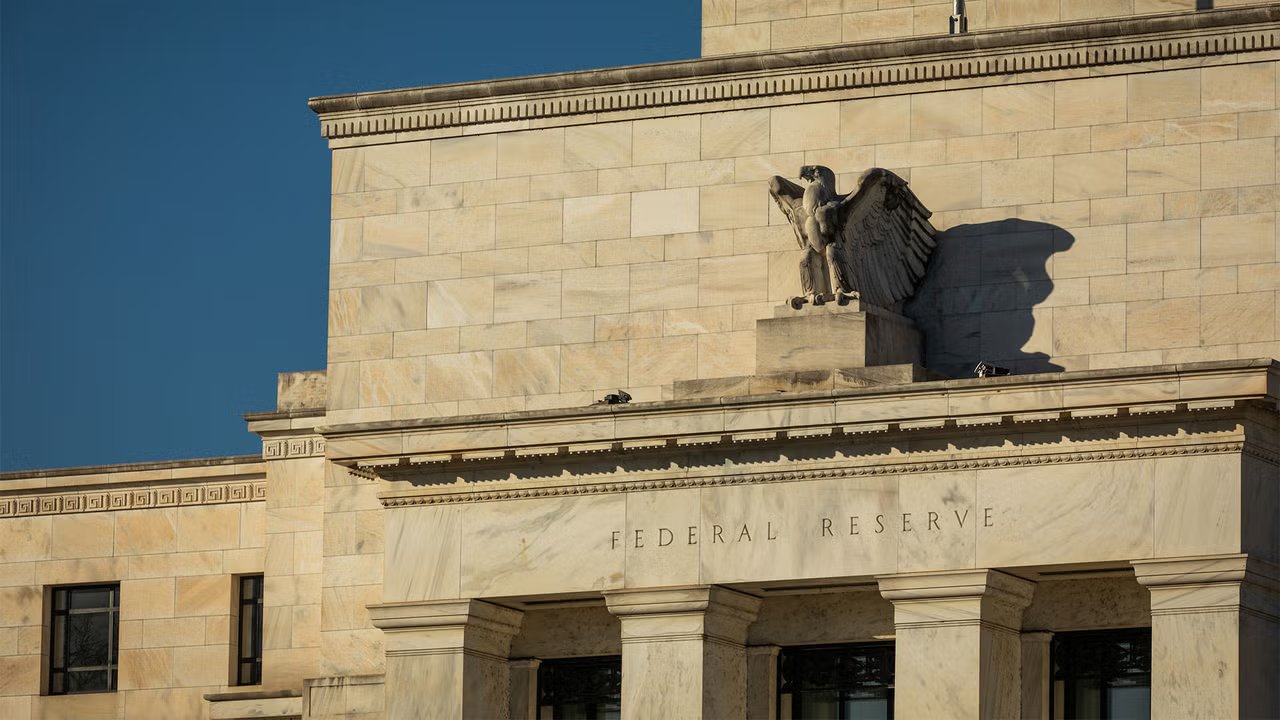
The Federal Reserve—one of the world’s most powerful institutions—affects the U.S. economy in a way that no other part of government can.
Interest rates, inflation, and bank regulation are all shaped by Fed policy and impact the everyday financial life of Americans, whether they realize it or not. Its decisions can influence everything from the cost of a mortgage to business hiring and the pace of economic growth.
As a result, Fed critics on both the left and the right have long asked whether the Fed is adequately accountable.
On one hand, Fed independence from political meddling has traditionally been considered key to its ability to control inflation. On the other, the Fed’s expanded activities since the 2008 financial crisis—more private-sector lending and large-scale purchases of government securities—have spurred calls for Congress to do more to ensure Fed policymakers are held accountable.
Complicating matters further is President Donald Trump, who has aggressively and consistently pressured the Fed to cut interest rates. He’s also still trying to oust one Fed governor, Lisa Cook, despite losing his case to do just that before the U.S. Supreme Court.
These are just some of the challenges facing new Fed Chair Kevin Warsh amid his first keynote speech at the storied annual conference in Jackson Hole, Wyoming, which brings together global leaders from finance, economics, and policymaking. Although no policy moves are made at the conference, Jackson Hole gives policymakers an opportunity to compare notes and debate ideas privately in a convivial atmosphere.
As scholars of central banking and finance, we know that to many Americans, the Fed is a big black box. And even as it has taken steps toward transparency, its decisions remain largely inscrutable and seemingly unaccountable.
We believe that a more accountable Fed may ultimately be a more defensibly independent one. But the challenge is defining what this accountability means. While independence allows central bankers to make decisions without short-term political interference from presidents wanting to juice the economy, credible external scrutiny helps provide the democratic legitimacy for that independence.
An independent outlier
The debate over Fed accountability played out in Congress in 1978, at a time when the U.S. economy was struggling under record high inflation and slow growth, or stagflation.
That year, Congress passed the Humphrey-Hawkins Act, which required the Fed chair to report to Congress twice a year—a formal and recurring channel of oversight that hadn’t existed before.
That same year saw the passage of the Federal Banking Agency Audit Act, which gave the Government Accountability Office, a federal watchdog, the authority to audit the Fed for the first time. Tellingly, the law had one crucial carve-out: The monetary-policy deliberations and transactions of its policymaking committee remained exempt to ensure that short-term interest rate decisions wouldn’t be derailed by political influence.
Despite those changes, the Fed remains an outlier among federal entities in several key respects.
It’s self-financing thanks to the capital put up by member banks, so its budget is independent from congressional appropriations. Its governors serve 14-year terms and can be removed only “for cause,” a far higher bar than the “at-will” standard that Trump has used to shape the federal bureaucracy to his liking. And the Fed’s inspector general is appointed by the Fed chair, not lawmakers or the president, so the person is part of the institution he or she oversees.
Some critics have summarized this regime as “undersight” rather than oversight.
Growth through crisis
The debate over Fed accountability has taken on a new dimension since the 2008 financial crisis, which catalyzed a historic expansion of its activities.
That included the Fed’s extensive use of its emergency lending powers to inject liquidity into the economy and its creation of special lending facilities to assist selected markets and institutions.
The Fed also purchased trillions of dollars worth of bonds during the crisis. The aim was to lower longer-term interest rates by raising the demand and price of bonds, which move in the opposite direction as yields. This policy, known as quantitative easing, vastly expanded the Fed’s bond holdings and was used again during the COVID-19 pandemic to stimulate the economy.
At its peak in March 2022, the Fed’s balance sheet was almost $9 trillion—about 10 times larger than in 2007 and larger relative to GDP than it had been anytime since World War II. While the Fed’s balance sheet has declined to about $6.7 trillion as of August 2026, it remains about seven times bigger than its pre-financial crisis peak.
The Fed isn’t just significantly bigger; some of its crisis interventions have blurred the traditional boundary between monetary and fiscal policy. Those include buying trillions of dollars in mortgage-backed securities to lower mortgage rates, supporting selected credit markets, and assuming certain financial risks.
Taking such actions on an enormous scale can affect the distribution of wealth and the protection of specific sectors—tasks that would normally fall to lawmakers. Soon after the 2008 crisis, some economists began to argue that decisions with such major consequences deserved greater scrutiny. Those included Warsh, who said in 2010 that the Fed’s bond-buying spree offered only short-term relief while opening up longer-term economic risks.
When scrutiny is due
As we see it, accountability can mean different things.
One is transparency about how decisions are made and who makes them. Another is retrospective evaluation of whether policies worked, what risks they created and what they ultimately cost. Or it can mean something broader still—how elected lawmakers can conduct oversight of an appropriately independent institution.
The difficult question is how far each form of accountability can go without compromising the independence the Fed needs to make monetary policy.
On one side are critics like Andrew Levin, a former senior Fed staffer. In a 2016 paper written for the Fed Up coalition, an activist group, he argued that the Fed’s governance structure “no longer ensures that the Fed serves the public interest.” He recommended fixes such as shorter and stricter term limits for Fed officials; a more transparent process for appointing the regional Fed presidents; and regular General Accountability Office reviews of the Fed’s policies and operations.
Levin explained to one of us in an interview for a forthcoming book, Fed Reckoning, that he believes comprehensive GAO audits would have flagged trade-offs about Fed decisions such as bond buying. But he believes this isn’t just about the need for greater transparency over Fed decisions. It’s for independent retrospective scrutiny of their consequences.
On the other side are economists, like former Fed Vice Chair Donald Kohn, who are more cautious. As he explained in an interview, external evaluations won’t necessarily threaten Fed independence as long as they’re not used to justify political interference in monetary policy.
Kohn’s concern is narrower and more specific. Past “audit the Fed” proposals in Congress would have given the GAO access to confidential information before the standard five-year lag on policymakers’ transcripts. And that, he argues, could compromise the free flow of debate within the committee.
A new mandate for a new chair?
Having just started in the Fed’s top job, Warsh has already tried to shake up some of the central bank’s procedures and set up five task forces due to report at year’s end, including one on how the Fed communicates. That review, we believe, opens a window to think more broadly about accountability, not as the enemy of Fed independence but as one of its supports.
In an interview for Fed Reckoning before he became chair, Warsh named public accountability as one of four objectives of Fed transparency. He argued that the Fed’s recorded and published policy decisions “should ensure accountability for the decisions made by appointed officials.” That’s accountability in its first sense—a clear record of who voted which way and why.
Warsh is unlikely to reveal his approach before the task forces report, but at Jackson Hole the whole world will be looking for hints regarding his plans to reshape the Fed.
Simon Bowmaker is a distinguished clinical professor of economics at New York University.
Paul Wachtel is an emeritus professor of economics at New York University.
This article is republished from The Conversation under a Creative Commons license. Read the original article.
