
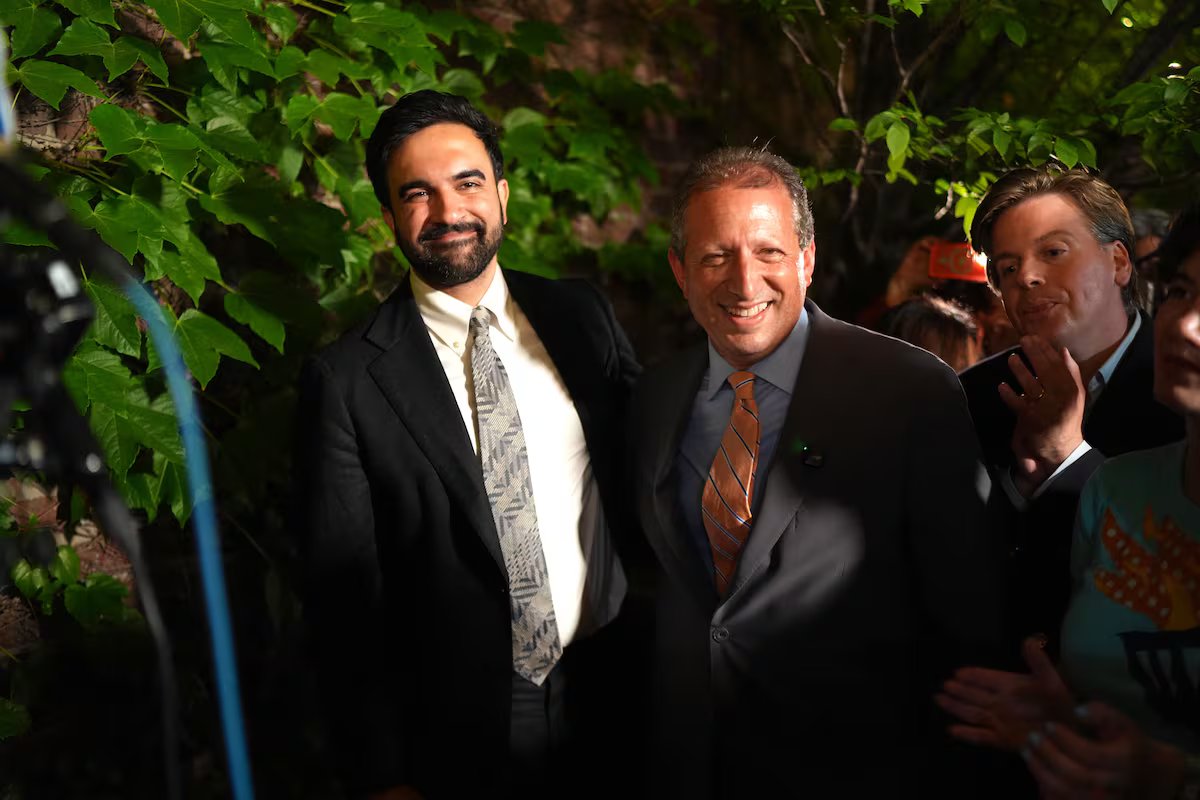
U.S. President Donald Trump likes to boast about the near-absolute power he wields among Republicans. He claims—though not always truthfully—that merely pointing to a candidate is enough to secure the latter’s nomination for any office. Well, this Tuesday Trump met a rival at the opposite end of the ideological spectrum: Zohran Mamdani. The New York mayor scored a major political victory when the three House candidates he backed won their Democratic primary contests on Tuesday.
The victories by Brad Lander, Claire Valdez and Darializa Avila Chevalier effectively guarantee that these three left-wing politicians will travel to Washington to be sworn in as members of the House of Representatives. Although the actual elections will be held on November 3, all three are running for seats in districts with an overwhelming Democratic majority, where Republicans stand no chance.
The surprising win last year in the country’s largest city by a Muslim politician born in Uganda is thus confirmed not to have been an isolated incident or an accident. Mamdani is no longer just an individual. He is a political movement. “A year ago, it was not the end of a political movement, it was the beginning,” he said.
With this decisive victory, the faction of the Democratic Party calling for a much tougher stance toward the Israeli government led by Benjamin Netanyahu gains strength. The generational shift—both victorious women candidates are under 40—also reflects demands for greater attention to issues such as the rising cost of living, a particularly acute problem in a city like New York.
These three new names on the national political map will bolster the Washington ranks of the party’s far-left wing. That faction is deeply dissatisfied with the work of fellow New Yorker Hakeem Jeffries, who aims to become House speaker if his party wrests the majority from the Republicans on November 3.
The most important outcome of the day is the message sent by Mamdani and his protégés. The mayor himself put it into words last Thursday. “The party of the past will not be what leads us into the future. We need a Democratic Party with character,” he said while still wearing the Knicks shirt he had put over his ever-present dark suit to greet the NBA champion team, after delivering a stirring speech that looks likely to be remembered for years.
Another signal from these primaries is the growing prominence of the socialist movement, a word that until recently seemed proscribed in the United States. Both Valdez and Avila Chevalier belong, like Mamdani himself, to the Democratic Socialists of America. Lander, who is Jewish, was a member of that organization until he left it in 2023 after the Hamas attacks on Israel on October 7 of that year.
A risky bet
Mamdani’s gamble was genuinely risky. He backed candidates who in some cases were viewed as inexperienced and newcomers to their districts, and who faced opponents with strong pedigrees — such as Congressman Adriano Espaillat, the first Dominican to reach the Capitol and head of the Hispanic caucus. This was the closest race ever; Avila Chevalier defeated Espaillat by a handful of votes: 49% to 46%.
With his movement, Mamdani also angered the long-serving Nydia Velázquez, who vacated her House seat after more than 30 years in Congress. Velázquez did not hide her anger that the mayor backed Claire Valdez over the candidate she had endorsed. But she will now have to accept that, at least in New York, the mayor calls the shots.
Beyond measuring Mamdani’s power, attention in these primaries focused on a specific New York district: the 12th. There, the veteran Jerry Nadler, a congressman since 1992 and a heavyweight in the party, was retiring. Jack Schlossberg, the only grandson of the iconic assassinated president John Fitzgerald Kennedy, ran to replace him. Despite the initial attention that Kennedy’s entry into politics attracted—a family that feeds the country’s presidential myth with attorneys general (and also the current secretary of health under Donald Trump)—Schlossberg’s campaign soon revealed limited traction. He ultimately finished a humiliating third with just over 10% of the vote.
Micah Lasher, a state assembly member backed by the outgoing congressman, will take the seat after narrowly beating young Alex Bores, who had drawn attention for his proposal to regulate artificial intelligence. In this Manhattan district, one of the wealthiest in the United States and with one of the highest percentages of Jewish residents, Mamdani’s winds of change did not prevail and an establishment candidate won. It is also true, however, that the left-leaning mayor had not backed anyone here. Even in Manhattan, Mamdani’s magic remains intact.
Sign up for our weekly newsletter to get more English-language news coverage from EL PAÍS USA Edition
