
Listen to this article
Estimated 5 minutes
The audio version of this article is generated by AI-based technology. Mispronunciations can occur. We are working with our partners to continually review and improve the results.
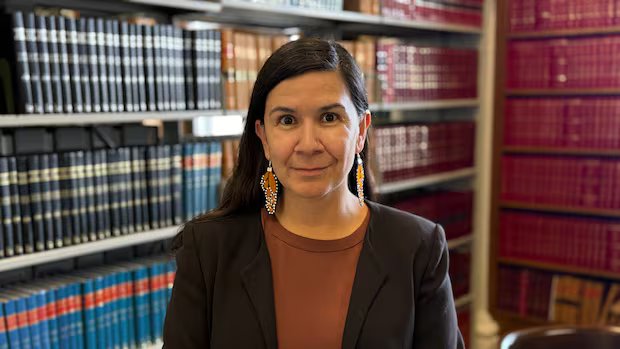
A Manitoba provincial court judge is helping the court chart a new path forward as the province’s first associate chief judge of reconciliation — a role she says she believes is the first of its kind in Canada.
“It’s quite close to my heart,” Judge Jerilee Ryle said at a news conference in the law library inside downtown Winnipeg’s courthouse Friday.
“I got into law to help Indigenous peoples. So, being able to have these opportunities to work alongside and empower Indigenous peoples and communities, and with the goal of healing Indigenous communities and peoples, is certainly — it’s very impactful for me.”
The update comes after Ryle, who is Anishinaabe and a member of Lake St. Martin First Nation, was sworn in as a judge last year. That ceremony opened with a traditional drum song and saw Ryle take her oath on an eagle feather — among the changes the court has already made with Indigenous people in mind.
Provincial court Chief Judge Ryan Rolston said future changes might include things such as using new Indigenous courtrooms being set up in Winnipeg and other areas.
Ryle’s appointment to the new role comes as Indigenous people continue to be overrepresented in Manitoba’s jails and courtrooms — problems Rolston said seem to still be “only getting worse” despite efforts for change.
He said the new role will see Ryle connect with Indigenous communities across the province, including the dozens the court drops into every month. She will then return and help the court make changes to be in line with Indigenous cultures and traditions, with the aim of improving trust in the system among Indigenous people.
“When I’ve been in those courts myself and left, I’ve often wondered how the people feel about what we do,” Rolston said at the news conference.
“I think it’s pretty clear how they feel about what we do. I think that it’s hard for them to identify with what we do.”
Ryle said she brings her experience “of walking in two worlds” to the role.
“I understand that this role calls for humility more than authority, courage more than certainty, and an unwavering commitment to truth, even when that truth is uncomfortable,” she said, adding she hopes other places follow Manitoba’s lead.
‘Reconciliation requires partnership’
Manitoba Justice Minister Matt Wiebe said the provincial government is “keen on taking concrete steps to stop these systemic patterns, but we know that we can’t do it alone.”
“The justice system as we know it has not always been fair to Indigenous people. And we’ve seen the legacy of colonialism in the overrepresentation of Indigenous people within our justice system,” he said alongside the judges.
“Reconciliation requires partnership, and it requires listening to Indigenous leadership.”
Niigaan Sinclair, an Anishinaabe writer and professor whose father, Murray Sinclair, chaired the Truth and Reconciliation Commission and worked on its 94 calls to action, said Friday he looks forward to hearing more about what the new position will involve.
“Very few professions have been more chronically undereducated — perhaps even miseducated — on Indigenous rights and the recommendations of the Aboriginal Justice Inquiry and other reports than lawyers and judges,” he said in a message.
“I should know; I have been one of the individuals asked to train and support judges in implementing changes. A position like this fulfilled by someone who has been at the forefront of incorporating reconciliation into the Manitoba justice system can do nothing but help.”
The Assembly of Manitoba Chiefs thanked the government for establishing the position, which it called an important step toward advancing reconciliation and strengthening relationships between First Nations and Manitoba’s justice institutions.
“As an Anishinaabe woman and a respected member of the judiciary, [Judge Ryle] brings experience, leadership, and understanding that will help advance efforts to build a more responsive, culturally informed, and equitable administration of justice,” the organization said in a Friday news release.
Before becoming a judge last year, Ryle practised as a defence lawyer, senior Crown attorney and reconciliation lead for the Manitoba Prosecution Service, the province said in a news release Friday.
Her appointment to the new role brings the provincial court’s number of associate chief judges — who take on extra administrative and leadership roles, on top of steering the court’s future direction — to four. Her seven-year term starts July 2, the province said.
