
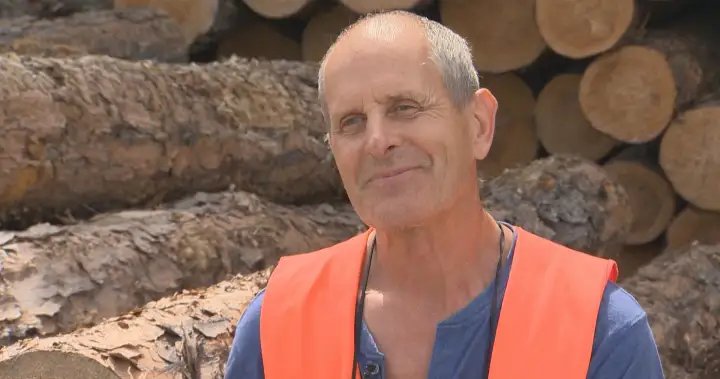
Arnold Reimer walks through a forest analyzing the colour of a tree’s needle – a fiery orange or green – and effortlessly pointing out if it’s dead or overmature just by a quick glance from years of experience.
He’s among the Manitoba loggers concerned their supply is turning to ash as wildfires continue to burn through forests across the country.
Last year’s wildfire season burned around 8.9 million hectares nationwide. In Manitoba, 445 wildfires and 2.38 million hectares burned, according to the government of Manitoba’s 2025 wildfire report.
Canada’s forest sector supports nearly 200,000 workers and contributes more than $20 billion to the GDP, according to the government of Canada.
Reimer, 68, started logging when he was in his mid-teens, after his dad got into it to make income outside of farming for the family of 11. He founded Spruce Wood Loggers, north of Arborg, Man., in 1981, which has been selling rough lumber, wood pellets, mulch, wood chips and firewood.
His sons, Charles and Scott, now own the business, but he fears it could stop there with an unpredictable wood supply.

Get breaking National news
Get breaking Canada news delivered to your inbox as it happens so you won’t miss a trending story.
Reimer said close to a third of the trees he comes across are dead or overmature. While overmature trees aren’t necessarily bad supply and still have their purpose, they have less moisture and can catch fire more easily, which poses a risk to the town.
“As long as we have that type of timber [dead and overmature] surround the younger stuff, the younger stuff is in jeopardy,” said Reimer, standing a few steps away from a healthy, growing forest he once clear-cut.
He noted that if a lightning strike landed on a particular tall, spiky tree, the whole forest could go up in flames. Fifty-eight per cent of wildfires in Manitoba are ignited by lightning, according to the province’s report on the status of forestry between 2016 and 2020.
John Morris, executive director at the Forestry Industry Association of Manitoba, said the loss of timber means job losses, fewer economic opportunities, and impacts on rural and northern communities that depend on the industry.
“It’s a decrease in the availability of products and an increase in price,” Morris said.
In the long term, investments in forestry could slow down.
Robert (Bob) Gray, a B.C.-based wildland fire ecologist, said logging is built on predictability — betting that trees will stay and mature, so loggers can reap the harvest — but wildfires are unpredictable.
“People won’t make investments in the forest industry because the system is so unpredictable,” Gray said. “Why would you invest $100 million on a mill to upgrade it when you look at the inventory, and it could be there this year, and it might not be there tomorrow?”
He said aging forests are more prone to insects, disease and wildfires.
Gray said the forest industry is “salvaging” as much timber as it can before it deteriorates.
Morris said a paper mill in The Pas, Man., Canadian Kraft Paper Industries Ltd., has been impacted, with wildfires burning unharvested timber and some harvested wood.
Canadian Kraft Paper Industries Ltd. did not get back to multiple requests for comment.
Global News recently reported that Canfor is closing a pulp mill in Prince George, B.C., losing more than 300 jobs.
There were 143 active wildfires burning in Manitoba as of Thursday, said the province.
© 2026 Global News, a division of Corus Entertainment Inc.
