
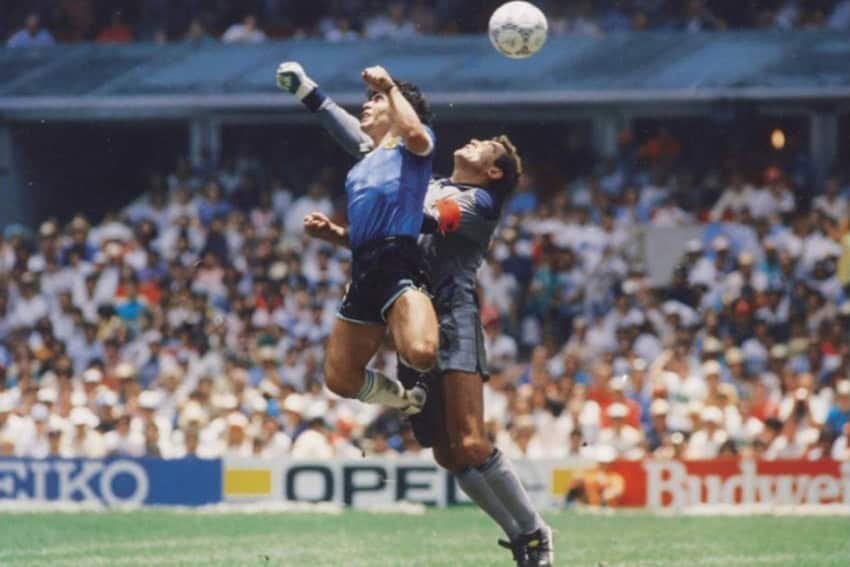
Argentine soccer legend Diego Maradona was brilliant and flawed and is sadly no longer with us. But he is still remembered around the world for his unique skills on the soccer field and his oversized character off it. As time passes, his faults — and he certainly had faults — are forgotten, and we miss him more and more. That is particularly true with the Spanish-speaking people of America, who see Maradona as above all the poor boy from the barrios who made good.
While every country he visited claimed a little of Maradona, we might be forgiven for believing that Mexico held a special place in his heart. Certainly, the two most memorable moments of his football career took place on the hallowed grass of Mexico City’s Azteca Stadium, during the 1986 World Cup when he was Argentina’s national team captain: “The Hand of God” goal and, four minutes later, “The Goal of the Century.”
These moments are immortalized in statues and plaques around the Azteca Stadium, and as World Cup fever takes over Mexico and the 40th anniversary of that great day approaches on Monday, it seems appropriate to honor the man and the deeds.
The birth of a legend
Diego Armando Maradona was born in the Buenos Aires suburb of Lanús to a working-class family. He was a true child sports prodigy on the junior Cebollitas team that went 141 games undefeated. He made his professional debut for the Asociación Atlética Argentinos Juniors’ first division team when he was 10 days short of his 16th birthday, becoming the youngest player to ever appear in the league. A few months later, he was playing for Argentina, but for all his talent, manager César Luis Menotti left Maradona out of the national team that won the World Cup on home soil in 1978.
Maradona had his moment on the world stage the following year in the World Youth Championships in Japan. He scored six goals, won the player of the tournament award and dominated every game as Argentina took another international trophy.
The 1982 World Cup in Spain was an underwhelming experience for both Argentina and Maradona. The holders went out rather tamely in the second round. It seemed that Maradona, for all his brilliance, could be subdued by big men shadowing him around the pitch and using muscle and violence to counteract his genius. The players departed from Spain expecting to meet up again in four years in Colombia.
Maradona’s career leading up to the 1986 World Cup
Colombia had originally been chosen as hosts way back in June 1974, although President Julio César Turbay Ayala was lukewarm to the idea of his nation staging a global event of this scale. Now, the tournament had been expanded to 24 teams, which had been fine for Spain, but would be a serious challenge for Colombia.

Embed from Getty Images
Colombia’s former president Julio César Turbay Ayala. (Bettman/Getty Images)
In November 1982, Colombia bowed out of hosting, and the 1986 World Cup was suddenly up for grabs. Mexico, the United States and Canada all submitted bids early in 1983, but the five-person special FIFA committee announced that only the Mexican bid had met FIFA’s criteria. On May 20, 1983, the committee announced Mexico’s successful 1986 World Cup bid, making Mexico the first nation to stage the tournament on two separate occasions.
For Maradona, the four years between World Cups had not been his happiest period in life. He had moved to FC Barcelona, which expected his unique skills to lift them out of the shadow of Real Madrid. The brutal treatment Maradona had faced in the 1982 World Cup continued: Most famously, Andoni Goikoetxea, “the Butcher of Bilbao,” broke his ankle, putting Maradona out of the game for three months.
The statistics show both the frustration and the potential of this period. Over two seasons, Maradona was only fit for 38 league games, yet he still scored 22 goals.
In July 1984, Maradona moved on again, to what seemed at the time the most unsuitable of places: He went to Italy to play for SSC Napoli. It seemed like a move designed to fail. Instead, the city and the player fell in love with one another.
‘The Hand of God’
In September 1985, Mexico was struck by a devastating earthquake, but the stadiums escaped any serious damage, and the World Cup plans went ahead. Our story now fast-tracks to June 22 and the tournament quarterfinals, with 114,580 spectators filling Azteca Stadium.
Argentina had been looking better and better as the tournament progressed. On June 22, they came up against an English national team that had scraped through to this stage by the skin of its teeth.
The English manager, Bobby Robson, was highly respected but not adventurous, and his most talented players were on the bench. The midfield was packed with players who could be trusted to do a simple job well; it was a team picked to avoid defeat, rather than one that hoped to win. There was also an element of political tension between the two nations, with the 1982 Falklands War still fresh in everyone’s minds.
Divine inspiration
For 50 minutes, Argentina pressed forward, and Maradona was everywhere. He launched a run from the halfway line, he skipped around a player, he flicked the ball with his heel to change the direction of the game.
Then, in the 51st minute, Peter Shilton, considered one of the best goalkeepers in the world, came out to punch the ball away, but Maradona got there first. Despite being only 1.65 meters tall, he outleaped Shilton and guided the ball into the net. Goal!
The English players protested furiously. At first, many in the stadium, as well as those watching at home, saw nothing wrong, but as the cameras showed the incident from different angles, it became clear that Maradona had knocked the ball into the net with his hand.
Maradona did nothing to appease the English. The opening goal was, he famously joked, “the hand of God.” This just confirmed to many Europeans the poor sportsmanship they felt lay at the heart of the Latin American game.
‘The Goal of the Century’
Many years before, England’s World Cup hero, Geoff Hurst, had been interviewed on British television after he had also used his hand to guide the ball into the net. Should he have owned up to the referee, the commentator asked. Hurst laughed and pointed out that each season, he’d had perfectly good goals disallowed. If the decision occasionally went his way, then he would say thank you and accept it.
Many Argentina fans saw it along these same lines: How many times had the English pulled, tugged and hacked Maradona to the ground? If the referee had made a mistake, perhaps that just brought a little justice into the game?
The English players were stunned. Set up to defend, they now had to attack and were are off-balance. Four minutes later, Maradona scored again. If the first goal has been one of the most controversial in the history of the sport, this second is the most celebrated: A 60-meter dash that takes Maradona past six challengers and ends with the ball in the net — 11 seconds of athletic skill that defy description and can only be watched and wondered at.
More of Maradona in Mexico
The Maradona story continued. He was at the peak of his skills and took Naples to their first-ever league title. But such a passionate love affair could not last, particularly as his personal problems increased.
It was widely known, for example, that he used cocaine, missing training sessions and being absent from games because of it. Then, in 1990, he helped Argentina beat Italy in the World Cup, and the Italian love affair was truly over.
The story of Maradona and Mexico wasn’t finished, though: In March 2002, by which time he had turned 40, Maradona played in the farewell testimonial for Carlos Hermosillo. He was on the pitch for 20 minutes and won a penalty, but, as the 5-5 scoreline suggested, it was hardly a competitive match.
He returned in 2006 with a group of former Argentina stars who put on the ‘Showbol’ indoor football spectacle in Mexico City and Monterrey. It was more circus than sport, but the crowd turned up just to be able to say that they had seen Maradona.
Nor was his love of Mexico limited to the football pitch. He was a fan of the actor Roberto Gómez Bolaños — aka “Chespirito” — and his legendary street orphan character, “El Chavo del Ocho.” Mexican singer-songwriter Marco Antonio Solis was another passion, and Maradona joined him on stage at Luna Park in Buenos Aires to sing “Si no te hubieras ido.” (If You Hadn’t Left).
The goals live on forever
Incredibly, in September 2018, Maradona was appointed head coach of Dorados de Sinaloa. The greatest player in the world was managing a team in the Mexican second division. Yet it worked.
It became, as in Naples, a love affair between the man and the community. Neither was it just a publicity stunt. Maradona worked hard, twice guiding the team to the playoffs, where they twice missed promotion to Mexico’s top football league, Liga MX. When he left after 10 months, it was due to declining health, and respect was openly displayed by both parties.
There would be one more job in football, a spell managing Club de Gimnasia y Esgrima La Plata back in his native Argentina, but the great man’s health was clearly failing. He died at age 60 in 2020, drawing hundreds of thousands of people to his wake and funeral procession in Buenos Aires. “The Hand of God” and the “Goal of the Century,” however, live on in the memories of all who witnessed them.
Bob Pateman lived in Mexico for six years. He is a librarian and teacher with a Master’s Degree in History.
