
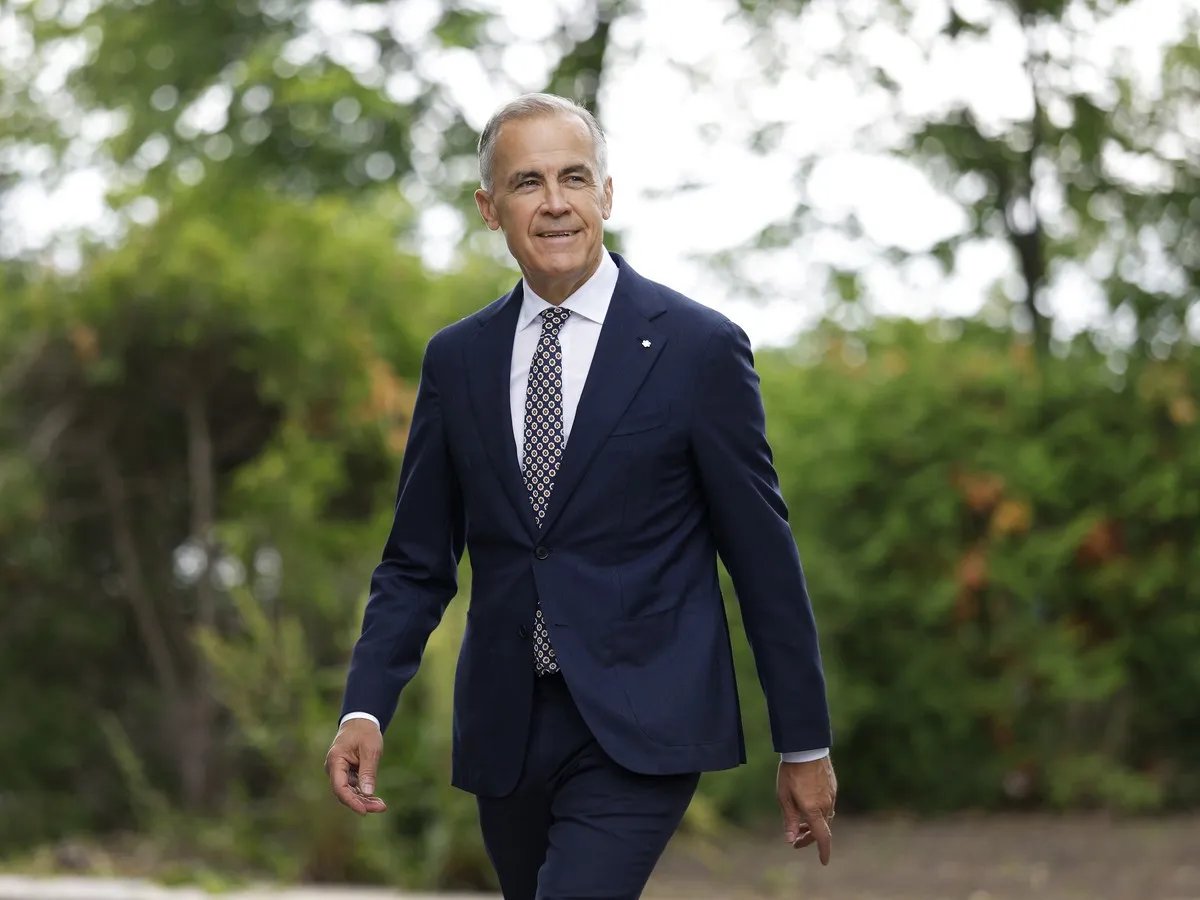
OTTAWA — Just before heading to Edmonton to celebrate Canada Day, Prime Minister Mark Carney took the time to reflect on the “divisions” that have pitted Ottawa against Albertans in the half-century panning from Pierre Elliott Trudeau to Justin Trudeau.
Carney presented his vision for Canada’s energy future, which includes renewables but also a new oil pipeline to the West Coast, in a 17-minute video on YouTube released Tuesday.
Sitting at a wooden table, Carney reminisced about his years as a teenager in Edmonton when the controversial National Energy Program (NEP) was introduced by Pierre Elliott Trudeau’s Liberal government, greatly contributing to the rise of Western alienation.
“I remember how Ottawa made Albertans feel like our resources weren’t our own,” said Carney of the NEP, without mentioning names.
“And then more recently, we were made to feel that our energy contributions were running against the tides of history,” he added.
“What should have brought us together began to divide us, contributing to a half-century of politics that have too often pulled us apart.”
Carney said he has acted as prime minister to the best of his abilities to “help put those divisions in the past” by focusing on what Canadians can build together in the future.
“From my perspective, there is no more important goal than a strong, united country working together in our common interests,” he said.
Carney will be participating in Canada Day celebrations in Ottawa on Wednesday before flying out to Edmonton later in the day. He said he is “looking forward” to the festivities in the province where he grew up, but it is unclear if he will be staying out west a bit later.
The Alberta government is expected to be unveiling its proposal to build a new million-barrel-a-day pipeline to the West Coast on Thursday . Carney said he has been in close contact with Premier Danielle Smith’s team and is “very up to speed” on the project.
He would not offer too many details on the pipeline but said in French he expects there to be a private proponent, adding “that’s the deal” that was struck with Alberta.
Carney notably made the case for the need for a new pipeline in his new video on Tuesday.
He said addressing energy security means creating “clean energy” but also producing conventional oil and gas “in the most environmentally sustainable ways.”
“The truth is no one knows how long the global economy will rely on conventional energy, but while it does, as much of that energy as possible should come from Canada, produced responsibly and with a clear focus on lowering emissions over time,” he said.
Carney said the United States had been Canada’s sole customer when it came to oil and has, but that changed when oil from the Trans Mountain pipeline started flowing to Asia.
For the first time, he said, Canada has access to “fast-growing Asian markets” from its West Coast and it’s in part why Canada is developing options for a second oil pipeline to the West Coast and a series of projects to export liquified natural gas to Asia and Europe.
“Put simply, we now need to build energy infrastructure to give ourselves more options, and those new options will be an important source of our strength, and they will help make our partners less vulnerable to conflicts,” he said.
Carney also cast some shade on his predecessor’s environmental strategy, saying while it made sense at the time it was created, it does not fit the current geopolitical realities.
“The climate plan we inherited from the previous government was well-intentioned and well-suited for the times in which it was designed,” the prime minister said.
“But the certainties of the world of 2015 are long gone,” he added.
Carney said that his government is still committed to fighting climate change.
“The goal remains the same, but as times have changed, we must change our plan to get there. We can’t afford to restrain the growth of an important part of our energy mix, oil and gas, to meet a short-term goal,” he said.
Trudeau was elected in 2015 with a promise to cut greenhouse gas emissions by 30 per cent by 2030 compared to 2005 levels. In 2021, his government increased its targets, promising to reduce emissions by 40 to 45 per cent below 2005 levels by 2030.
On Tuesday, Carney confirmed that Canada will not be meeting those targets.
“The changes we have made will mean that our emissions will be higher in the next few years than they were projected to be under the previous government’s plan,” he said.
But, he explained, that plan was “not sustainable” in the long run and would have been “too expensive” for Canadians who are already struggling with affordability.
He also said that plan would have been “too divisive” for the country.
“In the current environment, the old plan was an open opportunity for those people who wish to pull Canada apart, both at home and from abroad,” he said.
Carney has touted a new plan to help build clean energy at scale, one that will “make Canada more sustainable, more affordable and more prosperous.”
National Post
calevesque@postmedia.com
Our website is the place for the latest breaking news, exclusive scoops, longreads and provocative commentary. Please bookmark nationalpost.com and sign up for our newsletters here.
