
One hundred eighty years ago, on June 15, 1846, representatives of the U.K. and the U.S. signed the Treaty of Oregon.
What is this treaty, and why is it important?
The B.C. and Canadian governments assert that their right to govern, to assert sovereignty over the lands now called “British Columbia,” began in 1846 with the signing of the Treaty between Her Majesty and the United States of America for the Settlement of the Oregon Boundary.
The treaty did define today’s border with the U.S. west of the Rockies but most importantly it asserted that the British and U.S. were to exercise sovereignty over the Oregon territory – present day Washington, Oregon and British Columbia. The U.K. was to have sovereignty over the territory north of the 49th parallel, and the U.S. was to control the lands south of the border.
The text of the Oregon Treaty offers no justification for this colonial assertion of sovereignty. However, publicly available minutes of the negotiations in 1845-46 starkly reveal that the U.K. believed that visits to the region by James Cook, George Vancouver, and others gave them the right to take the land.
The treaty fails to mention that First Nations lived, governed, and worked across these territories for thousands of years. At the time, the settler population was at most a few hundred. Estimates vary, but as many as 300,000 or more Indigenous peoples lived north of the border. They were never consulted and the treaty rendered the land into a fictional terra nullius.
In effect, the Treaty of Oregon, and the Crown’s right to govern, is based upon the thoroughly discredited Doctrine of Discovery that even the Vatican has repudiated.
The bitter irony is that those who effectively stole the lands in 1846, are now accusing those whose lands they took of threatening private property. Nothing could be further from the truth.
History matters
Initially First Nations often supported newcomers to their territories. But settler governments, backed by British canons, asserted control by pushing First Nations off the land and onto reserves, refusing to sign treaties, and encouraging white settlers to exploit native lands. First Nations have been organizing and fighting the dispossession and genocide that ensued ever since. Our colleagues introduced a concise account of that history a few years ago – a history that made B.C. a province like no other.
One of the recent landmarks in this ongoing fight was the 1981 Constitution Express that saw First Nations mobilize across the country and Europe to demand Indigenous title and rights be recognized in the Canadian constitution then under consideration. This led to the adoption of Section 35 of the Constitution affirming Aboriginal title and rights for the first time.
Indigenous led movements, including Idle No More, the Truth and Reconciliation Commission, and Every Child Matters continued that fight and had an impact on the consciousness of many people in the province – Indigenous and non-Indigenous alike.
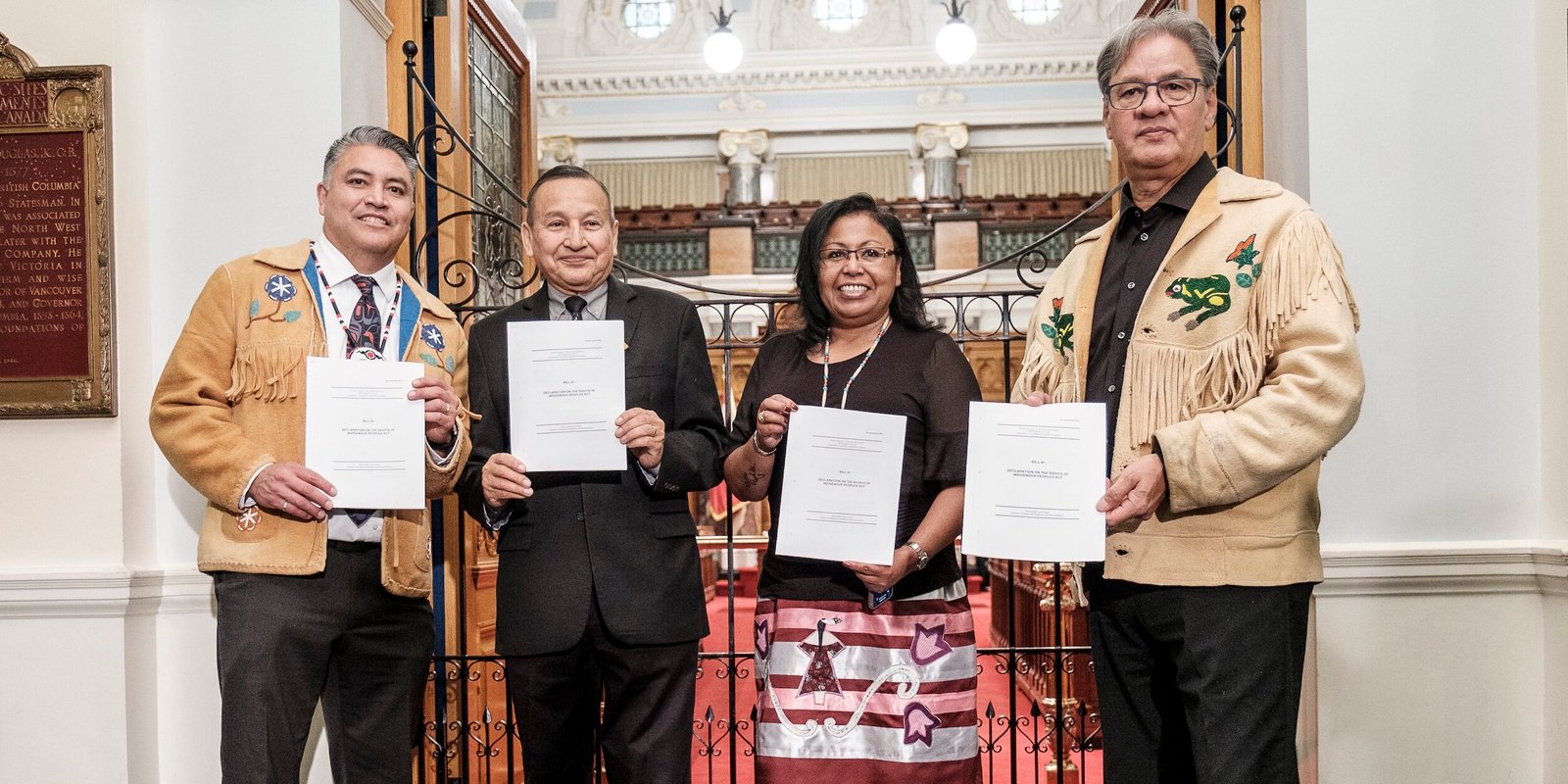
Consequently, the provincial legislature unanimously passed the Declaration on the Rights of Indigenous Peoples Act (DRIPA). It affirmed the application of the United Nations Declaration on the Rights of Indigenous Peoples to the laws of B.C. It declared that “in consultation and cooperation with the Indigenous peoples in British Columbia, the government must take all measures necessary to ensure the laws of British Columbia are consistent with the Declaration.”
DRIPA was a further step in decolonization and reflected the long struggle of First Nations for recognition of Indigenous title and rights. These hard-won gains set the stage for recent court decisions, Cowichan Tribes v. Canada and Gitxaala v. British Columbia that reinforced Indigenous title and rights, emphasizing the legal imperative for the government to fully implement DRIPA.
Backlash
In the Cowichan Tribes v. Canada case last year, the BC Supreme Court declared that the Quw’utsun (Cowichan) Nation had title to Tl’uqtinus, a parcel of land on the southern arm of the Fraser River in Richmond. The NDP government reacted immediately, declaring it would appeal the ruling: “This ruling could have significant unintended consequences for fee simple private property rights in B.C. that must be reconsidered by a higher court,” stated NDP attorney-general Niki Sharma.
A few months later, the B.C. Court of Appeal decision in Gitxaala v. British Columbia reinforced the legal obligations of the B.C. government to implement DRIPA to the laws of the province. It ruled that the mineral claims system was inconsistent with DRIPA. Again, the provincial government contested the decision, announcing it would appeal the decision in the Supreme Court of Canada.
In a major speech to the B.C. Chamber of Commerce this spring, the premier criticized both decisions, saying they invite “further and endless litigation,” and were “the exact opposite of the direction we need to go.” David Eby then promised to amend or suspend DRIPA, provoking a crisis.
Over 100 First Nations publicly objected to the Eby government’s move to amend DRIPA, as did the Law Society of BC and the BC branch of the Canadian Bar Association. Over 130 civil society organizations, including the B.C. Federation of Labour and the B.C. Civil Liberties Association, publicly called on the government to stop their attempts to amend DRIPA, warning: “We are deeply troubled by the recent rise in anti-Indigenous rhetoric and fearmongering in this province that has framed the realization of the fundamental human rights of Indigenous peoples as detrimental to economic growth, security, and the interests of others. We stand united in opposition to these divisive narratives.”
Under pressure from within his caucus, David Eby was forced to shelve his plan to amend or suspend DRIPA and instead committed to engage in consultations with First Nations. Meanwhile, the Conservative Party and right-wing think tanks such as the Fraser Institute have been outspoken in their criticism of DRIPA.
Understanding the crisis
First Nations have made it clear that their title and rights are not out to dispossess property owners. The landmark Gaayhllxid • Gíhlagalgang “Rising Tide” Haida Title Lands Agreement, calls for “a staged transition to Haida jurisdiction, while protecting and maintaining private property rights and existing government services and infrastructure on Haida Gwaii.” The Cowichan Nation publicly promised that they were not seeking “to invalidate any privately held fee simple titles.”
Furthermore, many legal experts argue that Indigenous title can overlay and co-exist with fee simple private property, as does Crown title. So, what is really at stake?
Political polarization is occurring in many places in the world. In B.C., Indigenous title and rights has become the flashpoint, reflecting this province’s unique history.
Conservative forces are pushing to roll back hard-won social gains, whether it be Indigenous rights and title, women’s rights, LGBTQ rights, labour rights, or environmental regulations.
Kerry-Lynn Findlay, recently elected as leader of the B.C. Conservatives, has a track record of anti-Indigenous activism and has reiterated the Party’s commitment to repeal DRIPA. Her election night clarion call for “family, faith, and freedom” eerily echoes the conservative right, south of the border.
However, the current crisis resonates with deep cultural differences that transcend partisan politics. The colonial world conceives of the land as being owned, and ownership translates into economic terms, monetary – the land is monetized. For the Indigenous world, it’s not about who owns the land, it’s about who is looking after that land and all life upon it.
Another layer is economic. The NDP government’s agenda focuses on fast-tracking the exploitation of LNG and critical minerals – continuing the long tradition of colonial extractive projects. Some in the government feel that Indigenous title and rights, and the courts’ recent decisions, go too far and that “free, prior, and informed consent” may impede the fast-tracking of resource projects.
Governing with a slim majority, the Eby government seems to be listening to the BC Business Council who recently released a recent survey in which 98 percent of its members were “very concerned” about the Declaration on the Rights of Indigenous People’s Act (DRIPA) applying to all laws in the province.
The threat to the land, regardless of ownership, comes not from Indigenous peoples but from forest fires, flooding, and pollution – an ever-deepening environmental catastrophe that has arisen from unfettered growth. This has often altered the land to the point that it is unable to heal.
