
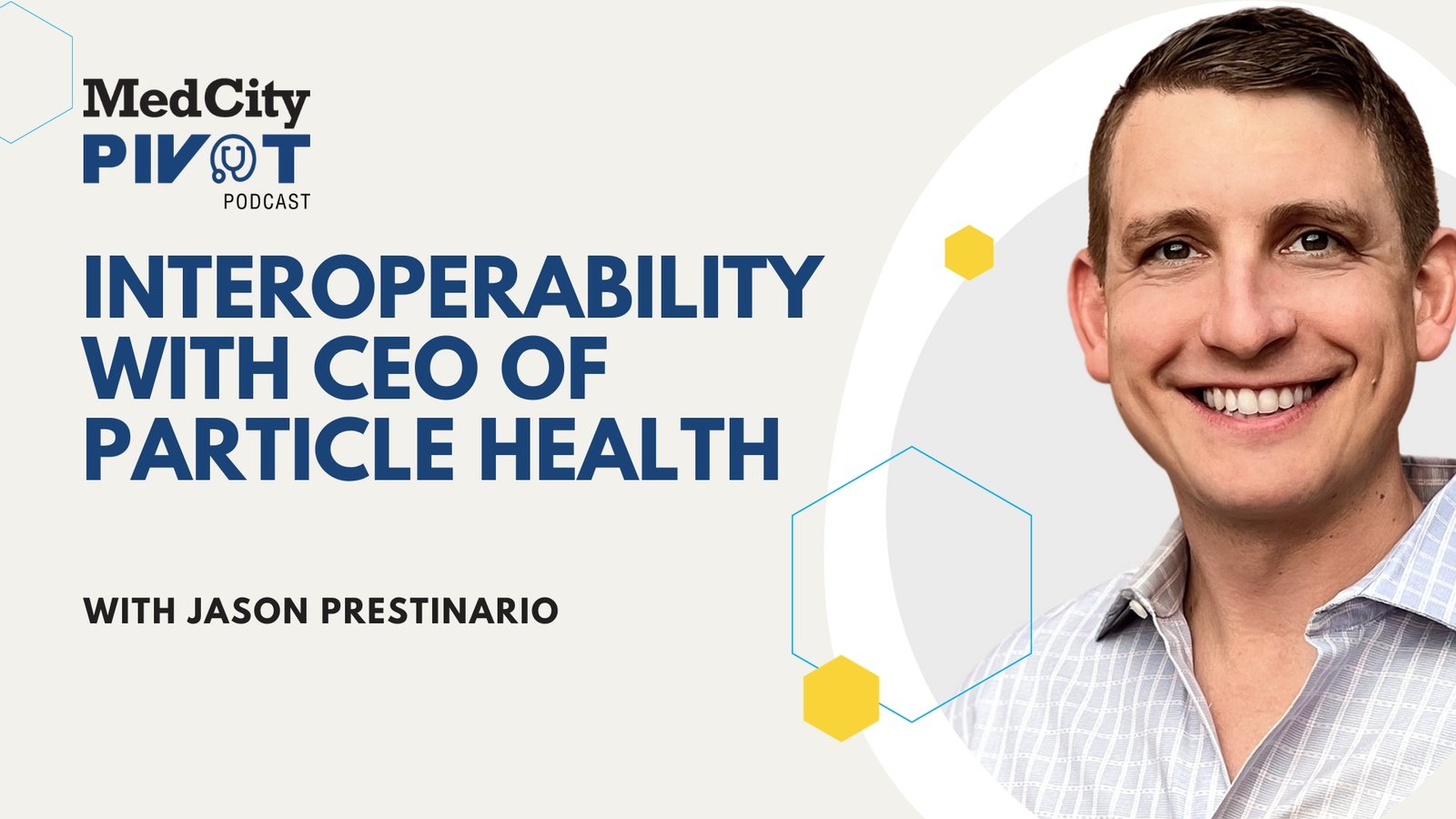
Both the Trump and Biden administrations made immense strides in improving healthcare interoperability —for instance, with information blocking penalties as part of the 21st Century Cures Act and the launch of TEFCA, to name just two important advances. More recently, CMS launched the interoperability framework. But the work is far from complete. What is the state of healthcare data interoperability today? What score would the nation receive on this?
For that and more — including discussions around lawsuits that will be significant in this field of interoperability — we reached out to Particle Health CEO Jason Prestinario.
Here is the video of the episode:
Here is the audio:
And below is an AI-generated transcript of our conversation.
Arundhati Parmar: Hello and welcome to MedCity’s Pivot podcast. I’m your host, Arundhati Parmar, editor-in-chief of MedCity News. This month we’re talking about interoperability and how we get from interoperability to value-based care. Our guest today is Particle Health CEO, Jason Prestinario. Now, Particle Health is a company that has created a single API through which payers and providers and digital health companies can basically connect to health information networks and, um, access medical records data that will help patients.
Uh, it’s a very interesting company, uh, not the least of, um, the reason being they have a lawsuit against Epic. Um, we’re in the middle of that lawsuit right now. So, uh, when I thought of having a discussion on the state of interoperability today, I thought we should definitely have a conversation with Jason.
Arundhati Parmar: Hi Jason. Welcome to the MedCity Pivot Podcast.
Jason Prestinario: Thank you so much. Thank you for having me.
Arundhati Parmar: So CMS has taken, has made some strides when it comes to interoperability under different administrations, the Trump administration included. How far do you think we’ve come in terms of interoperability, healthcare and interoperability, and what letter grade would you give, you know, CMS and other agencies in sort of furthering the cause of interoperability in the US?
Jason Prestinario: Yeah. So first off, uh, just to take a moment to say, yeah, uh, excited to be here, CEO of Particle Health. Uh, Particle Health is a data intelligence hub covering more than 70,000 healthcare organizations, uh, nationwide, see over 50 patient-provider interactions per second, process billions of data points across longitudinal medical records.
Um, and unlike basic data exchanges that simply move information from point A to point B, Particle is built to transform those fragmented records into actionable clinical insights that power better patient care. Um, so obviously, uh, with that as, uh, you know, what Particle is and what we do, we certainly spend a lot of time thinking about and caring about interoperability across the country.
Um, and, you know, I think what I would say first and foremost, uh, which may- may be a little bit tongue in cheek, uh, but I think it actually speaks to the point is, um, I would actually love to not spend any time talking about interoperability and sort of where it stands today, right? Um, you know, my hope would be all of why this data, uh, is valuable to use for patient care, advancements in how we’re able to use it to better understand next steps for patients, and talking about the level of, of impact that it’s having on the quality of care.
That’s what I would love to spend time talking about. Um- Mm-hmm … but obviously, none of that really matters if the data isn’t actually accessible to begin with. Um- Mm-hmm … so all that’s to say, I think, uh, where things currently stand and, you know, to give it a, a letter grade- You know, I think that’s hard ’cause it’s all about, I’d say the derivative is positive, right?
We are, we are trending in the right direction. Um, I think a lot of kind of recent, uh, advancements and pushes have been made, which is, um, obviously pushing us towards more interoperability. Um, you know, the health tech ecosystem, uh, that CMS launched, uh, last summer- Mm-hmm … uh, which we are one of the original, uh, signatories of, um, has really put a lot of emphasis on and a lot of spotlight on the need for medical records to be made more accessible.
Um- Mm-hmm … and so, uh, you know, whenever we are trending in the right direction, um, you know, to a certain extent, that’s what you have to ask for, right? So I think positive marks, uh, all around in terms of, uh, the better advancement and being better today than we were yesterday and better tomorrow than we are today.
Arundhati Parmar: Mm-hmm. So you can’t give a letter grade because it’s, it’s, uh, the progress hasn’t been that great, or why, why not? Yeah, I mean- It’s too complicated to simplify it like that.
Jason Prestinario: Yeah, I mean, I think partly is it’s, it’s too complicated to simplify it like that. Um, you know, I, I’ll put it this way first and foremost maybe.
Um, when it comes to the actual pipes, if you will, uh, you know, we’re, we’re, we’re at a B, I’d say, B plus. Um- Mm-hmm … you know, we have come pretty far in terms of that data, uh, being, um, able to be transmitted, uh, digitally without a whole lot of overhead. Um, you know, there’s still, uh, you know, institutions out there and providers out there that are not connected.
There are still some, uh, but by and large, right, as I mentioned, we see, again, 50 times a second we are seeing, uh, transmissions and interactions going back and forth where providers are seeing patients and requesting medical records and, um, you know, and pulling that through. So in terms of the pipes themselves, um, yeah, I mean, I think that’s at a B.
We’re, we’re, we’re in a pretty good place. Mm-hmm. Um, I think where things start to get more complicated is who gets to use the pipes and when and under what purpose and for what and for why and so on and so forth. Um, you know, and that’s where I’d say we’re still, you know, uh, at a C maybe at best- Okay
uh, in terms of, uh, uh, kind of our current state of the world.
Arundhati Parmar: So we’ll talk to who gets to use it and how in li- further down in in our conversation. But let’s talk a little bit about what are the gaps that need to be filled? You said you d- you wanted to be in a place where you’re not talking about healthcare interoperability anymore.
Uh, how do we get there? Yeah.
Jason Prestinario: I mean, I think first and foremost, right, we need to see, um, you know, all of the, all of the legal framework, all of the, uh, uh, kind of agreements, if you will, the regulations, um, the laws that have been made, uh, all are pushing us in the right direction. Um, you know, I’m actually, uh, uh…
Interestingly enough, I, I realize I’m coming up on my 10-year anniversary of being in healthcare- Mm … uh, which also, ironically enough, is about a 10-year anniversary of, of the Cures Act, um, you know, being signed into law in 2016. Mm-hmm. And, uh, you know, that was really the starting point of, of really saying, you know, “No, we wanna ensure that medical records are made programmatically available.”
And, you know, obviously, as the years passed, we got closer to the final rule and, um, you know, putting the, uh, both the carrots and the sticks in place and, you know, I’d say largely they are at this point. Uh, you know, there are information blocking penalties and statutes that are in place- Right … to ensure that, um, and like I said, all purposes of use, um, uh, are, are, are responded to and people, individuals can get access to their medical records, their doctors can get access to their medical records.
So I think the infrastructure, uh, in many ways is, is in place. I think what still remains, um, you know, as a gap is- Uh, again, getting just alignment on following all those rules- Mm-hmm … um, understanding who is going to, uh, be the adjudicator of those rules, who is going to oversee the process. Um, you know, we, we kind of have an alignment on the rules of the road.
We kind of have… You know, I kind of view it as, uh, we have the, uh, speed limits in place and things of that nature and, uh, but also the roads, uh, uh, that we need. And now the question is, well, what happens next? How do we really start to say let’s turn it on and, you know, let’s see what happens and, and, and make sure that we are, um, you know, kind of pulling back when and where we need to pull back.
But ultimately, overall, focusing on we want the flow of information. We want the democratization of this data and the use of it, right, in order to improve patient care.
Arundhati Parmar: So I wanted to ask about the latter part, improving patient care. You know, we’ve been talking about value-based care, value-based care for a really long time, and I kind of feel that interoperability is sort of the underpinnings of value-based care.
If you cannot get data from different sectors and different parts of what- whatever you do, how do you… You know, if you, you can’t improve what you can’t measure, right? So I… Do you see those two as sort of married to each other? How, how closely do the interoperability is viewed as really important to, to value-based care?
Jason Prestinario: Yeah. I mean, you know, first and foremost, I, I think, um, uh, you know, the, the concept of value-based care is, um, in some ways continuing to evolve and change, but in other ways has been around for, you know, a, a, a very long time, right? Mm-hmm. The idea of, uh, you know, a Kaiser, um, you know, for fifty years now, right, being, uh, sort of o- on the one hand, um, you know, a, a plan that is focused on the care of its patients, uh, and members, but on the other hand, obviously being, uh, you know, a provider of their own right and sort of being that payvidor that’s kind of thinking about both sides, right?
That’s not a new concept. Mm-hmm. Um, but obviously there have been, you know, a lot of advancements in, um… And, and again, right, uh, credit to, um, you know, if you will, the largest payer in the country in CMS, uh, for largely being the ones to spearhead these kind of new, uh, novel, uh, programs, right? So, uh, their latest, uh, access program is, you know, uh, another, uh, opportunity and, and experiment in, in some ways, right, to see how we can continue to open up new ways to say we care about the actual, uh, end result of how, um, healthy is this patient.
Mm-hmm. How we get there kind of doesn’t matter, um, right? Which obviously, uh, is, um, you know, uh, kind of a direct, uh, antithesis of a more fee-for-service-based system, uh, which really just says let’s count up all the procedures that were performed. So that is to say that I think value-based care has been around for a long time.
We are seeing more and more opportunities, uh, for it to, uh, be used and to be pushed throughout the ecosystem. Uh, I think it’s hard for anyone to argue, um, that the theoretical benefits of value-based care, um, are, are very real. Uh, and then obviously there’s a question then of, uh, you know, pragmatically are we able to achieve it and, and, and, you know, but that’s…
But, but we’re, we’re, we’re striving, right? And I, I, I certainly think that that is a, uh, a good thing and a good place to be in. And to your point, interoperability and data flows are certainly… And, and really more than I, like I said, just the flow of data, but it’s the understanding of that data- Mm-hmm … um, become really critical towards doing value-based care well, right?
Ultimately, you know, a lot of the ways that, um, we think about it is it’s still certainly important for, you know, even a fee-for-service provider to care about the patient that’s right in front of them, right? Mm-hmm. I mean, I think if you were to ask pretty much any doctor out there, um, would you rather know more about your patient, uh, than less?
I, I think they would say- Mm-hmm … yeah, I’d love to know more. Yeah. Um, especially if, uh, you know, it is, uh, what I need to know when I need to know it and, you know, not a thousand pages of medical records that I don’t have time to read. But I think pretty much every doctor would say, “Yeah, I’d love to know more about the patient that’s in front of me.”
I think the difference, uh, with value-based care though, uh, and what that means for, um, how, you know, CMS and other payers are continuing to kind of push that, uh, ability to really sort of think about the, you know, care of those patients and those members is now I care about what happens outside my four walls, right?
Mm-hmm. I care about what’s happening when this patient’s not directly in front of me. Um, and I care about the outcomes, right? The value, if you will, um, side of it, uh, uh, of that, of that patient. And that fundamentally is just a different paradigm, right? That is a paradigm that requires- Mm-hmm … uh, information and data from elsewhere because by definition they’re not right in front of you.
Um- Mm-hmm … and so to me it’s the difference between even in a fee-for-service model, it’s a nice to have, right? No, no, no provider out there I think is gonna say, “No, don’t tell me about my patient.” But if in a value-based care construct, it becomes a requirement. It’s a need to have. Mm-hmm. Uh, and that to me is the difference as I think about how interoperability is great for everyone.
Mm-hmm. Uh, it is a need, uh, for value-based care.
Arundhati Parmar: Uh, so let me talk to you about interoperability networks. You know, we have a bunch of different ones, right? We have TEFCA, we have Carequality, we have CommonWell, we have eHealth, if I’m not mistaken. And what’s the purpose of having so many? Uh, wouldn’t it be better for data fluidity and, you know, just better data flow or easier data flow if there were just one or two?
Jason Prestinario: Yeah, you know, this is an interesting, um, observation you have that I certainly, uh, have spent time thinking about because I’ve talked to people out there that, um, have said, you know, I think there should be, um, you know, there should always be multiple, uh, sort of networks and, and, um, you know, there, there should never just be one network.
Um- Mm-hmm … and I’ll be honest, I don’t really track that. I don’t really understand that, right? I, I think the way that if I’m a patient, if I’m a doctor, the way we certainly think about it to, um, you know, service, uh, uh, you know, the healthcare ecosystem here at, at Particle, I don’t care where the data comes from, right?
Comes from. Like, I don’t… I, I, you know, I, I’m not, um, thinking and tracking about, oh, well, this piece of information came from Care Quality, this came from CommonWell, this came from TEFCA. Yeah. Um, what I care about is do I have as much, um, frankly, hopefully all, uh, right, of the data on this patient in order to make my decisions.
I don’t really care where it came from. Right. So that’s kind of where the push on, oh, we should have multiple networks and things of that nature, I think is a little… I, I don’t really understand it. Um- Mm-hmm … I think that, you know, while there are certainly, uh, different networks out there and they all are kind of h- starting to have different, um, uh, you know, areas where they’re strong, right?
So obviously, um, TEFCA now and QHINs, uh, are becoming one of the, um, uh, y- you know, most important parts for individual access, which is now kind of really, um, you know, uh … The, the reason that you would connect to, to TEFCA, obviously the CMS ecosystem and Align Networks are also trying to really push into that and, you know, kind of be the, the leader versus the floor in, in, in, in the way that they frame that, um, across ONC and, and CMS.
Um, but the reality is, is that the majority of, you know, information exchange, um, that’s happening across, um, you know, between healthcare, um, uh, you know, uh, uh, uh, organizations today is still care quality. That is still by far, um, the largest source of information out there. Uh, you know, uh, TEFCA, you know, in their history is, is sort of celebrating doing 100, 200 million, uh, requests.
Care quality does more than a billion every single month. Mm-hmm. Um, so it’s, it’s just literally an order of magnitude difference, uh- Yeah … between the two. So, you know, to me it’s like, uh, you know, should we continue to have all these different networks theoretically, um, you know, as a interoperability, uh, company, right?
Theoretically, it’s like, oh, that’s great, we… You know, that, that’s more barriers to entry for us, if you will, because there’s all these different networks that you have to connect to. But, you know, we don’t really think that way. To us, the more, uh, democratization of data, the better. The more access to data, the better.
Mm-hmm. Um, you know, what the, the questions then, the much more valuable questions to answer is once I have the data, what am I gonna do with it- Mm-hmm … in order to really understand it?
Arundhati Parmar: Sure. That makes sense. Um, okay, so you can’t talk about interoperability without talking about lawsuits. Um, you’re party to one of them.
Um, so let’s start with that. Let’s start with your lawsuit against Epic. Now, you sued in 2024 because you allege that Epic is using its market dominance to prevent competition in the payer platform space. Uh, obviously all of this began when Epic sort of started blocking some of your customers from accessing patient data, and Epic is basically saying that, well, these customers were accessing the data not to treat patients, but actually to t- make money off of selling off the data.
Um, now I know last year a federal judge ruled that the core argument, um, that you had of antitrust, um, that can move forward against Epic. So I guess the question is, A, first of all, did I describe all that very clearly and correctly, and B, why is this case important to the industry?
Jason Prestinario: Yeah. I mean, you know, the, the way that I’ve always described it, right, is that this, um, you know, lawsuit and, and why we’re doing this is about making data work for patients, right?
That the only way we can get to, uh, again, that healthcare system that delivers better outcomes based on, you know, understanding the patients, understanding what’s happening both to the patients that are right in front of them, but also patients that are outside those four walls, um, is for that, you know, data to fro- flow freely, right?
For it to be accessible. Um, you know, and obviously we haven’t even spent that much time talking about, um, you know, AI and how it’s going to transform healthcare just like every other industry- Um, but, you know, one of the things that we find very interesting is the use of AI in our industry, um, largely doesn’t touch clinical, uh, outcomes yet.
And the reason it’s not, and, and there’s more and more kind of research being done that, um, you know, like everywhere else, AI is improving leaps and bounds, and I don’t think anyone’s saying that, you know, AI can’t be a help in understanding clinical outcomes. Um, you know, I don’t think that’s a, a particularly tough leap to make.
But it requires data, right? It requires to actually understand what’s happening- Mm-hmm … with the patient and allowing it to be, um, uh, you know, uh, accessed. And, and as I mentioned, right, the ten-year anniversary of the Cures Act, this isn’t a controversial view, right? This is what’s in all of our laws. So we did see, uh, right, that there was blocking of information that was occurring and that was impacting, um, you know, patient care.
That was impacting people who were trying to deliver outcomes, uh, for patients. And, you know, we believe that, um, obviously Epic is using that monopolistic position to stop the flow, um, of healthcare data, and that’s bad, right? For all the reasons we just talked about, that’s bad for individuals. That’s bad for the patients.
That’s bad for the professionals. Um, and it is not the, um, you know, it runs counter to the laws that were put in place, um, you know, in order to, to ensure that patients had access to the best care, that the best care models were able to be innovated on. Um, you know, that that could lead to more choice in healthcare and more opportunity for patients to, um, to get better outcomes.
So frankly, that’s the reason that we felt it was, uh, an important move for, for us to make. Um, and so I think that was your kind of first question on, on kind of why we did it. Um, in terms of the current status, uh, that’s right. So in September, um, as you, you mentioned, uh, right, the judge ruled that we were gonna move forward, um, on the kind of core antitrust, uh, complaints.
Um, and, uh, you know, that was the first time in, in Epic’s history that, uh, an antitrust case has gotten to that point. Um, and since then we’ve been undergoing, um, you know, a lot of, uh, kind of discovery in, in, in sort of this initial phase. Um, and, uh, you know, there’s a, a lot of, um, uh, kinda even in the last, uh, couple weeks, a lot of back and forth around that sort of first initial discovery phase.
Um, but, uh, you know, we’re excited to continue kind of marching forward. Um, you know, kind of all the procedural legal back and forth, um, you know, can sometimes frankly be a little bit beyond me. Uh, but the important point being that we are, um, continuing to advance forward, continuing to march forward with this, um, you know, with this lawsuit and this case.
And, um, you know, we’re, uh, continuing to look forward to, um, you know, we think our, our, uh, claims are strong. We think our position is strong, and we continue to look forward to, um, you know, marching the ball forward.
Arundhati Parmar: I’m curious about what you think about Texas’s lawsuit against Epic, ’cause they too have sued on the basis of, um, that it’s trying to stifle competition.
Jason Prestinario: Yeah. I mean, we’re seeing, uh, at this point, you know, several different, uh, actors, right? So, um, uh, Curious was another, uh, company, uh, who sued under antitrust, uh, not long after we did. Um, you mentioned Texas. Um, you know, there was also a, uh, not antitrust, but an employment, um, uh, complaint that Viva, uh, actually brought forth as well.
Um, you know, I think that there’s just a recognition that, um, uh, you know, at a certain point, um, uh, the Davids of the world have to stand up to Goliath and have to, you know, uh, sort of say, “Hey, we can, we can do the right thing here, and we can, you know, stand up for that.” And, um, you know, not to say that, uh, the state of Texas is, um, is, is David by any means.
Uh, you know, um, but, but it is to say, right, that I think, um, there’s an understanding here that, uh, you know, that, that there are activities, uh, there are, there are, um, uh, uh, ways in which, um, uh, you know, uh, Epic operates that I think people are starting to recognize need to be questioned. Uh- Mm-hmm … and that’s, I think, what we’re seeing across the industry.
Arundhati Parmar: So I’m not gonna comment on the merits of any case because, A, I’m not a lawyer, and B, I don’t know enough to comment. But I do, uh, um, I can talk about the, the recent developments. They too have sued. Um, they’ve sued Health Gorilla, um, alleging again and the same thing that, um- The da- patient data is being accessed for selling to lawyers for non-treatment purposes, right?
Uh, they’re saying these entities, HealthGorilla and a few other companies, are basically using this to enrich themselves in the name of treating patients. And I’m forgetting the name of the company, um, just now, but there’s a company in March that actually settled with, um, Epic, right? Saying that, okay, you know, they sort of admitted, uh, to some of the allegations, I guess.
And I thought that, well, that boosts Epic’s case. So E- Epic is also not wrong when it alleges that people and entities are misusing the data. Would you at least give them that?
Jason Prestinario: Yeah. So I mean, first off, the disclaimer, of course, um, that I also am not a lawyer. Uh, and I certainly, you know, I’m not gonna overly comment on sort of the merits of any specific case, um, of which, uh, I– other than ours, of course, of which I am a, uh, just a backseat observer, just like everyone else, obviously.
But, you know, what I will say is, um, I think, you know, first and foremost, um, that any time there’s any, you know, um, kind of speed bump, if, uh, it kind of in, in, you know, in, in these networks and in this data access, um, uh, you know, that, that can’t be used as an opportunity to set back information sharing, um, right, for, for years.
Uh, so, so first and foremost, I think that’s an important thing to, uh, to recognize is, um, there will be speed bumps, uh, along the way. Um, and we need to look at those speed bumps, and we need to carefully analyze them, and we need to investigate them and- You know, we believe very strongly in that. We’ve really, um, you know, I, I think bar none, we have, um, the strongest compliance program out there, and we thoroughly investigate and look into, um, you know, what’s happening.
Uh, not just with ourselves, but frankly, throughout what we can see, right, in our 50 times a second that we’re seeing patient-provider interactions. Um, because it is really important, right? You have to respect, um, that this is important data, that privacy, uh, and security, um, you know, are relevant things within, you know, the HIPAA construct and, and, and the sanctity of PHI.
But, you know, we also can’t suddenly say that, you know, that flow of information needs to be, uh, stopped, right, every time that there’s a speed bump along the way. So that’s, that’s kind of my overall, um, kind of first point. Okay. I think my second point, though, very specific to, uh, again, the allegations I see having no more information than anyone else is, you know, there’s a very interesting, uh, question here.
Um, right? Epic’s alleging that, uh, to your point, this was, um, uh, information being taken and, and sold to law firms, uh, effectively without the patient’s, um, authorization. Right. That’s very different, right, from a patient authorizing, uh, the access of their data and, and, and requesting and wanting their data to be used, uh, for whatever purpose.
Mm-hmm. Uh, and, um, obviously then that data being requested under a treatment purpose of use. Now, I wanna be very clear, right? If it’s not a treatment purpose of use, you shouldn’t request it under a treatment purpose of use. Sure. Um, but I think there is a massive difference here, right, between a, uh, a, a- an individual patient saying, “I want this,” uh, right?
Mm-hmm. “I want my information to be used.” Um, and a law firm, uh, taking information from patients who haven’t authorized it, uh, and trying to monetize it. Mm-hmm. And to me, we don’t know, uh, right, what’s actually under the hood here. We don’t know which one is true. Yeah. Mm-hmm. Because if it’s- If it’s the, the, the former, uh, right, then again, should not have been requested under a treatment purpose of use.
Um- Mm-hmm … but that is what all of the CMS health tech ecosystem and aligned networks, that’s what they’re all about, right? That we should give patients access to their own data. Um- Mm-hmm … and if it’s the latter, then that’s a totally different ball game. And I think what’s interesting and, and, you know, over time maybe we’ll see is, um, if it’s the latter, there should be HIPAA violations, uh- Mm-hmm
that are coming out of this, right? OCR should be saying, you know, actually there are a bunch of, um, you know, HIPAA breaches that are, have occurred here. That’s right. Um, and again, we don’t know, right? Those investigations take a while. Maybe they’re happening under the hood. Um, but I point that out because I think those two…
I don’t think enough people are talking about what are these two very different, uh, modalities of what might have occurred and transgressed.
Arundhati Parmar: Yeah. Yeah. I mean, and from what I’ve seen re- reported, um, in our own publication, one of our reporters wrote a story, you know, it’s, you know, they were creating shell websites and creating fake provider IDs, and all of that obviously sounds pretty horrible.
That sounds
Jason Prestinario: terrible.
Arundhati Parmar: Yeah. But are you saying that if a patient decides to ha- share that information, share their medical data with any other entity, um, and it doesn’t have to be for treatment purposes, that facility exists today for the patient to be able to share that information through Epic or through any organization, or no?
Jason Prestinario: No. That’s the problem, right? That’s the problem. Uh, that’s the core issue that we need to solve. That’s the core interoperability. Yes. That’s why we still have that C, uh- Yes … right as the mark- Right … to bring it full circle, is that facility doesn’t actually work today. Exist. Um, it doesn’t exist. Because
Arundhati Parmar: no matter what, what…
I’m sorry to interrupt, but no matter what people say- Yes … they’re- I’ve heard people and physicians say, you know, data belongs to the patient. But actually, I don’t think data truly belongs to the patient. It belongs to the hospital and the HR companies. I, I never get the sense that I can easily access my information if I want to.
Yes, now it’s gotten better with, uh, with patient portals and things like that, but, um, you know, i- it’s still a lot of paperwork to fill out and, and call and request and, and this and that. Even to get a copy of your MRI is such a huge issue. So, uh, so w- how does that change? How does that framework- Yeah
change because Epic’s making money off of that data too, right? And so are the providers and so on, so is everyone except the patient.
Jason Prestinario: Yeah. A- a- again, w- the way it needs to change is we just need to continue enforcing the rules that exist today, right? Yes. We need to see information blocking, uh, complaints turn into violations, turn into penalties.
Mm-hmm. Um, I think, you know, again, just like speed, um, you know, speed limits, uh, and, and tickets, right? It doesn’t mean that we need to file information, you know, complaints and, and, and, um, have penalties against every information blocking, uh, transgression in order to change behavior. Uh- Right … as soon as people start to believe, uh, that the penalties associated with information blocking are real- Real
uh, then I think they will start to pay attention to them. But as it stands today, they’re kinda not. Um- Yeah … you know, there’s really nothing that, um, you know, prevents it. We filed our own information blocking complaints, uh, against Epic as well, uh, based on some of the activity and the information blocking that they had, um, you know, performed actually against themselves, uh, right- Mm-hmm
where they blocked their own providers from being able to access data from some of our customers, things like, uh, you know, community oncology centers. Um, and, uh, you know, uh, I’m, I’m hopeful that someday, um, you know, we will hear back on, on some of those complaints. Um, but I think that’s what needs to happen, um, because you’re right.
Uh, that’s, that is true that today, um… And actually, I can tell you this ’cause we’ve looked at the numbers. I mentioned the majority of, of transactions are occurring on Carequality today. Um, there’s about 120,000, um, uh, kind of active sites, uh, where you can pull, uh, data from, from kind of Carequality and otherwise from these legacy networks.
Uh, TEFCA has, uh, I believe, um, uh, 60,000, so it’s about, uh, half, uh- Mm-hmm … first and foremost. Uh, and then within that, only about 15,000, uh, of those sites, um, you can actually pull individual access information based just on an API, uh, call. Mm-hmm. Everything else requires, well, you still have to do your login and authentication, login and password, uh, for your MyChart instance of Epic in order, and, and state, “Here’s who I wanna give access to, for how long, what pieces of information.”
You have to do that again and again and again, uh, for each and every login, uh, if you remember your login, if you remember your password. Um, and that’s just really onerous, right? Like, that’s not easy programmatic access to your own data, and so that’s- Right … what’s still blocking things. Um, and I can tell you just even from my own experience, um, recently there was information pulled on me, um, you know, through interoperability networks for a treatment purpose of use.
Um, and I, I thought it was really interesting ’cause there was actually some records going back to, uh, when I was in San Francisco, uh, over a decade ago. Uh- Mm-hmm … and, uh, you know, I was like, “Oh man, these records still exist at Sutter Health, and these records were pulled on me.” And then I was curious. I actually checked.
Um, I don’t have a Sutter Health MyChart login. Uh, I have no login or password. Uh- … so to your point, um, literally there’s no way for me to, uh, pull those under an individual access paradigm because I don’t have a MyChart login. Now, I could create one, and to your point, that was gonna, you know, give, uh, Epic more money ’cause now Sutter’s gonna have-
one more patient on a MyChart login and all of those things. Um, and that, you know, that data should be accessible regardless, right? It shouldn’t require that type of login and password in order to ma- you know, give me access to it.
Arundhati Parmar: Um, okay, and finally, to close, are, are there any particular regulations or CMS actions that you’re looking forward to that might be coming down the pipe regarding interoperability that might make things a little bit better even down the road?
Jason Prestinario: Yeah, I mean, you know, listen, I, I’m, um, you know, still actively involved, uh, myself and, and some of the folks on my team are leading some of the work groups, uh, within the CMS ecosystem. Um, you know, July 4th there’s, uh, kind of another, uh, tranche of deadlines, um- Mm-hmm … uh, that people are marching forward towards.
I’m excited about all of that. Um, you know, I think that there’s- Um, uh, we need to continue to emphasize all of the aspects of data access, um, uh, accessibility in the ecosystem. Um, you know, we need to ensure that that data is working for patients through providers, um, and payers and, you know, value-based care organizations and payviders, um, and not just focus on individuals accessing their data.
Um, but that’s still part of it, right? Any and all progress forward on making sure that data is accessible by patients and their caregivers and everyone in the ecosystem who needs access to it, I’m here for all of it.
Arundhati Parmar: Well, on that hopeful note, thank you so much for joining us at MedCity Pivot Podcast today.
Jason Prestinario: Absolutely. It was a pleasure.
