
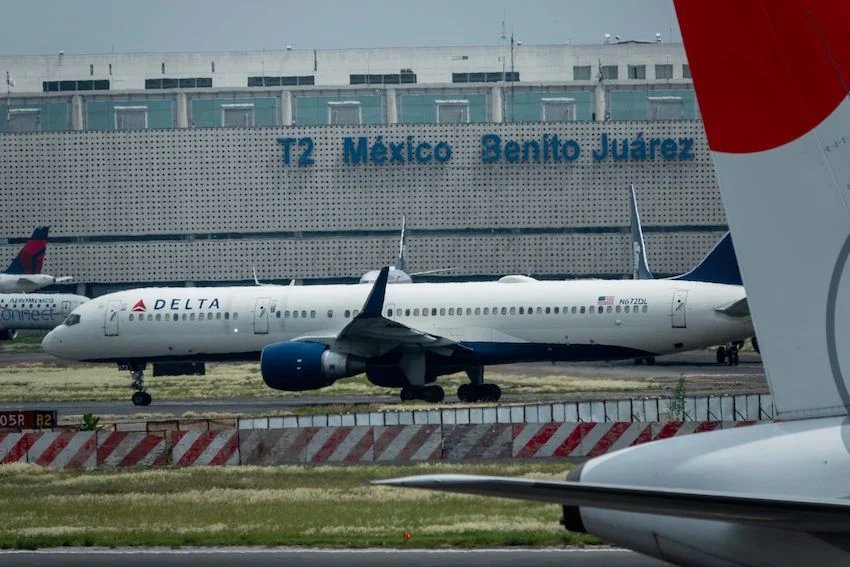
Just over three weeks before the FIFA men’s World Cup kicks off in Mexico City, Mexican air traffic controllers are threatening to go on strike over inadequate pay and “exhausting shifts,” among other concerns.
In a statement issued on Tuesday, the National Syndicate of Air Traffic Controllers (Sinacta) said that its representatives would go to the Federal Tribunal for Conciliation and Arbitration in Mexico City on Wednesday to file a formal strike notice (emplazamiento a huelga).
In doing so, the union — which represents employees of the state-controlled Navigation Services for Mexican Airspace (Seneam) — will increase its pressure on the federal government to meet its demands. It specifically wants to enter into dialogue with federal officials with the aim of securing better pay and conditions for its members, who work at airports across Mexico.
If air traffic controllers were to go on strike in the coming weeks, the operation of airports in Mexico could be severely disrupted, if not halted altogether, at a time when demand for flights to and from Mexico will be higher than normal due to the World Cup.
In its statement, Sinacta said that its members have maintained their “commitment to the safety and efficiency” of Mexico’s airspace with “irreproachable professionalism.”
However, the union asserted that federal authorities, including the Ministry of Finance and the Ministry of Infrastructure, Communications and Transport — of which Seneam is part — have responded to air traffic controllers’ “dedication with silence and indifference.”
Sinacta outlined five central complaints. It said that:
- More than 19 air traffic controllers are working without the formal employment “appointment” to which they are legally entitled.
- Air traffic controllers’ wages have lost 30% of their purchasing power (over an unspecified period of time.)
- Air traffic controllers face “more barriers” to performing their job.
- Air traffic controllers are required to work “exhausting shifts.”
- Air traffic controllers haven’t received sufficient training in “new technologies and procedures.”
Sinacta said that its decision to file a strike notice wasn’t taken lightly. However, it said that the notice is a “legal and legitimate recourse to demand that the state guarantee the minimum salary and working conditions required to practice our profession.”
“To every colleague who is today covering their shift in the control towers and centers. You are not alone,” Sinacta said.
“This [strike] notice is a tool to force the opening of a table for decisive and real dialogue,” the union said, adding that it wants commitments in writing from the federal government.
“We know the enormous responsibility we carry on our shoulders every time we sit in position. It’s time for that responsibility to be remunerated and respected as it should be,” said Sinacta, which received support for its position from the Association of Airline Pilots of Mexico.
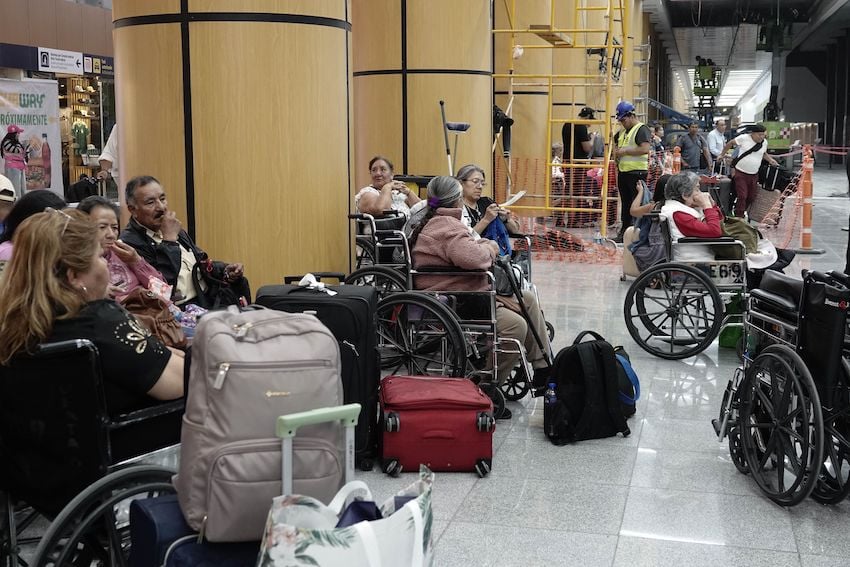
The union issued its statement after holding its National Congress meeting on Tuesday. At that meeting, Sinacta members demonstrated their support for strike action by chanting “huelga, huelga, huelga!” (strike, strike, strike!).
José Alfredo Covarrubias, the secretary general of Sinacta, said that federal authorities — rather than air traffic controllers — posed a threat to the normal operation of airports during the World Cup, a 39-day tournament during which teams, officials and a large number of football fans will be flying into and out of Mexico, precipitating the need for additional flights.
“We lack personnel, there are equipment failures, there are communication failures,” he said on Tuesday.
Covarrubias said that there is currently a shortage of 500 air traffic controllers at Mexican airports.
“The most concerning thing is that due to a lack of personnel, the controllers have to work more hours. And, in addition, the payment for this extra work time is irregular — they take months to pay,” he said.
The newspaper La Jornada reported that air traffic controllers said at Tuesday’s meeting that they have remained on the job for as long as 30 hours.
Ulises Orozco Velázquez, a retired air traffic controller, said that the air traffic control system in Mexico is facing a critical situation that places operational safety at risk.
“While the United States is in the process of incorporating 2,400 [additional air traffic] controllers, in Mexico it’s projected that only between 50 and 60 [new] positions [will be added] in the coming years,” he said.
With reports from El Universal, Reforma and La Jornada
