
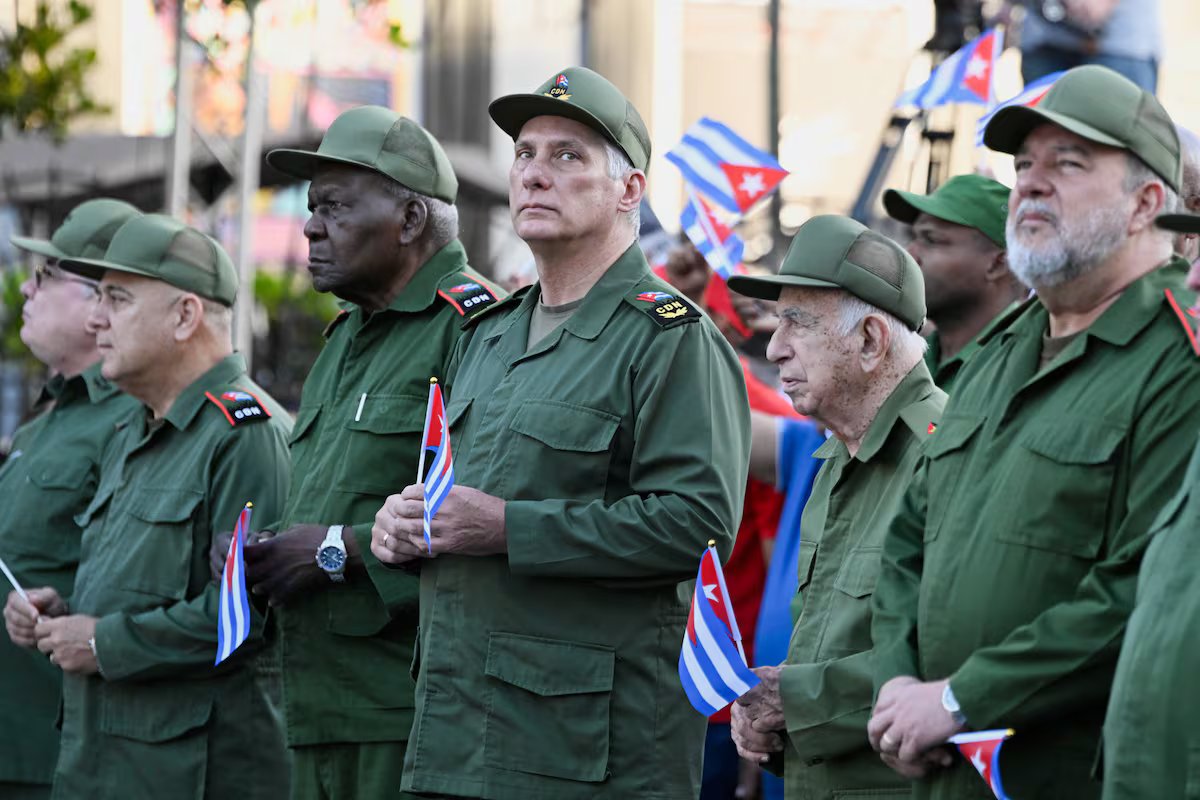
Miguel Díaz-Canel grows emotional, raising his fist before hundreds of left-wing activists from Europe and Latin America gathered at Havana’s convention center, as seen in a video recorded days before a shipment of humanitarian aid arrived, while they chant, “Cuba is not alone.” On May 22, he is seen giving a military salute amid trumpets and Cuban pennants before thousands gathered at the so-called anti-imperialist platform between the U.S. embassy and the Malecón to show support for 94-year-old Raúl Castro, who has just been charged by a U.S. court for ordering the shooting down of two planes belonging to an anti-Castro organization in 1996, an attack that killed four people.
Two months separate the two scenes, and 66-year-old Díaz-Canel has swapped his blazer and T-shirt for an olive-drab, military‑inspired suit he wears as head of the National Defense Council during disasters, solemn events, and emergencies. His rhetoric is less about “creative resistance” and more about “genocide” and “brave resistance to any form of subordination to the empire.” In two months, the country has continued hurtling toward collapse under the fast‑track energy siege imposed by Donald Trump since January 29, which has plunged the population into days‑long blackouts and led to water shortages, halted transport, and forced people to buy food at prices equivalent to a month’s wages.
Added to that reality is uncertainty about the country’s future, as it faces ever‑intensifying and accelerating U.S. pressure, sanctions, and hostilities. No one knows whether any solution will emerge from talks between the two countries, nor whether the threat of a U.S. military intervention will materialize. Meanwhile, public suffering is giving rise to strong indignation.
As president, Díaz-Canel is the institutional face of the system, the visible figure of a dictatorial power that has ruled Cuba for 67 years. Since assuming office in 2018, he has faced the country’s galloping economic decline with scarcely any changes, weathering successive crises and catastrophes — from the Covid-19 health emergency to a plane crash, the largest popular protests in decades in July 2021, several total islandwide blackouts, the cut in Venezuelan oil and a relentless energy blockade from Trump, who had already reimposed the harshest measures of the decades‑long embargo during his first term and has returned in his second with the idea of “taking Cuba.”
But the most complex moment for the regime — an existential threat — comes now. It arrives not only amid economic and humanitarian disaster but also during such profound public discredit and widespread rejection of the government that many people only await its fall, by any means, including the military option. Most Havana residents say they want and need change now.
Within the opaque power structure of the Cuban regime, it is hard to discern how much Díaz-Canel decides, what room for maneuver he has, and what he is responsible for, always operating in Raúl Castro’s shadow. When he was appointed president, Díaz‑Canel — born in Placetas, in Santa Clara province, in the center of the island — raised some expectations of opening and reform, seen as necessary after the rapprochement between Raúl and Barack Obama. It made sense: he is of a different generation — younger, raised and educated in the Revolution — unlike the Castro brothers and their 1950s comrades in arms, and he did not come from the military. Díaz‑Canel’s trajectory within the system gave him responsibilities from a young age in local and later national structures of the communist apparatus, moving through many posts, acronyms and committees in a decades‑long, methodical revolutionary climb. But he quickly dispelled those hopes and chose the political slogan “we are continuity.”
“It’s a fatal phrase; no politician in any country will do well with ‘I’m more of the same,’” says Michael J. Bustamante, professor of Cuban studies at the University of Miami. “He also seemed to want to reassure the historical generation, to tell them he was no Mikhail Gorbachev — the Russian leader who carried out perestroika in the USSR — and that he did not represent a rupture.” As Cuban analyst and former diplomat Carlos Alzugaray notes, that continuity “was his political suicide, because what was asked of him was to implement a series of already approved reforms, and he was unable to do so, leaving them in the hands of bureaucrats who did not want to apply them.”
One of the most important reforms he did undertake, postponed by his predecessor Raúl Castro, was the elimination of the dual currency system between the peso and the convertible peso; it failed due to technical shortcomings and hit the already battered household economy hard.
Questions about how much influence Raúl Castro and his circle still wield grow stronger when one of Washington’s interlocutors in talks between the two countries is the old general’s grandson, Raúl Guillermo Rodríguez Castro, alias “El Cangrejo,” who is little seen publicly and holds no formal office. Although Díaz‑Canel announced that negotiations were underway and that he was participating, it is unclear what role — if any — the president plays.
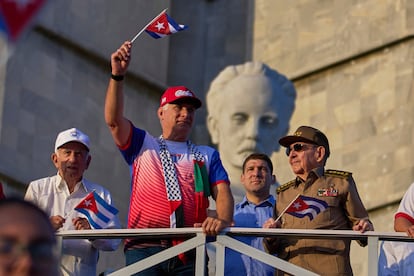
The fact that Washington has now fixed its sights on Raúl Castro, with a criminal indictment, shows how much importance it attaches to him, even if only symbolically. “Díaz‑Canel is not a puppet; he has significant powers, but Raúl Castro has veto power over strategic policies,” explains Cuban political scientist Arturo López‑Levy, who says Díaz‑Canel’s big mistake was “remaining in Raúl’s shadow, because that has limited his projection as a man of change.” And the word change is key in Cuba today.
Díaz‑Canel has deepened his closeness to Raúl; on May 21, the day the nonagenarian was formally charged, he said he views him as “a father”: “For me Raúl has been above all a teacher, a boss who commits himself and whose steps one tries to follow every day.” The closing of ranks with the former president was staged before thousands on May 22, when the indictment opened the door to justify an intervention like the one the United States carried out by taking Nicolás Maduro from his bed and moving him to a New York prison. “Everyone came out to defend him as if to say: ‘I am not Cuba’s Delcy Rodríguez,’ and that’s because while he lives, he continues to have influence,” Bustamante interprets.
Díaz‑Canel is a president who “has been unable to present himself to the country as someone capable of pursuing his own political or economic agenda, although to be fair, his term has not been smooth: natural disasters, a pandemic, the loss of Venezuelan oil even before January,” Bustamante notes. Less so now, when his government faces the colossal challenge of an unpredictable and more aggressive White House than ever, after decades of embargo and antagonism, and a citizenry exhausted and disconnected from the regime, which many see as a group of privileged people enriching themselves at the country’s expense while others suffer.
Díaz‑Canel’s fuzzy leadership coincides with the exhaustion of the idea of the Revolution as an economic and social model, which has been in crisis for decades. The system took 60 years to transfer power to a generation different from that of Fidel and Raúl Castro, López‑Levy notes. Now, with great desire for political change and transformation, “dissent has multiplied, but the system applies the same logic as 40 years ago, as if it still had the majorities of the early decades, that political capital,” explains Fabio Fernández Batista, professor of Cuban history at the University of Havana.
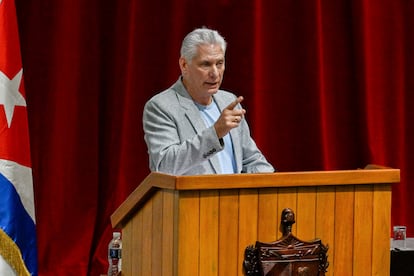
Which Cuba is Díaz‑Canel speaking to when he calls for “creative resistance”? He is speaking to those who have endured years of structural economic crisis, with postponed or incomplete reforms, who see stores where payment is accepted only in dollars — a currency they have little access to. And in the midst of the energy siege, he speaks to those who cannot sleep because of heat and mosquitoes without a fan, to parents who skip dinner so their child has breakfast the next day, to those who must take advantage of brief returns of electricity, even at dawn, to wash and cook before darkness returns, and to those who must cook with charcoal or wood.
Following the indictment, Díaz‑Canel wrote on X: “The new aggression has united us more and elevated honor, dignity and anti‑imperialist feeling.” That rhetoric comes as many on the island embrace the idea of a Trump intervention as the only path to a political transition — even if it jeopardizes sovereignty, a concept Díaz‑Canel frequently invokes. “I don’t eat sovereignty,” says one of the few taxi drivers still able to work in Havana, with gasoline rationed or bought on the black market at $10 a liter. “What do I want it for? Sovereignty is taking care of the people. What sovereignty do we have in a country where they imprison you for thinking differently?” he says angrily.
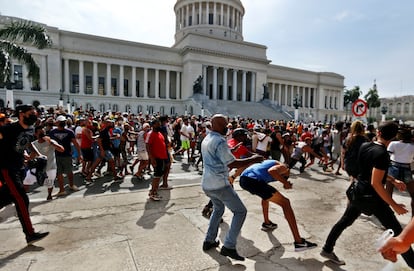
The ripple effects of the July 11, 2021 protests — the largest since the 1990s — reach to this day and have marked Díaz‑Canel’s term. He was the visible face of the repression, which began after the president uttered this phrase: “The order to fight has been given; revolutionaries to the streets.” In the days and weeks that followed more than a thousand political prisoners were jailed. “It’s clear he had to deliver that call, but the decision was not his; it was the power group around Raúl Castro, the military,” says Cuban intellectual Alina Bárbara López, who protests on the 18th of each month for amnesty for political prisoners. “Nevertheless, that marked a before and after, because the image that was damaged was his; his wear as a political figure, which was already significant, grew much greater.” Those “revolutionaries” were “the police and state security forces who came out with sticks and bats and beat people.”
The United States has not clarified what it hopes to achieve with this intense punitive policy toward Cuba. U.S. Secretary of State Marco Rubio last week offered Cubans a “new relationship” and said “the only thing standing in the way of a better future are those who control the country,” implying he seeks not only radical economic change but the regime’s fall. “Are they going to arrest a 94‑year‑old man? Everyone already knows the script; Raúl Castro must be living in a bunker. On the other hand, the Cuban economy needs reforms, money, and time, but it’s not clear what the Americans want — all scenarios are very complicated for the White House,” Bustamante comments.
In the case of the Cuban government, doubt arises as to whether there is a plan beyond resistance, which is increasingly hard to sustain against Trump’s stubborn aggressiveness. The government has made few concessions since negotiations were announced, but time — partly because Washington embarked on a war with Iran — works against it. In the regime’s logic, “there are historical pincers that make a pact with the United States difficult without it being seen as surrender; some in the system are willing to immolate themselves, and in that sense they resemble the Iranian leadership more than the Venezuelan, living under the Revolution’s paradigm,” an analyst explains.
As a ruler, Díaz‑Canel has barely shown a distinct profile, as if he is tasked with managing in rhetoric what remains of the Revolution, in a speech that is becoming increasingly solitary. The plan seems to be to endure whatever comes. “His achievement has been to seek a way out of the Cuban crisis by undermining U.S. coercive measures and simply surviving,” says political scientist López‑Levy, who warns that “anyone who underestimated the regime’s capacity for survival was wrong.” On Friday Díaz‑Canel posted a video on X with epic music and background images from the anti‑imperialist platform event in which he says: “We have come to defend Raúl because Raúl is the homeland, Raúl is Cuba.” In that logic, it is clear what Díaz‑Canel wants to save. The question is where the Cuban people fit in.
Sign up for our weekly newsletter to get more English-language news coverage from EL PAÍS USA Edition
