
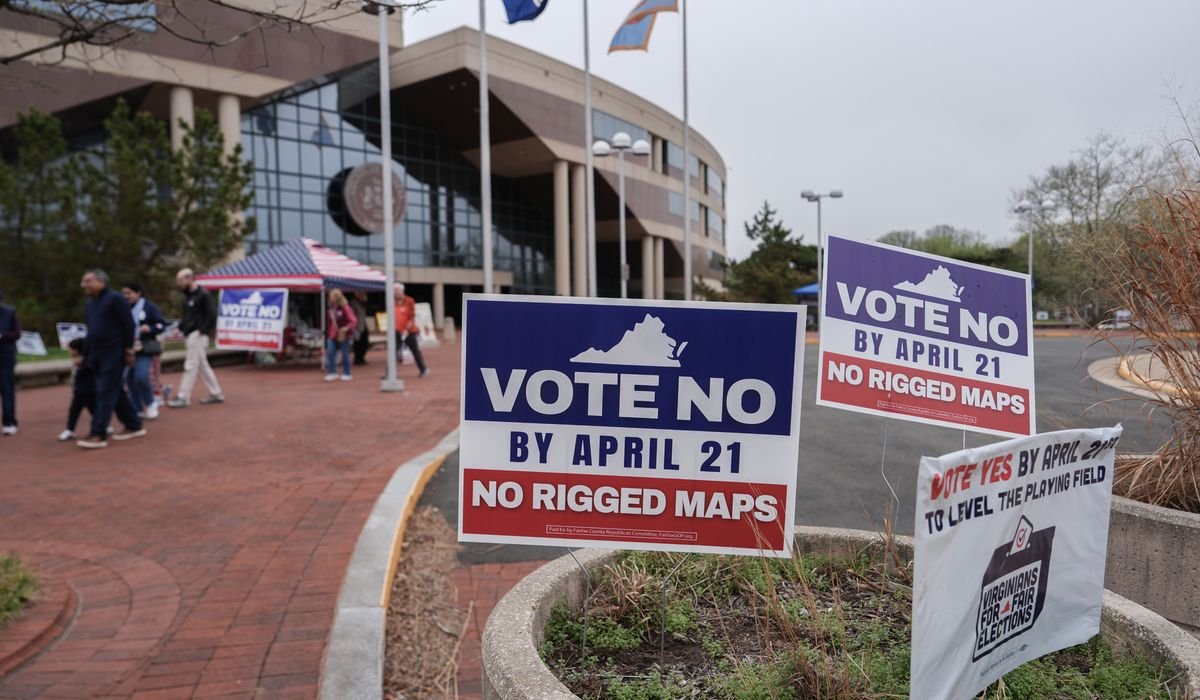
Virginia’s referendum next week marks the beginning of the end of a nationwide battle to use mid-decade redistricting to gain seats in the U.S. House.
The fight is drawing to a close in nearly a dozen states that have gerrymandered, or plan to gerrymander, congressional district lines for partisan advantage ahead of the November elections.
House Speaker Mike Johnson of Louisiana and former Virginia Gov. Glenn Youngkin rallied Republican voters this weekend in deep-red Rockingham County, Virginia. A special election Tuesday will decide whether Democrats can redraw district lines and cut out nearly all the state’s Republican representation in Congress.
“This monstrosity has been created to overwhelm and overcome the voice of the people,” Mr. Youngkin told the crowd, urging them to vote and bring their neighbors to the polls.
Democrats say Texas Republicans triggered the multistate redistricting brawl last year by redrawing their state’s legislative map to give Republicans five more House seats.
Republicans have gained a three-seat net advantage so far in redistricting in California, Missouri, North Carolina, Ohio, Texas and Utah, according to Ballotpedia, which is tallying the redistricting fight.
Redistricting efforts in Georgia, New York and Louisiana remain subject to litigation and court decisions.
The showdown will likely conclude this month with the closely watched referendum in Virginia and legislative action in Florida.
Florida Gov. Ron DeSantis plans to persuade state lawmakers to redraw maps to create up to five additional Republican-leaning districts.
The Democratic-led Maryland General Assembly gaveled out this week after failing to agree on new district maps that would have eliminated the state’s only remaining Republican district.
In Democratic-led Virginia, polls and early voting tallies show voters nearly evenly divided on whether to allow a mid-decade redrawing of congressional district lines.
Early turnout in Virginia has been slightly lower than in the November election that put Democrat Abigail Spanberger in the Governor’s Mansion. Still, more than 65,000 ballots were cast in person Saturday, a surge that marked the highest daily turnout so far.
More than 111,000 ballots have been cast in early voting so far in Democratic-leaning Fairfax County, but Republican-leaning districts have produced higher early turnout overall, according to the Virginia Public Access Project, which is tracking the numbers.
In the five Republican congressional districts, 514,694 ballots had been cast as of Tuesday, compared with 468,617 in Democratic districts.
Final in-person voting takes place Tuesday.
The Virginia General Assembly approved congressional lines aimed at countering Texas’ new Republican-leaning districts.
The new map would likely give Virginia 10 Democratic seats and just one Republican seat in the House.
The map would wipe out four of the five Virginia congressional districts now held by Republicans. It can be enacted only if voters approve a constitutional amendment in the special election.
The state’s mid-decade redistricting battle is an abrupt about-face from the recent creation of the bipartisan Virginia Redistricting Commission. In an overwhelming bipartisan vote in 2019, the General Assembly passed a resolution to amend the Virginia Constitution to allow a commission to draw district lines. State voters approved the change in November 2020.
Previously, the legislature drew the new district maps and approved them through the normal legislative process.
The ballot question seeks to allow the General Assembly to temporarily redraw new congressional districts “to restore fairness in the upcoming elections.” The amendment would return Virginia to the standard redistricting process every decade after the 2030 census.
Strong opposition to President Trump and the Republican congressional agenda is expected to drive voters to the polls in Democratic-leaning districts. Republicans have rallied voters in deep-red areas, warning that the new lines would leave them without representation in Congress.
Democrats see a chance to erase the Republicans’ two-vote margin in the House and reclaim the gavel, giving them the power to put the brakes on the Trump agenda and open various investigations into his administration.
“We have one of the smallest margins in U.S. history,” Mr. Johnson told voters in Bridgewater, Virginia. “The eyes of America are on you. You have the power to say no to this.”
Mr. Johnson’s Democratic counterpart, House Minority Leader Hakeem Jeffries of New York, stumped in Democratic-heavy Richmond over the weekend. He said a vote to approve redistricting “will help us stop the MAGA power grab so we can end this national nightmare.”
Florida may have the final say in the Republicans’ bid to get the upper hand in the redistricting fight.
Mr. DeSantis is expected to reconvene the state Legislature this month to coerce lawmakers to redraw district lines in Republicans’ favor for the second time in four years.
On Tuesday, Mr. DeSantis said he may postpone the session, scheduled for Monday.
State lawmakers have yet to come up with a new congressional map. Currently, 20 seats are held by Republicans and eight are held by Democrats.
Waiting to convene a special session until after Virginia’s special election would give Mr. DeSantis an idea of how many seats to redraw in favor of Republicans, but he denied that Virginia had anything to do with the delay.
Florida law prohibits partisan gerrymandering.
“I saw some reports that somehow Virginia’s doing something,” Mr. DeSantis said when asked whether the session was delayed to wait for the special election results. “I have no idea where that came from.”
