
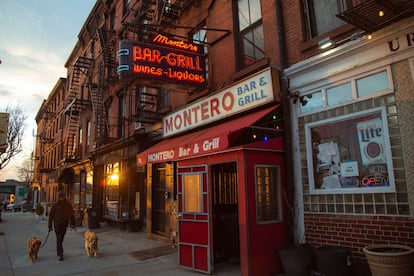
Years ago, you could sense the Galician influence on the Brooklyn waterfront. Dockworkers looked forward to the end of their shift so they could warm their bones with whisky, good company, and a caldo gallego. To get there, one had to turn one’s back on the bay and the Manhattan skyline, walk up Atlantic Avenue following the crews who had just disembarked, and let oneself be guided by a succession of neon signs in the red-light district that was then the Spanish corner of Brooklyn Heights. It was there that Spanish migrants served those who labored on the docks, plus sailors, the ones who had docked for a few days and the ones who were aground indefinitely. A dozen bars, many with Spanish names, flanked the street as though it were the entryway to an entirely different continent. The neighborhood lived and died within unmapped borders in the great city, permanently mired in a sensation halfway between rootlessness and homesickness. But the death blow came when the docks closed in the 1970s. The sailors left, the rents started going up, and the “gallegos” left seeking new ports, some returning to their native shores in northwestern Spain, others going further inland, others six feet under. Just two bars, the Long Island and the Montero — owned by two siblings who spent 50 years on opposite sides of the same street without speaking to each other — withstood the test of time and money thanks to their family motto of “buy, don’t rent.” The notion of securing a place where they could die in peace was deeply ingrained in the immigrant subconscious. The Long Island was sold years ago. The Montero will soon mark nine decades on its side of the port, but even Atlantic Avenue’s last Galician remnant has just changed hands.
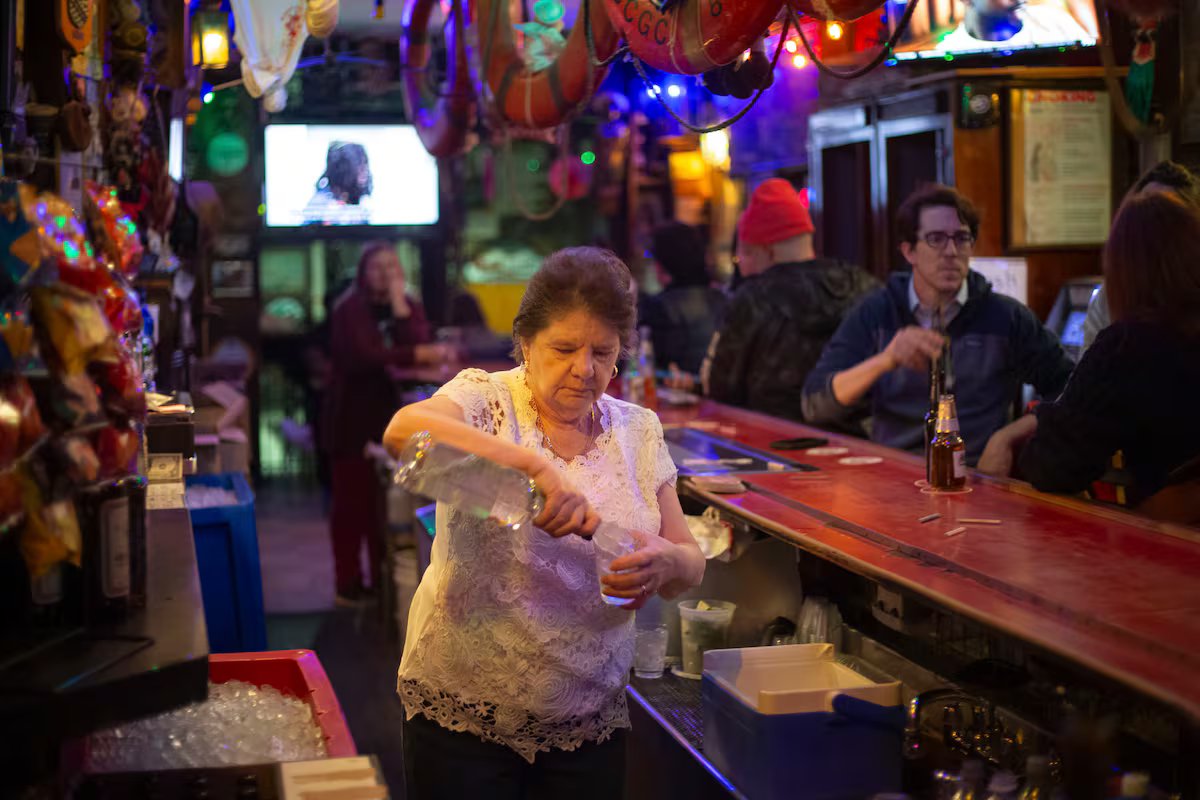
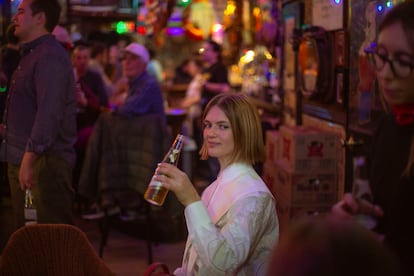
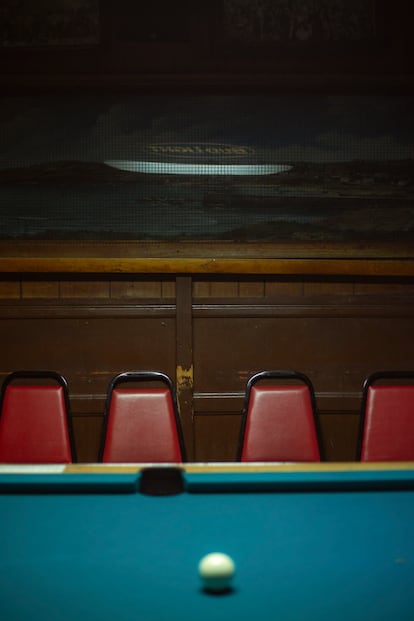
You’re pulled in by the red neon. You walk through a doorway in a glass-bricked wall and step into a picture-perfect scene of what Brooklyn once was. It’s narrow, deep and dark. The walls are made of wood, but not a single inch of them has been left bare, with orange life preservers hung from the ceiling and portraits on the walls of sailors whose names have been forgotten, long-gone regulars, and members of the Montero family. There are rudders, hatches, knots, oars, model ships that sailors built on the high seas to stave off boredom. On the left is the bar, a red Formica atop glass bricks affair. On the right, two phone booths that were already old half a century ago. There’s a pool table. At around 6 p.m. on a recent Friday, five people are having a drink; in a few hours, the dive will be packed thanks to karaoke — which breathes new life into it Thursday through Sunday. Usually, Pepe sits on his stool at the back of the bar.
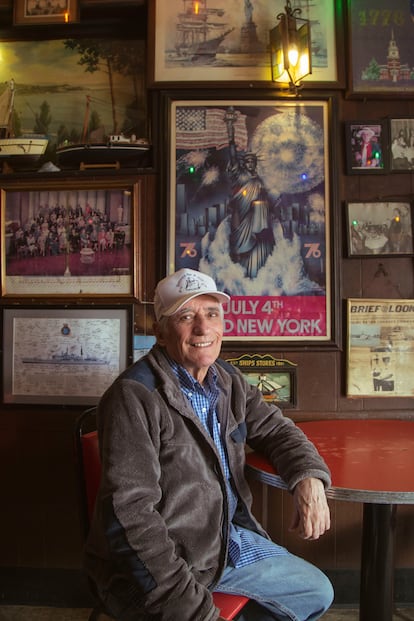
Atlantic Avenue’s last Galician sports white hair, a Montero baseball hat, a button-down shirt and blue jeans, nothing too unusual. He speaks Spanish with a Brooklyn accent. He emphasizes his sentences with yeah’s, allright’s and you know’s. He is about to turn 80 years old. The thought invokes a half-smile that shows his teeth and suggests more than he’s telling. His father Joseph Montero came from Meirás. His mother Pilar was born in Manhattan’s Little Spain neighborhood back when 30,000 Spaniards lived in New York City. The Monteros opened a bar at 56 Atlantic Avenue in 1939. But construction of the Brooklyn-Queens Expressway, the highway that connects the island to the continent, felled its first location and turned that corner of the neighborhood into a series of phantom street signs. After the demolition, Joseph Montero took on debt twice without going through a bank, bought a building at 73 Atlantic Avenue on the opposite side of the street, and built another tavern.
Pepe was born on the top floor of Montero’s new building in 1947, the year the bar crossed the street. He was brought into the world by two British sisters “who were almost like a hospital.” In school, they thought he was “how do you say it? Bobo (dumb),” until they discovered that he was just Spanish. He grew up within the limits of that world between two bodies of water, surrounded by accents that were just passing through, framed Galician landscapes and memories inherited from an unknown homeland. Joseph and Pilar tended the bar starting at eight in the morning, when the dockworkers’ night shift ended, until four in the morning, when the last sailors were on the verge of collapse. Pepe played in the street with other Galician boys. He didn’t learn the language of his birth country until he was six years old and started school, at which point he glimpsed a world beyond Atlantic Avenue.
He says those were simpler times. Perhaps they were. The docks were the natural habitat of people who had their own notion of honor and morality. Port nights were full of violence, drugs and sex for money. And after World War II, there was hunger too.
“Many women had to raise their kids alone. Many of those buildings that are now worth $8, $10, $15 million dollars, at that time were part of the red-light district. Everyone helped as much as they could because everyone had to survive. And they got together here, at the bar, to talk about their worries and their problems,” Pepe says.
Pepe first went to Galicia when he was 10 years old. But he seldom returned. His father traveled there faithfully for a few months a year. He crossed the Atlantic on El Guadalupe or El Covadonga, the ships that traveled the New York-A Coruña route, weighed down with presents for friends. He bought sardines from the fishermen who went out to sea from Sada de Arriba and fixed up the family home. Pepe started working at the bar during vacations from school when he turned 13 years old. One morning in the ‘70s, he came into the kitchen and saw a man taking his clothes off. Joseph explained to him that it wasn’t a man, but rather, the famous British model Twiggy, the androgynous face of Swinging London, who was posing alongside Montero’s kitsch décor. Pepe still has a photograph from that long-ago session tucked away on the bar’s walls.
The first member of the family to come to the United States was his grandfather Ramón, a native of Meirás who wanted to get away from the military presence in Spain, putting the Atlantic between him and it at some point in the 1920s. Ramón Montero worked half his life for Con Edison, the company that brought electricity to New York — a lucrative gig in the city that never sleeps. Ramón knew how to squeeze the juice from the new world, investing in the company’s stocks when they were worth nothing and retiring with a good pension plus dividends. In the middle of the century, he built the Long Island a block from Montero. Like many Galicians from his generation, in his old age he heard the call of the homeland. He sold the Long Island to his daughter Emma. The dollar was gaining value against the weak peseta when Ramón returned to Galicia in his old age. He had the orgullo de los indianos, as the traditional pride of the returnees from America to Spain in those days was called. Also, a Pontiac he had shipped from New York, in which he’d cruise down Calle Real in A Coruña.
Joseph came to the United States in his early years. As a young man, he signed on and spent years aboard Danish merchant ships. When he finally dropped anchor, he didn’t stray far from the docks. He signed on again during the war to deliver supplies to ships fighting in Europe. Pilar had been a flamenco dancer. In the pool room — which for years served as the bar’s dining room — a poster from a festival still hangs on the wall, announcing the sensational performance of Pilar Montero, a party that lasted until dawn with dances like fandangos, sevillanas, rumbas, seguidillas and tarantas.
Before opening the bar, Joseph and Pilar ran a grocery store, which they eventually sold to Emma. The highway was built soon after, and put it out of business. That was the start of a feud that would become deeply entrenched. The two branches of the Montero family grew old, each on their own side of the street, serving the same customers, listening to the same stories, and harboring different perspectives of the same grudge.
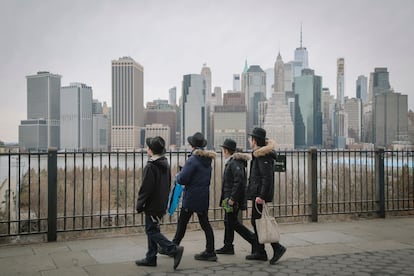
Between 1955 and 1970, the winds changed. Mechanization of their labor left the dockworkers obsolete. New York lost its patience with the wars over control of the port and its unions between the Italian and Irish mafias. The port moved to New Jersey and the sailors went with it. Some still crossed the bay out of loyalty to the Monteros. Then Manhattan’s money made the leap over the East River and cleaned up the red-light district. Today, the docks are parks.
Pepe’s generation graduated, swapped out their parents’ businesses for offices and restaurants; Brooklyn Heights for family-friendly suburbs. They visited Montero every once in a while, like their parents had visited Galicia every once in a while, until their time ran out. “I would be the youngest, and I’m about to be in my 80s,” Pepe says. He stayed between the two bodies of water, as he always had. He taught in public schools for 40 years, but never let go of the Montero. Like him, the bar was stuck between two eras.
One day, the Spanish-born writer Eduardo Lago docked on Montero’s shores. In 1988, Federico and Achero Mañas, two brothers who wanted to make movies, rented him a studio in the 19th century brownstone they shared with their mother on the Brooklyn Heights Promenade, on a hill overlooking the East River, lower Manhattan and the cranes of the Ports of Jersey. Eduardo liked to watch how the light changed as the afternoon sun reflected off the glass facades of Wall Street skyscrapers. Then, he’d end up at the corner bar, a place that helped ease his nostalgia for Spain, run by an old Galician sailor who seemed to have come straight out of a book.
At the time, a new generation of Spaniards were arriving, exiles like playwright Fermín Cabal, writer Javier Puebla, Ceesepe and El Hortelano and the actress Ana Torrent. Some would stay until dawn with Lago and the Mañas brothers at Montero. Lago hung out at the bar with the other regulars and with Joseph, a man who would take up with any lost cause who walked through the door. There was also a guy with dwarfism as tall as the bar who drank miniature Budweisers (“scaled to his size, but he’d make you think your perspective was off, that you were the giant,” Lago recalls). There was also a “gay Cuban with a glass eye” and a man who drank and wrote alone, at the far end of the bar.
Joseph made Lago his confidant, telling him stories from his earlier days. “He reminded me a lot of the Cervantes character from Rinconete and Cortadillo, trapped in a hazy milieu with underworld elements, but quite honorable,” says Lago. One night in 1988, Lago came home from Montero and began to write. He didn’t stop for 20 years. The slow burn of two decades fused those early mornings at Montero into stories in his head, and resulted in his first novel. Its protagonist is a tormented journalist who drinks and writes alone in a Brooklyn port tavern owned by a Galician and frequented by Dutch sailors, a young writer, a man with dwarfism and a gay Cuban with a glass eye. He called it Call Me Brooklyn.
At the end of the century, Joseph said goodbye to his family. “He said, ‘I want to go back to Galicia and see the last of my friends who are still alive,” remembers Pepe. The family home in Meirás was around the corner from a small church where the family of the late dictator Francisco Franco went to Sunday mass when they summered at their pazo, a traditional residence often inhabited by nobility. As a young man, one day Joseph had approached the priest, Don Antonio, and negotiated a berth in the cemetery. “And when he died in Spain, we all went over there and he was buried in Meirás, in the mausoleum he had waiting for him.” That was the last time Pepe set foot in Galicia. He would like to return.
But, to live there?
“Just for vacations. Not to live, I’m staying here. All my friends are here, and my children.” When they ask him where he is from, what does he say? New York or Galicia?
“Galicia,” he answers.
Pilar outlived her husband by more than a decade, becoming a fixture on her stool at the bar’s entrance. There, she would welcome her old Galician friends, doze off, or spend the afternoon drinking with Frank McCourt, another writer who moved into the apartment above the bar, won the Pulitzer Prize, and would later recall in his memoirs the red flicker of its neon sign against his bedroom window. “Every day he’d sit in the corner with my mother, and the two of them would get drunk,” says Pepe. Pilar died in 2012, having become one of those figures with street cred that New York delights in calling its own. The New York Times ran her obituary.
After Joseph’s death, Lago stopped passing by Montero so much. “It took me years to realize what had happened there,” he says. He moved to Manhattan, won Spain’s Nadal literary award, and ran New York’s Instituto Cervantes for a few years. In March, he returned to the bar after a long time without having done so. He walked around looking at its walls, nearly recognizing them by touch, rediscovering in its photos faces of his Call Me Brooklyn characters he hadn’t seen in years. He didn’t stay long. Then he walked to the house where he’d lived with the Mañas brothers, and returned to Manhattan via the promenade, watching how the light changed in the afternoon.
Pepe inherited the building his parents had bought for a few thousand dollars, and sold it for millions. Its new owners, two siblings who own several nautical-themed restaurants, had been after the Montero for years. They’ve promised to keep it exactly as it is, without disturbing a speck of dust. They even plan to reopen the kitchen. Pepe wants to retire: the long-awaited return to Galicia. It’s hard to imagine the bar without him. The siblings want him to help them, to ensure that the last witness to a time when Brooklyn Heights spoke Spanish with a Galician accent and Atlantic Avenue was the gateway to New York stays within these walls, as in a cramped ship’s cabin. Perhaps he will.
Sign up for our weekly newsletter to get more English-language news coverage from EL PAÍS USA Edition
