
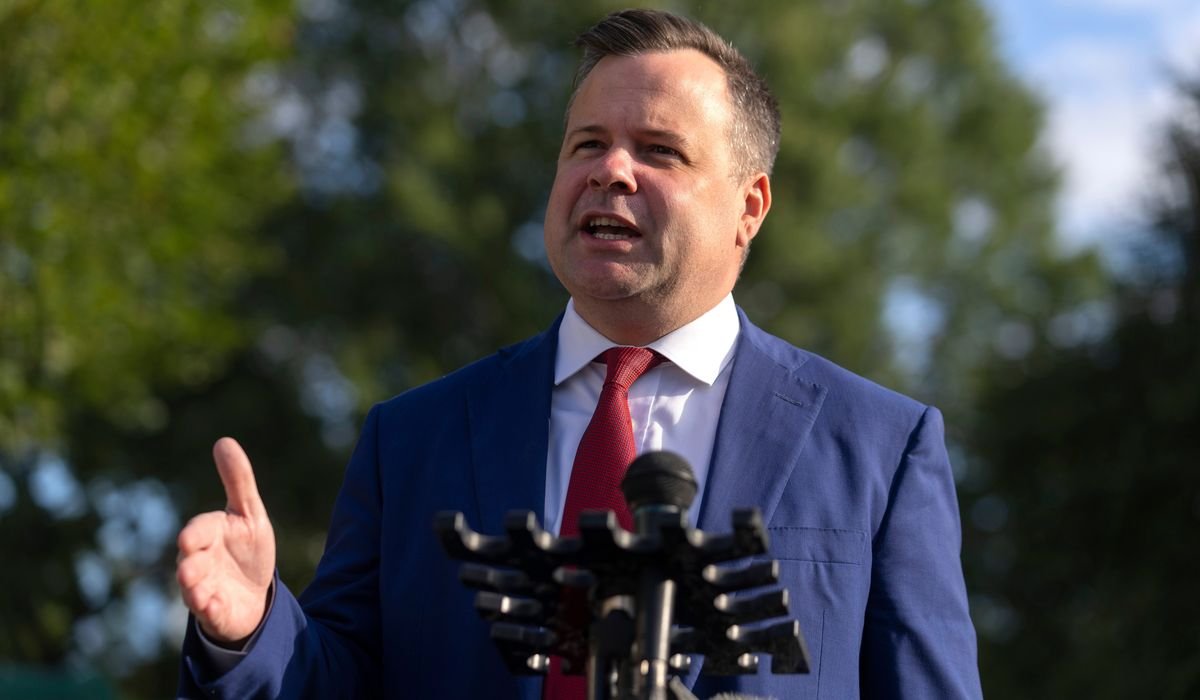
President Trump has directed William J. Pulte, his temporary choice to replace Tulsi Gabbard as Director of National Intelligence, to significantly downsize the office and eliminate those he sees as political enemies, sparking bipartisan outrage and dredging up criticism that has plagued the position.
Security experts and lawmakers argue the office is bureaucratically bloated, ineffective and vulnerable to politicization. Mr. Trump’s political allies have come out in support of his desire to radically reshape the agency.
“President Trump is right: the ODNI has grown far beyond its original mandate. I’ve long advocated for downsizing, if not outright eliminating, this bureaucracy,” Sen. Tom Cotton, Arkansas Republican and chair of the Senate Intelligence Committee, wrote earlier this month. “Time to return these officers back to their home agencies to focus on actual intelligence work.”
Discussion about the office’s effectiveness comes as its future is in flux.
Mr. Trump abruptly canceled the confirmation hearing for Jay Clayton, his permanent pick to replace Ms. Gabbard as DNI, last week, demanding that James McDonald first be confirmed as U.S. Attorney for the Southern District of New York and that Congress pass the SAVE America Act, an election-integrity measure.
The White House has not yet sent Mr. McDonald’s nomination to the Senate, and the SAVE Act still lacks the votes to pass. Those obstacles all but ensure that Mr. Pulte, who has no intelligence experience, will remain acting DNI for at least the next few months.
Lawmakers are increasingly concerned that Mr. Pulte will use the office to purge the intelligence community of Mr. Trump’s perceived political opponents. Mr. Trump has said he hopes Mr. Pulte will move to declassify documents related to the 2020 presidential election, potentially bolstering his claims that he won.
Established in 2004 to reduce bureaucracy by coordinating the intelligence community’s activities, the ODNI has instead become its own bureaucratic beast over the past two decades, according to critics.
Before Ms. Gabbard took over, the ODNI operated five national centers intended to assist existing agencies in coordinating over serious national security issues such as counterterrorism, biosecurity, foreign interference and cyber threats.
During her brief tenure as director, Ms. Gabbard eliminated the National Counterproliferation and Biosecurity Center, the Foreign Malign Influence Center and the Cyber Threat Intelligence Integration Center.
The centers often had similar, if not identical, missions to those agencies they oversaw, leading to turf wars, redundancies and competing budget claims.
“I think there’s a significant amount of bureaucracy and there needs to be attention paid to the role ODNI plays. It was created to make things run more smoothly, but some efficiencies can still be had,” said Sen. Jerry Moran, Kansas Republican and member of the Senate Intelligence Committee.
The Intelligence Reform and Terrorism Prevention Act, which established the ODNI, does not give the director much power, either — another prominent criticism of the office.
The ODNI holds only partial budgetary authority over the intelligence community, and prominent organizations such as the Defense Intelligence Agency, the National Security Agency, the National Geospatial-Intelligence Agency and the National Reconnaissance Office remain well within the Pentagon’s sphere of influence.
Critics also have long argued that the structure of the ODNI makes it particularly vulnerable to political capture by the president. Because the director controls the president’s daily intelligence briefings, critics on both sides of the aisle contend that whoever holds the office can pressure analysts to reach conclusions that serve the White House’s interests rather than the facts.
For Democrats, the Trump administration’s reaction to an April 2025 National Intelligence Council assessment — which undercut the White House’s legal reasoning by concluding that the Venezuelan government was not coordinating the operations of the Tren de Aragua criminal gang — was a prime example of how the office can be politicized.
Ms. Gabbard eventually fired Michael Collins, the acting chair of the NIC, and Maria Langan-Riekhof, the council’s vice chair. The ODNI described the two officials as holdovers from the Biden administration who had been removed for politicizing intelligence.
Conservatives, meanwhile, say the January 2017 Intelligence Community Assessment on Russian election interference was an attempt by liberals to delegitimize Mr. Trump’s 2016 election victory. Critics point to a compressed timeline and the use of the controversial Steele Dossier as evidence that the Obama White House and senior intelligence officials worked to undermine an incoming president.
Sen. Ron Wyden, Oregon Democrat and Senate Intelligence Committee member, has advocated for legislative changes to the ODNI to ensure the office cannot be used for political purposes.
“I’ve never seen anything like it. I’m the longest-serving member on the committee and I’ve never seen anything like it,” he told The Washington Times. “What’s going to give you the predictability and certainty to really do this right? That’s why I think black-letter reform is really the key.”
