
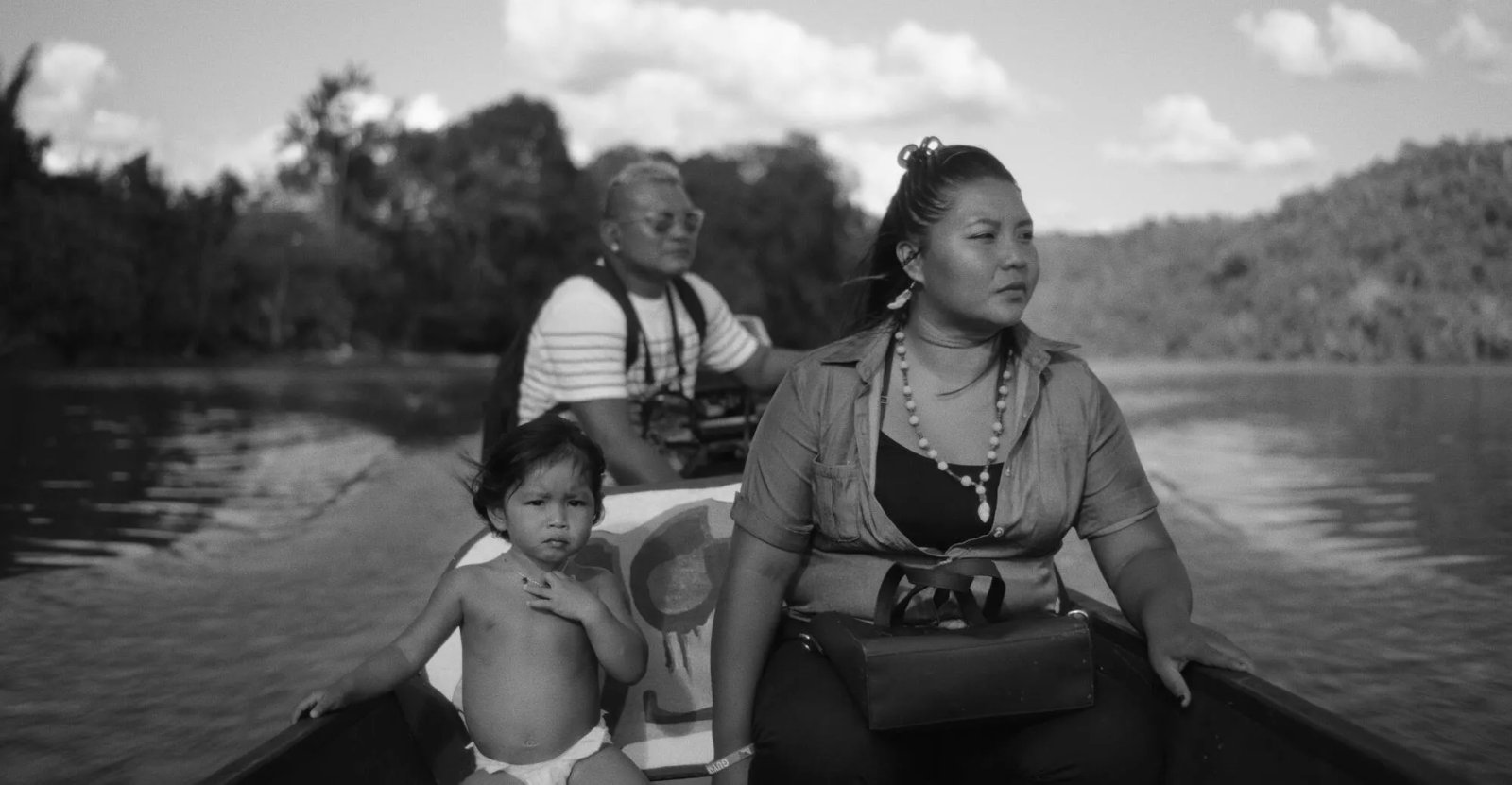
Parasisi brings us to Kawemhakan. The village, formerly also known as Anapaikë, sits on the border with French Guiana, on the side of Suriname. The country that faces Brazil on the south side and the Atlantic Ocean from its northern fringes is not widely known, as if it kept a precious secret (one might think). But it has been subjected to colonial abuse for over 300 years. It’s been just 50 years since the completion of independence from the Dutch, with the latter only recently initiating reparation (which probably will remain limited to an apology stated by the kin)
The natural environment, defined by the rainforest and the Lawa River, is in constant disruption. The gold discovered in the banks of the river (that figures!) renders the area primarily of monetised value and its inhabitants, of the Wayana tribe, recipients of subjugation. Periods may change, from the Baroque to the Enlightenment to post-modernity, but the colonial mechanisms remain the same. War has many faces, and like seasons, it repeats itself in rotation.
For the Wayana people, life is complicated with poisonous emissions of mercury caused by gold mining. Illegally or otherwise, these extractive activities have stressed the biotope and its natural dwellers to an irreversible state. The observational camera of Dutch-Belgian duo Zaïde Bil and Sébastien Segers is infiltrating this state. With alternating shots between doctors’ visits and gospel gatherings, eventually the image of erosion is depicted.
Chapter by chapter, the story is forged by the evident import movements of Western influence and the modernised world. The forces of baptismal missionaries are not less present, although they’re given a whimsical (if not contemptible) dimension—a consequence of juxtapositional sequences. The image of the American finding Jesus in the rainforests is no less absurd than a child seated on a pile of goods, boxed, wrapped, and sent in good faith from the West.
Inclined to tranquil considerations, with the static to the landscape camera and the black-and-white finish (I guess a choice tribute to the light and a soft nod to the race), the commentary becomes sharper on moments when conversations are happening, in French or in English, with the participation of an intermediary. The directors allow us to see the differences in points made in what is translated and what is altered or omitted, giving an abrasive and spirited, albeit mild, agency to the population. Perhaps this is too subtly incorporated to articulate any aspect of the indigenous people and their foreignness. But it does bring forward the other perspective, one that sees the conflict and might as well not actively participate. As confusing as this may sound, there are values beyond the ones produced within the systems of Western culture, and they are not necessarily visible.
The conflict here is indeed one-sided, as the indigenous population, besides their obedient behaviours, seems neither sceptical nor vexed in the face of the intrusive. In fact, they are selective in the foreign words they would learn and the foreign advice they would take, as much as they are in adopting technological mannerisms. Besides the frequent interruptions by baptism ceremonies, they will enjoy the waters and their union with this land. This is indelibly felt in passing shots as much as in the gestural and palpable teaching of the makers.
Parasisi is ultimately an act of listening—a simple teaching, which is missing, it seems, so far—and it is invaluable for their national leaders and their efforts of decolonisation.
★★★★ 1/2
World premiere at Hot Docs 2026 in the International Spectrum Competition section / Dir: Zaïde Bil, Sébastien Segers / Cinematography: Angela Otten / Editor: Dieter Diependaele / Production Company: Dokma Film / Belgium
Discover more from
Subscribe to get the latest posts sent to your email.
