
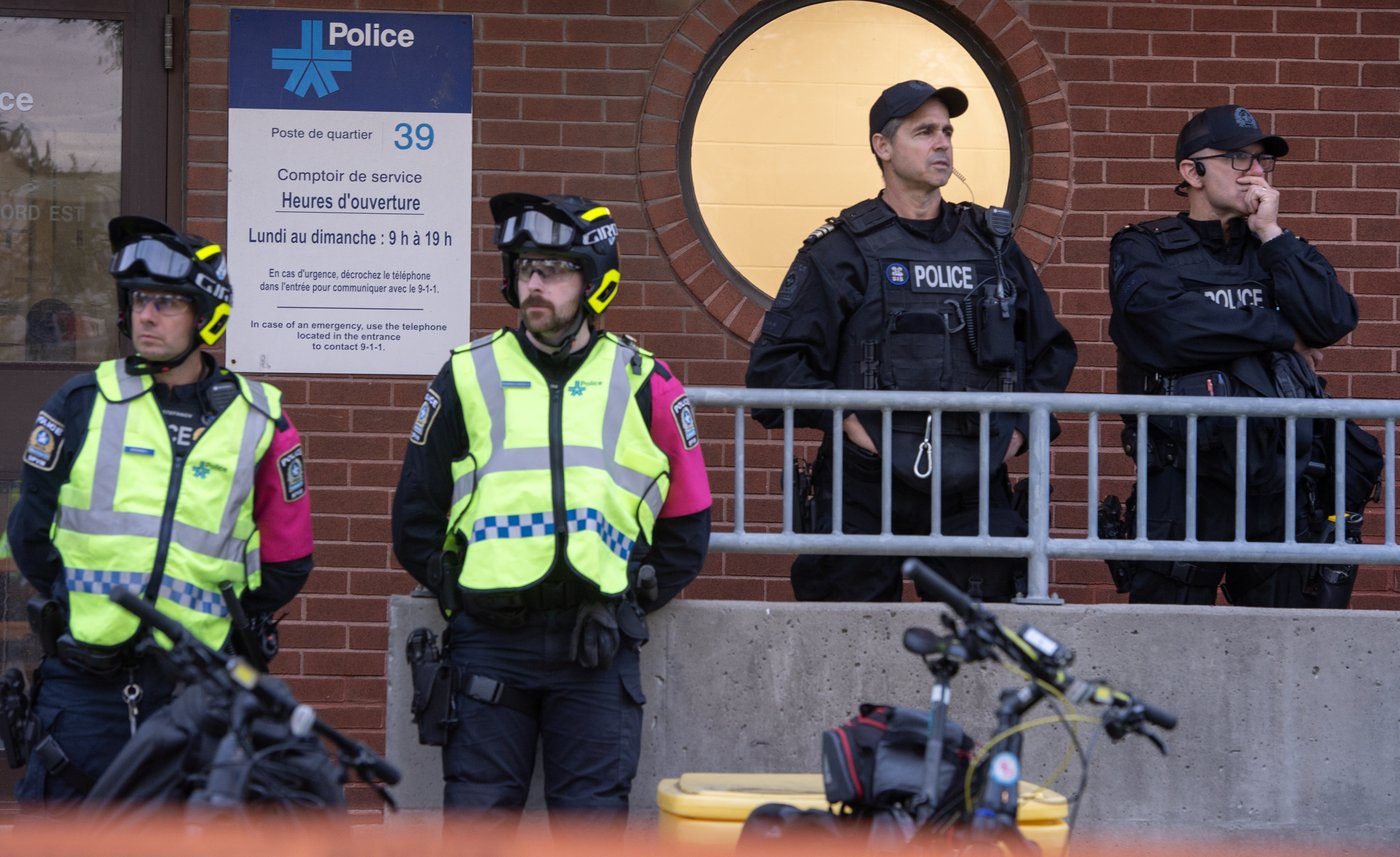
MONTREAL — Police in some of Quebec’s largest metropolitan regions have handed out thousands of fines over the past six years to citizens for allegedly hurling insults at officers or other municipal officials, according to internal data obtained by The Canadian Press.
Quebec City police have largely driven these numbers, issuing 11,092 fines between April 1, 2020, and March 31, 2026, to people who allegedly violated a municipal bylaw that prohibits disrespectful language directed at officers and other public officials.
Quebec City released the numbers in response to a formal access to information request.
Meantime, a spokesperson for the police force in the municipality of Laval, directly north of Montreal, says its officers issued 4,502 fines to people who violated a bylaw that prohibits abusive behaviour towards municipal employees between January 2021 and April 2026.
Police in Sherbrooke, in the Eastern Townships region, say they issued 855 fines in 2025 under a bylaw prohibiting insulting and obstructing police officers.
The five municipalities in the Longueuil area, all served by Longueuil police, have a similar regulation prohibiting insults toward municipal officials, including police. Longueuil police say they handed out 53 fines for this offence in 2025 and 49 to date in 2026.
The release of data showing the staggering number of fines for foul language coincides with a series of high-profile cases about police misconduct in Quebec, including in Montreal, where investigators recently dismantled a patrol unit in a multicultural neighbourhood over allegations of racism and what local police described as reprehensible behaviour by officers.
In Montreal, municipal officials have been studying the possibility of their own version of a bylaw that would allow for fines for foul language.
While the local brotherhood representing officers in Montreal has argued its members need this to deal with abuse from members of the public during routine interactions, civil rights activists say now is not the time to hand new powers to police.
“The good cops may never use that bylaw, never,” says retired RCMP officer Alain Babineau. “The bad ones, they’ll use it all the time. It’ll pile on.”
Babineau is now an advocate with the Red Coalition, an organization dedicated to fighting racial profiling and systemic discrimination across Canada. He also served on Montreal’s anti-racism task force in 2021 and 2022.
He said the push to ban insults against Montreal police is “frivolous” and “moot” in light of the recent allegations against police about racism and criminal behaviour in the multicultural neighbourhood of Montréal-Nord.
It’s not the only recent case of alleged police misconduct.
The Quebec government recently ordered an investigation into the actions of the police force in Longueuil after an officer shot a 15-year-old boy last September.
Babineau warned that tensions between citizens and police could escalate if the city decides to give officers more powers.
Quebec City reported collecting nearly $1.7 million over six years from people fined under its bylaw. It states “it is prohibited to abuse or insult a law enforcement officer or a municipal official in the course of their duties, or to make hurtful, defamatory, blasphemous or obscene remarks to them, or to encourage or incite another person to abuse them or make such remarks to them.”
Jean-Pascal Lavoie, a spokesperson for the Quebec City administration, says the bylaw “aims to ensure that interactions between city employees and citizens are conducted in a civil manner, whatever the circumstances.”
The debate around banning insults against police in Montreal was first sparked in March after videos of a man insulting a police officer with a barrage of misogynistic comments went viral. The man, who is of North African descent, later alleged he was a victim of racial profiling and has often been stopped by police. On the day the video was taken, he had been fined $186 for having tinted windows, police said.
The Montreal police force condemned the man’s actions, while the brotherhood said that “respect is a value shared by Montrealers of all backgrounds” and that “diversity cannot be used as an excuse for inaction.”
Montreal Mayor Soraya Martinez Ferrada has said she is still open to implementing a rule like the bylaw in Quebec City, but her office dismissed suggestions from civil rights activists that granting new powers to police could exacerbate tensions or instances of police misconduct.
“I’m simply saying that we shouldn’t mix up the two files in a casual manner,” said the mayor’s spokesperson. “The context of each situation is important, and we should avoid trivializing them by comparing them or setting them against one another.”
The Montreal mayor has stressed that any bylaw that prohibits citizens from insulting officers must be drafted carefully to protect both police and citizens, and ensure it will not be contested in court.
Advocates say police already have powers to call for backup during an intervention and charge people with uttering threats, resisting arrests or obstruction of justice, they say.
“It’s not a crime to insult anyone. We have the right to insult police,” says Ted Rutland, a professor of geography at Concordia University who researches policing in Canada. “The people most likely to face the charges will be the people more likely to face police abuses and repression in general.”
Mike Diomande and Jacky-Éric Salvant, lawyers who led a successful class-action lawsuit alleging systemic racism amid Montreal’s police force, say they are concerned that, were the city to adopt such a rule, it could encroach on Charter rights like freedom of expression, dignity and privacy.
“The statistics are quite alarming and worrying. They justify the legitimate concerns that people may have about such regulations, which we regard as an infringement of individual rights,” says Diomande.
The Quebec Superior Court ruled in 2024 that Montreal police violated the Charter rights of those they unfairly stopped, arrested, detained and profiled between mid-August 2017 and January 2019. The City of Montreal appealed that decision and legal proceedings are ongoing.
This report by The Canadian Press was first published June 17, 2026.
Erika Morris, The Canadian Press
