
At The Birds & The Beets in Vancouver, Matthew Senecal-Junkeer’s cafe-restaurant transitions from sandwiches and coffee in the day to wine and small plates at night. And recently, he’s noticed his customers’ price sensitivity changes from day to night, too.
During cafe hours, every choice customers make — oat milk versus regular dairy, whether or not to add avocado to a sandwich — is driven by its price tag.
“What we’ve seen is a shift down the price scale,” said Senecal-Junkeer. “Our cheaper menu items sales have gone up really almost exponentially and [with] our pricier items on the menu, we’ve seen sort of a dip.”
At night, that’s less of an issue. While some customers at the wine bar might go for a smaller bottle or opt not to add caviar to an appetizer, Senecal-Junkeer says there seems to be less hesitation around those big-ticket menu items.
“Its a luxury experience and [customers] sort of don’t want to be nickel and diming,” Senecal-Junkeer said.
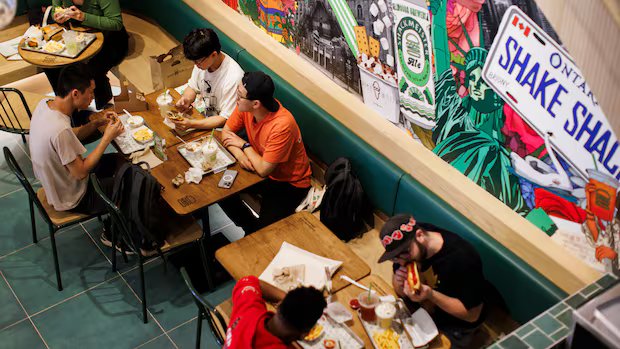
While restaurants of all kinds are feeling pinched, quick service restaurants are getting hit harder than higher-end ones, according to a report from Restaurants Canada. It’s a signal of a K-shaped economy, where those with the most money can still shell out for a nice meal, but those with lower incomes have no option but to cut back, according to Restaurants Canada president and CEO Kelly Higginson.
“It shows that low-income households in particular are being more impacted by the current instability and the impacts in the economy and are pulling back a bit more on discretionary spending as they are the hardest hit within the economy right now,” said Higginson.
Rising costs impacting restaurants, consumers
The report from Restaurants Canada out this week surveyed 300 of its members in March. Real sales among full service restaurants grew by 4.6 per cent in January of this year compared to the same time a year prior, while sales for quick service restaurants declined by two per cent.
What’s more, the report notes that fine dining restaurants saw the largest growth in traffic in 2025.
“What we are seeing is … stronger sales, stronger profitability, a bit healthier industry within that true fine dining level,” which accounts for about one per cent of the restaurant industry in Canada, according to Higginson.
Still, that doesn’t mean full service is doing just fine. Nearly half — 49 per cent — of all restaurants were reporting lower total sales, while 54 per cent were seeing fewer guests come in. Meanwhile, 81 per cent of quick service restaurant respondents also reported declining profitability, whereas 70 per cent of full service restaurants said the same.
Higginson says the rising cost of fuel will likely continue to have a big impact on costs for restaurants and consumer habits, so quick service might be more of a canary in the coal mine for the restaurant sector more broadly.
“None of these things are going to be staying away from impacting the full service operator,” Higginson said.

A new report from Restaurants Canada suggests the industry is under major financial pressures. Half of restaurants are reporting lower sales and fewer guests in 2026 — and more than two-thirds say their profitability is in decline.
Quick service faces more competition
Mike von Massow, a food economist at the University of Guelph, says he’s not surprised quick service is taking a bigger hit.
He points out that some large chains have already been trying to use value meals to lure more sales as some consumers pull back. In January, McDonald’s in Canada froze the price of a small cup of coffee at $1 and shaved a buck or so off of their value menu items in order to help their customers amid financial challenges, while Burger King has pushed two-for-$5 and three-for-$7 special offers.
Von Massow says it makes sense that quick service restaurants might be where Canadians start cutting back. Lower income Canadians tend to visit quick service restaurants more frequently than the average, he said, so if they started to pull back due to cost of living pressures it would likely show up in the quick service sector.
“If they’re getting squeezed by higher prices, not only in food, but elsewhere … they have less room to play. And so they are much more likely to make the choice not to go out,” von Massow said.
A hit to quick service could jeopardize jobs, von Massow adds — especially for young people who are already struggling to find work, as many Canadians find their first job at fast food joints.

Fast food prices are climbing, and big chains like Chipotle say that they’re losing young adults who are cutting back on their spending. With cheap meal deals on the table at McDonald’s and Burger King, the battle for the future of fast food rests with Gen Z — but many of them are opting not to dine out.
And it’s likely not just Canadians in a lower income bracket that are popping into quick service restaurants less. Von Massow says quick service restaurants face more competition from grocery stores, and those of a middle or higher income group might also choose to plan ahead and bring a snack instead of hitting the McDonald’s drive through on the way to their kids’ hockey practice so that there is some money left at the end of a month to go for a nice, sit-down dinner.
“If you’re going out [to a full service restaurant] once a month then maybe that’s an indulgence you maintain,” von Massow said.
Fine dining still thriving
Chef Daniel Hadida of Pearl Morissette near St. Catharines, Ont., which was recently ranked as the country’s best restaurant for the second year in a row, says he’s seen a trend toward high-end dining being the main event of an evening, rather than one part of it.
“People are looking at that sort of dining experience, the high-end dining experience, as more of a full night out than just something that happens before or after you go to a show or whatever the case is,” Hadida said. “People want to feel special and they want to be impressed.”
Hadida says his restaurant, which holds two Michelin stars, is very busy right now. Online, reservations for May and June are completely sold out (dates beyond then aren’t available to book yet).
Even then, he says he hasn’t raised menu prices by much in an effort to be fair to those that dine with them, especially considering many have to travel quite a distance to get to the restaurant nestled in Niagara’s countryside.

For Senecal-Junkeer, price sensitivity among his customers has made deciding whether to raise prices a real struggle. While he says the cost of food on his end has gone up by about seven per cent — and higher in some cases for daytime staples like eggs — he knows he can’t raise menu prices by that much, opting for about three per cent.
“We’re having to calculate, do we want volume or do we want to keep our margin?” Senecal-Junkeer said.
