
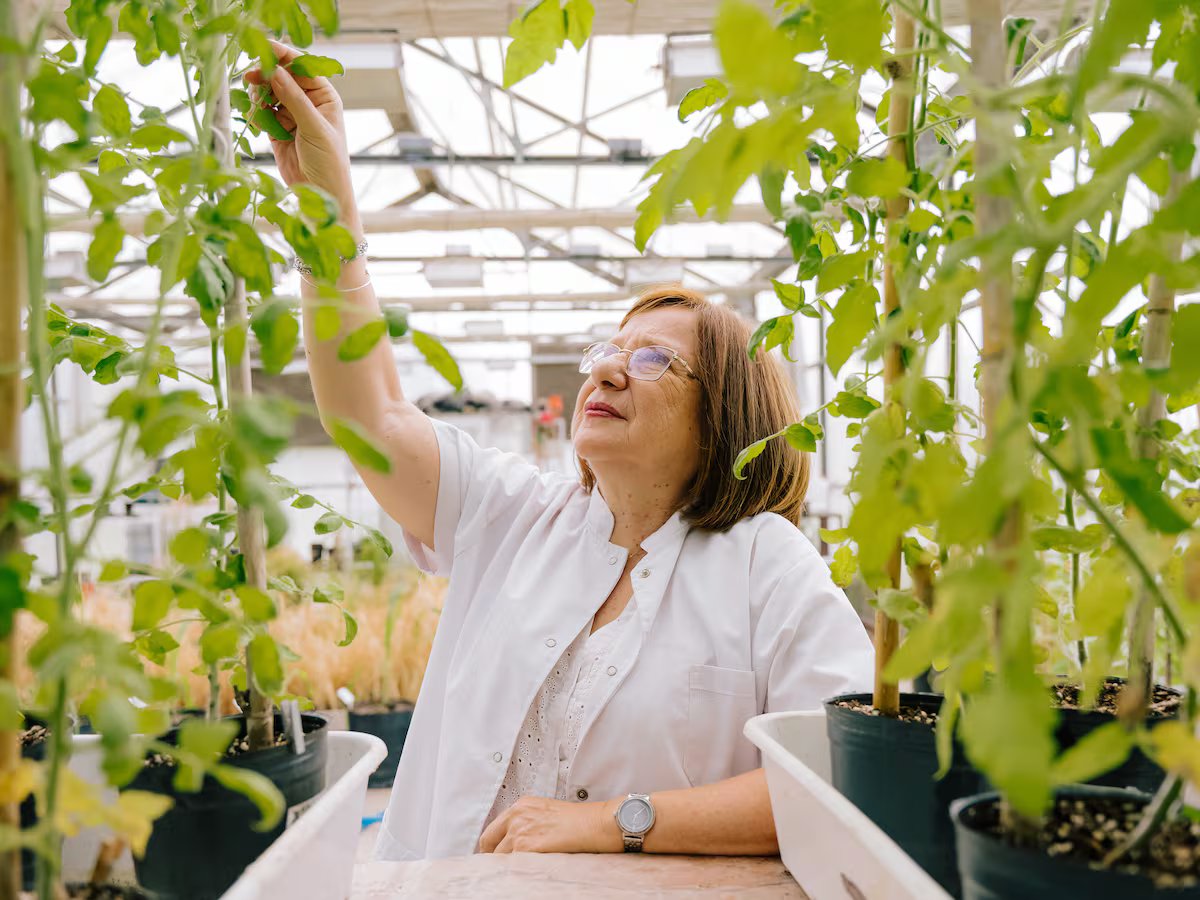
Climate change is setting the stage for increasingly extreme phenomena that present challenges to agriculture. In the Argentine city of Santa Fe, researcher Raquel Lía Chan, 66, created GMO seeds designed to combat one of the countryside’s greatest threats: drought.
She and her team from the Litoral Institute of Agrobiotechnology were able to modify wheat and soy seeds using a sunflower gene that activates a response mechanism in the plants when they are under stress from lack of water, rendering them more tolerant to drought.
Thanks to this development, Chan was recently recognized by the 2026 L’Oréal–UNESCO for Women in Science International Awards as one of the world’s top five women scientists. The organizers of the international prize rewarded Chan for “transforming fundamental plant biology into agricultural innovation through her discovery of genes and biological mechanisms that enhance plant tolerance to changing environments.”
Chan remembers being very curious as a child, asking the same question up to 20 times until she was offered a response she considered valid. Today, she says that curiosity was the seed of her scientific calling. She found support in her parents, workers who never went to university but who, like so many other Argentines, saw education as a path to social advancement. Chan studied chemistry in Israel, completed her doctorate in the Argentine city of Rosario, and emigrated again to France for her postdoctoral work. When she returned to her home country, she eventually settled in Santa Fe in the 1990s, when the National University of the Litoral created its biotechnology program and was seeking professors of genetic engineering and plant biology.
What had begun as a question — why do some plants dry out immediately, while others do not? — resulted in a decades-long investigation, with results recognized around the world. Chan believes that, with certain exceptions, scientists aren’t geniuses, but rather resilient and hard-working people who are passionate about what they do, like her and her team.
At the end of 2021, while the world was recovering from the COVID-19 pandemic, Brazil’s biosafety agency CTNBio approved the sale of HB4 transgenic wheat flour. Chan’s phone didn’t stop ringing for days. The seeds born in her Santa Fe laboratory — about 280 miles northwest of Buenos Aires — were beginning to gain ground in South American fields and markets and to draw attention in countries as far away as the United States and Australia.
The L’Oréal-UNESCO Award, worth €100,000 ($116,000), has put her back in the spotlight, and the scientist speaks at a virtual press conference from the city where she has lived for nearly three decades. “It’s recognition for the whole team,” she says.
The award, which is being given to an Argentine scientist for the second year in a row, brings visibility to national research amid the deep budget cuts ordered by the Javier Milei administration. “For experimental sciences, it’s killing us,” Chan warns, referring to a reduction in funding that is widespread but hits even harder in disciplines that require large investments for research, like her institute.
Between 2012 and 2016, the scientist was director of CONICET, Argentina’s largest research organization. At the time, investment in science accounted for 0.30% of her country’s GDP — a percentage she considers insufficient, but still double the current level, which hovers around 0.15%. The drop in research fellowships and funding for ongoing projects has triggered a major brain drain that shows no sign of stopping.
“We’ve taken several steps backward,” she laments, before categorically stating that “to stop being a poor country, we have to do science.” Chan is also self-critical, noting that scientists should do more to raise public awareness of their work and its importance to their country’s development.
The award-winner also thinks it’s necessary to advocate for genetically modified organisms. In her view, “GMOs have become a dirty word,” but that opinion stems more from lack of knowledge than from scientific evidence showing they are harmful to health.
“The first GMO was insulin,” she says by way of example, explaining that the hormone diabetics receive today to regulate blood glucose was created from a genetically modified organism to avoid extracting it from a pig’s pancreas, as was done before. She believes that sooner rather than later, the mistrust surrounding genetically modified cereals and other foods will also fade.
Sign up for our weekly newsletter to get more English-language news coverage from EL PAÍS USA Edition
