
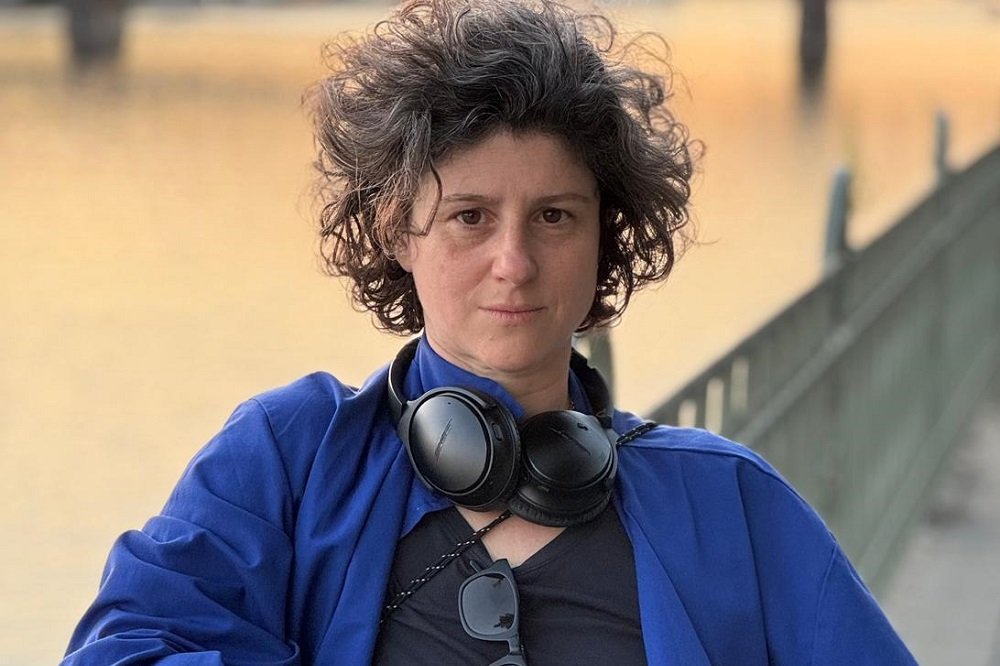
– CANNES 2026: The project manager outlines the philosophy of the new fund, its successful first call and the growing role of private players in financing independent cinema
(© Adam Olha)
Following a panel entitled “Investing in Stories: How Brands Are Becoming Film Industry Stakeholders”, held at the Investors Circle at Cannes’ Marché du Film, we spoke to Rebecca De Pas, project manager of the Fondazione Prada Film Fund. Launched by Fondazione Prada, the initiative aims to support independent cinema through grants for projects in development, production and post-production, with no geographical limits or production-nationality requirements in place.

Cineuropa: The panel discussed the growing involvement of brands in the film industry. What were the main talking points?
Rebecca De Pas: The panel was part of the Investors Circle, an initiative that, for the past four years, has brought together investors interested in getting involved in film projects selected by the Cannes market. The goal was to showcase different ways of accessing alternative financing compared to the traditional European pipeline, which relies mainly on public funds and conventional instruments. In particular, we discussed how luxury brands, but also players like Red Bull and tech companies, are increasingly keen to enter cinema in a more structured way.
Did the issue of potential conflicts of interest come up?
Not directly. The premise of the panel was that these actors come on board based on a convergence of vision and intent. In Fondazione Prada’s case, however, the model is different: it isn’t an investment geared towards a financial return, but support for the production of independent works with strong artistic and cinematic ambition. Nor is it an initiative directly tied to a commercial brand, but to a cultural institution with over 30 years’ worth of history.
How has the Fondazione Prada Film Fund’s experience been so far?
Very positive. The first call exceeded our expectations: we received around 1,200 applications and selected 14 projects. The fund is open to films in development, production and post-production. It stems from a very simple observation: securing financing today has become difficult not only for emerging voices, but also for already established filmmakers. The aim is to back independent projects whose artistic resonance chimes with Fondazione Prada’s cultural activities, and to make a concrete contribution to closing budgets, both at the early stages and in the finalisation of the films.
Would you describe it as a form of gap financing?
Partly, yes. But it’s important to stress that the fund isn’t tied to Italy: you don’t need an Italian producer to apply, and it’s open to features from anywhere in the world. Of course, there are specific eligibility criteria, but the guiding principle remains the quality of the project.
What kinds of filmmakers did you support in the first selection?
We sought a very broad balance. Among those selected are first-time directors — such as Andrea Gatopoulos, with his debut feature following his work in shorts — but also debut features by filmmakers working across a variety of formal registers, such as Verena Paravel and Daria Martin. At the same time, we’re supporting established auteurs who continue to experiment, from Apichatpong Weerasethakul to Corneliu Porumboiu and Hlynur Pálmason. We’re looking for diversity not only in professional pathways, but also in cinematic languages.
How does the selection process work?
There’s an initial pre-selection phase handled by an international group of readers, followed by a final decision taken by a six-person committee composed of Paolo Moretti, head of the fund and cinema curator at Fondazione Prada; myself; Violeta Bava, programmer and producer; Giuliana Bruno, scholar of visual arts and professor at Harvard; Chiara Costa, the Fondazione’s head of programming; and Miuccia Prada, the Fondazione’s president and director.
What is the fund’s budget?
At present, the annual budget is €1.5 million. Grants are capped at €100,000 for development, €250,000 for production and €100,000 for post-production. The final amount is defined case by case by the selection committee, according to the project’s needs. The model will remain unchanged for the 2026-2027 cycle, and the next call will be launched in June, with selection slated for early 2027.
Are you already looking into potential partnerships?
Not for the moment. It’s still a young fund, and at this stage, our priority is to consolidate its positioning and cement its operations. However, being at Cannes is crucial in order to take part in discussions on funding policies and on the transformations reshaping the international landscape. This is a time when many things are being rebalanced, and it’s important for us to play an active role in this conversation.
(Translated from Italian)
