
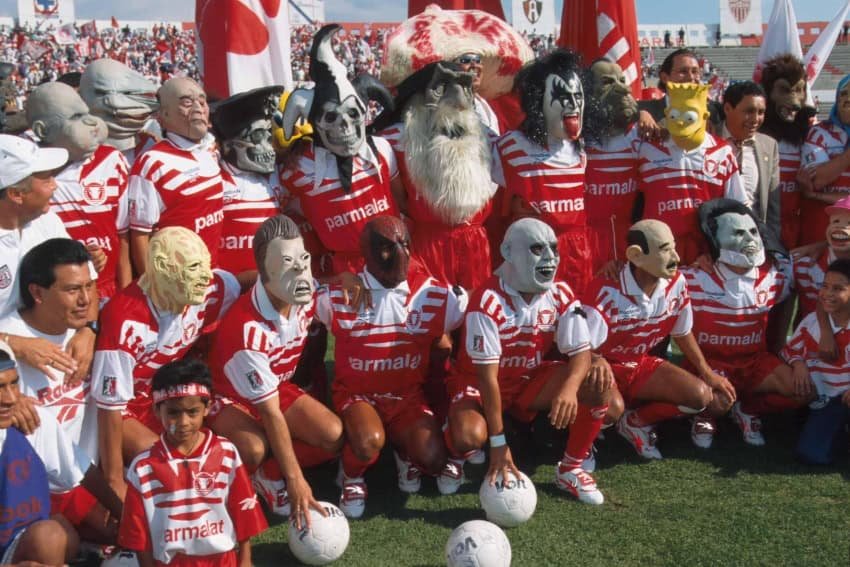
The year is 1997. It’s the quarter-finals of the top-division Mexican soccer league (today known as BBVA Liga MX). Club León, one of the country’s most decorated franchises, is set to face off against Toros Neza, an unlikely expansion team from the outskirts of Mexico City that has only been in existence for less than a decade.
As the two teams take the field, a scene unfolds that probably will never again occur at the professional level. The Toros Neza players, fully uniformed, walk onto the pitch bedecked in a random assortment of Halloween masks: Bart Simpson, Gene Simmons, Freddie Krueger, a werewolf and an ex-Mexican president, among others. The colorful soccer team from the city of Nezahualcóyotl assembles midfield for the standard pre-game photos, still completely masked, during a high-stakes match. And then the game begins.
@el.re.portero “Se nos ocurrían las locuras de la nada” Piojo Herrera #elreportero #futbolmexicano #yosgartgutierrez #ligamx #futbolmexico #torosneza #miguelherrera #piojoherrera #turcomohamed #mohamed ♬ sonido original – El RePortero ⚽🥅🧤🎙️
They would go on to lose and be eliminated from the tournament as one of the best teams that season. But the image of them gathered while wearing their masks is perhaps the most emblematic moment of the team’s short-lived, explosively unpredictable history.
A meteoric rise and collapse
In only a few years, Toros Neza took the professional Mexican soccer world by storm, rivaling the most historic and successful teams in the country before collapsing as rapidly as they had surged.
Today, they are a mythic squad of the 1990s, as representative of Mexico City’s scrappy working-class identity as they were of Mexico’s passionate soccer culture. Though they no longer exist, their reputation endures in the hearts of many longtime Mexican soccer fans. A recent documentary series by ViX, titled “Toros Neza,” has brought renewed attention to the iconic team, which is unlike any other in Mexican pro soccer history. Here’s their story.
The unlikely origins of professional soccer in Nezahualcóyotl
Located just northeast of Mexico City’s Benito Juárez International Airport in Estado de México, Ciudad Nezahualcóyotl is a densely populated suburb with a population of over one million. Named after Nezahualcóyotl, a famed Indigenous poet and philosopher, the relatively young municipality was officially founded in 1963, following the draining of Lake Texcoco. However, in the 1940s, it began to grow informally as a settlement for Mexican migrants from around the country. With limited housing options and frequent flooding, the area was often avoided by those with more promising options. But the region attracted desperate working-class families hoping for better opportunities and proximity to the nation’s capital.
It has never been the kind of famed capital or regional gem that would attract a successful professional sports team and investors — though it did serve as a host site for the 1986 FIFA World Cup, which global celebrities like Rod Stewart and Diego Maradona would attend. But somehow, against the odds, Nezahualcóyotl (or, Neza York, as locals playfully refer to it as) became the unlikely epicenter of professional soccer in Mexico – if only briefly. The national government did its best to cover up the area’s surrounding poverty, but it only added to Neza’s unique status in Mexico’s soccer imagination.
The birth of Toros Neza
The city’s regional soccer pride first took off in 1978, when Club Deportivo Neza (also referred to by their logo, the Coyotes) was created after the city of Neza purchased and relocated Club de Fútbol Laguna from Torreón, Coahuila. A second-division unit, the Coyotes lasted until 1988. Earlier in the decade, in 1981, a semi-professional sports stadium was built for the team, which would become the genesis for hosting the aforementioned World Cup, despite the Mexican Football Federation expressing security and safety concerns. Years later, that stadium would be deemed unsafe for fans, requiring temporary closure and the team’s interim relocation to Pachuca, Hidalgo.

After the Coyotes shuttered at the end of the 1980s, the door opened for Neza’s next, and better prepared, team to lead the charge through the 90s: Toros Neza. Backed by Mexican business mogul Juan Antonio Hernández, the Toros had enough financial muscle to make a real run into Mexico’s top tier of soccer. Behind the ambition of Antonio Hernández, the city of Neza converted itself into a national soccer powerhouse in 1991 — despite the doubters.
A decade as Mexico’s underdog darlings
Starting in the second division like the Coyotes, Toros Neza quickly dominated their way through the lower-tier teams, advancing up to the Mexican first-class by way of league promotion in 1992. What initially set them apart was their ability to go after international, high-profile players: a Swiss goalie and a group of Chilean, Brazilian and Argentine players and coaches to go along with rising Mexican nationals, some of whom would later go on to become generational icons and eternal memes in the soccer world.
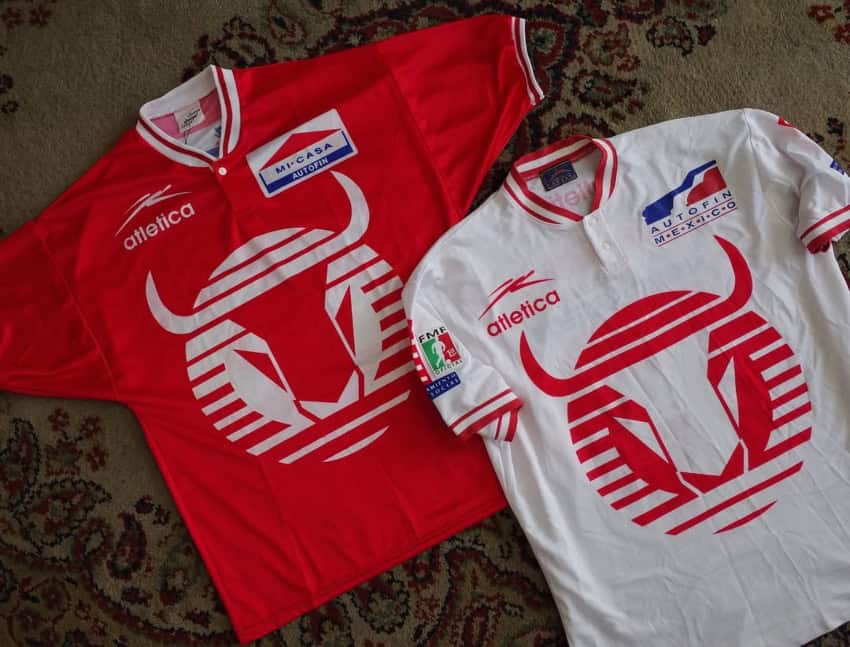
Remembered for their bright red jerseys with the geometric silhouette of a charging bull on the chest, as well as the dyed hair styles and vibrant personalities of their rebellious players, Toros Neza became a team of the barrio — scrappy, resilient and unwavering, like the economically struggling city they represented.
Among the central figures were Antonio “El Turco” Mohamed, Miguel “El Piojo” Herrera, Federico Lussenhoff, Pablo Larios Iwasaki, Rodrigo “El Pony” Ruiz and Nidelson Silva da Melo. The team blazed off to a promising debut against América in Estadio Azteca in 1993 with a victory against Mexico’s top-funded, legendary club. Just a few years later, as a young and still relatively unproven team, they would inevitably reach the league championship against the famed Chivas de Guadalajara in 1997 (a cinderella story that ended in crushing defeat, as one of their star players couldn’t participate for personal misconduct reasons).
A team of destiny … almost
To be sure, the team was entertaining to watch on the field: at their best, delivering a series of poetic, coordinated passes in perfect unison that would end with a trick shot past the opposing defenders and goalie. The team was offensive-minded, brash, aggressive and played a style of smashmouth soccer (by Mexican standards) that involved scoring plenty of goals, rather than hunkering down on the defensive side — which some teams are more prone to do— and resulted in a more tempered flow of the game. Having such an explosive, unpredictable style, though, sometimes backfired, as the team would have stretches of discombobulated play, lack of leadership and internal frustrations (see: players voting other players off the team).
In the span of a few seasons, the team burned through three coaches, and the players later admitted that no coach would have been able to wrangle in so many big, clashing personalities. Their apex season in 1997, which ended in a championship loss against the better-equipped Chivas, highlighted the team’s biggest strengths and weaknesses: themselves. The players ultimately couldn’t get their act together, with off-field antics, mismanagement and the temptations of fame derailing at least a few careers in their primes.
The rest of their existence was brief from that point forward — their best players left to get paid elsewhere, veteran replacement players couldn’t replicate the lightning-bolt success of prior years (the team even recruited Brazilian legend Bebeto, well past his prime), and by 2002, the team folded, nearly as unexpectedly as they had sprung up.
Legendary moments and a lasting legacy
Among their notoriously on-brand moments? In a friendly scrimmage, Toros Neza agreed to play against the Jamaican national team at an amateur field in Toluca. Just a couple of minutes into the lightly officiated game, a fight-turned-brawl broke out, with reports of weapons being flashed, including a gun from the Jamaican side.
On the positive side, the Toros were also responsible for initiating changes in the Mexican league that are still in effect today. During their peak, Neza owner Antonio Hernández invited every other first-division team owner from around Mexico to his home in Cuernavaca and together they drafted a new system of play, which notably divided the long season into two separate mini-tournaments, known as the Clausura and Apertura (a system that is still in use decades later).
The flippant, if not anarchistic, squad delivered some of Mexico’s most beautifully reckless soccer and brought an entire region of Mexico that had forever been overlooked along with them. For a variety of reasons, there will likely never be another team, or era, in Mexican soccer like Toros Neza.
Alan Chazaro is the author of “These Spaceships Weren’t Built For Us” (Tia Chucha Press, 2026), “Notes from the Eastern Span of the Bay Bridge” (Ghost City Press, 2021), “Piñata Theory” (Black Lawrence Press, 2020), and “This Is Not a Frank Ocean Cover Album” (Black Lawrence Press, 2019). He is a graduate of June Jordan’s Poetry for the People program at UC Berkeley and was selected as a Lawrence Ferlinghetti Poetry Fellow at the University of San Francisco. His work can be found in NPR, The Guardian, SLAM, GQ, L.A. Times, and more. He is currently based in Veracruz.
