
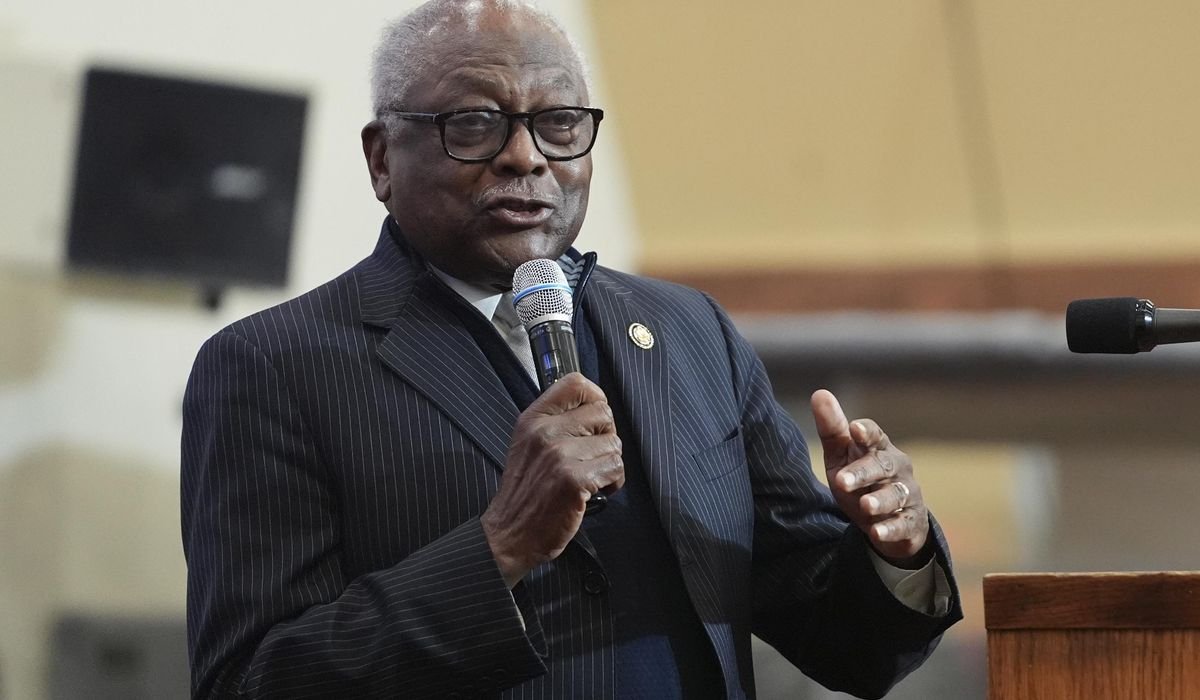
South Carolina Democratic Rep. James Clyburn said he is running for reelection even if the Republican-controlled state legislature approves a new congressional map that attempts to push him out.
“I’m going to run irrespective of what the makeup of the district might be, because I believe that I have a record that is very acceptable to the South Carolina voter, and I have a good understanding of America’s promise, and we’ll run on that,” he said Sunday on CNN’s “State of the Union.”
Mr. Clyburn represents South Carolina’s 6th District in the southeast portion of the state. A draft South Carolina map the state Legislature is set to debate soon would move the 6th District to the north and transfers much of Mr. Clyburn’s current constituency into the 2nd District, represented by Republican Rep. Joe Wilson.
“The voters will have the last word on this, and I don’t know why people think I cannot get reelected if they redistrict South Carolina,” Mr. Clyburn said. “Now I have a district that’s about 45% African American. I have no idea what the number will be after the Legislature finishes, but whatever that number is, I will be running.”
The congressman is confident his record of serving South Carolina for more than three decades will carry sway, even if he has to sell it to more Republican voters.
“Most voters can tell the difference between a true public servant and someone who may be in it for the next social hit,” he said.
Mr. Clyburn is the only Democrat representing South Carolina on Capitol Hill. The state’s two senators and six other House members are all Republican. Some of those House districts would have to absorb more Democratic voters for the effort to dilute Mr. Clyburn’s district to succeed — which could backfire on Republicans if Democrats have the wave election cycle they believe anti-Trump sentiment can deliver.
“Be very careful what you pray for, because what I do believe is that when they finish with the redistricting, there will be the possibilities of at least three Democrats getting elected here in South Carolina to the United Congress,” Mr. Clyburn said.
The South Carolina redistricting effort follows a Supreme Court ruling that the Voting Rights Act cannot be used to force states to add more minority districts to their maps unless there is clear evidence of racial discrimination.
Mr. Clyburn, the former No. 3 House Democrat who was first elected in 1992, credits the Voting Rights Act for helping him and other Black lawmakers get elected after states with large minority populations were forced to redraw their maps with that in mind.
The congressman, who recently published a book about the eight Black members of Congress who served nearly a century before him, likened the current redistricting effort and congressional Republicans’ attempts to tighten voting laws to the Jim Crow-era laws designed to disenfranchize Black voters.
“There are 95 years between number eight in my book, and yours truly, number nine,” Mr. Clyburn said. “That did not happen organically. That happened because Congress and the Supreme Court changed the rules, as they are doing today.”
