
– CANNES 2026: In the third feature by Kantemir Balagov, Barry Keoghan’s newest single-father character is caught up in a crisis of masculinity with his teenage son
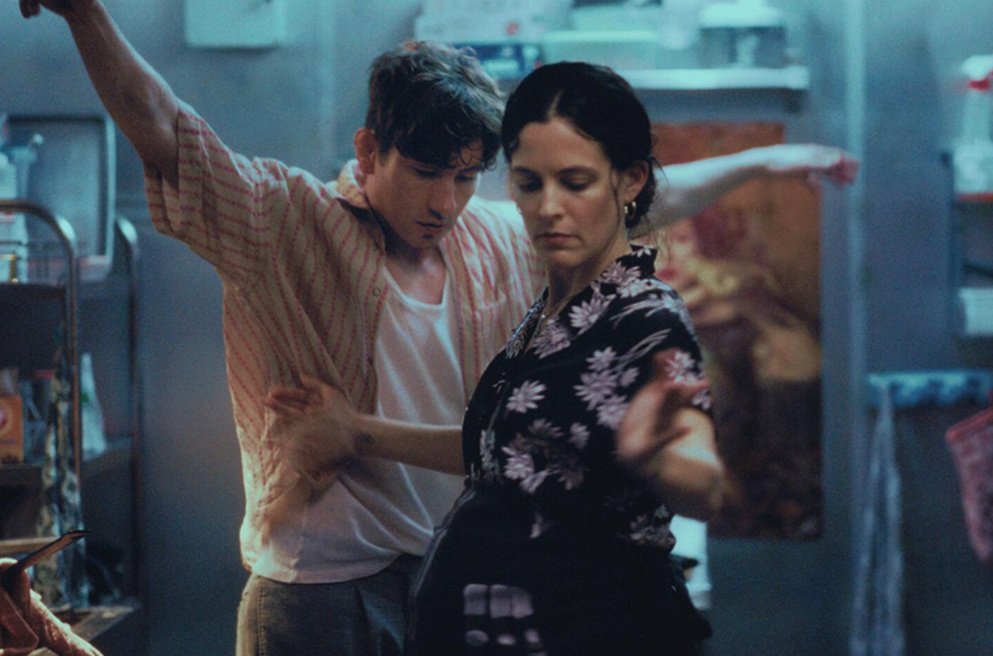
Barry Keoghan and Riley Keough in Butterfly Jam
“I am a fairy tale,” says Barry Keoghan in his newest role as a whimsical yet dysfunctional on-screen single father, this time in the third feature by Kantemir Balagov. The young Russian director-in-exile of Circassian descent rose to critical acclaim with his sophomore feature, the 2019 Un Certain Regard pick Beanpole, which picked up the Best Director and FIPRESCI Awards. However, no matter how many iterations of this part the Irish actor plays, he does it with such gusto that it’s impossible not to be drawn in, even when the film built around him is weighed down by its screenplay.
With the Keoghan-led Butterfly Jam, Balagov makes his English-language debut, which has just enjoyed its world premiere as the opening film of the Cannes Film Festival’s Directors’ Fortnight sidebar. Single father Azik (Keoghan) and his pregnant sister Zalya (Riley Keough) run a small Circassian diner in New Jersey, trying to make ends meet. Azik’s son, Temir (Kazakh-born, Turkish-US actor Talha Akdogan), is an aspiring wrestler who finds himself drawn to fellow athlete Alika (Jaliyah Richards, in her first film role).
A rift – suppressed, yet omnipresent – reveals itself between Temir’s and Azik’s understandings of masculinity, with Azik’s rooted in impressing women and a certain machismo with which his son simply does not resonate. As much as the filmmaker creates scenes with such vivid ensemble chemistry, emotionally integral moments disappointingly grind to a halt with oddly overwritten dialogue in a screenplay by himself and Marina Stepnova – although Keoghan, especially, plays off this aspect with ease. Character arcs thus emerge partly underbaked – one example being the significance of Temir’s wrestling to the relationship between himself and his father. Similarly, Zalya remains as more of an appendage to this tale that relies also on the importance of women in the lives of men, despite them existing on the peripheries.
When Azik’s friend Marat (Harry Melling, in a decidedly different role than the one he played in last year’s Un Certain Regard entry Pillion) tries to work with him to make a quick buck, his sneer, complete with a moustache and crooked teeth, starts to define the man. His erratic presence fuels the film’s shocking third-act turn, partially recovered by a further development of the theme of masculinity, even though it drags the movie out in yet another unexpected direction.
By the end, narrative threads trail away underserved in favour of a few quirky one-offs, although they do elicit laughs. Thankfully, it’s easier to forgive much of the unevenness of the film’s rhythm thanks to Balagov’s images, which, with lensing by Jomo Fray, float with ease between the characters. A roving camera makes long scenes still feel immersive and extraordinarily dynamic, whereas two-character sequences are much more stilted and prone to literalisms.
Even with the canted script of Butterfly Jam, Balagov’s eagerly awaited return to the big screen, the filmmaker shouldn’t be written off. The dialogue-free scenes shine brightly – with two that rely most on movement and sound standing out in particular. In one, father and son activate dozens of car alarms in a bout of beautiful play, and in another, we watch Azik and Zalya as they dance in the kitchen, a moment of spirited joy amidst a hectic life.
Butterfly Jam is a French-German-Belgian-US production staged by Why Not Productions, in co-production with Senator Film Produktion, Les Films du Fleuve, ARTE France Cinéma, A.R. Content and Goodfellas. Goodfellas also holds the rights to its world sales.
