
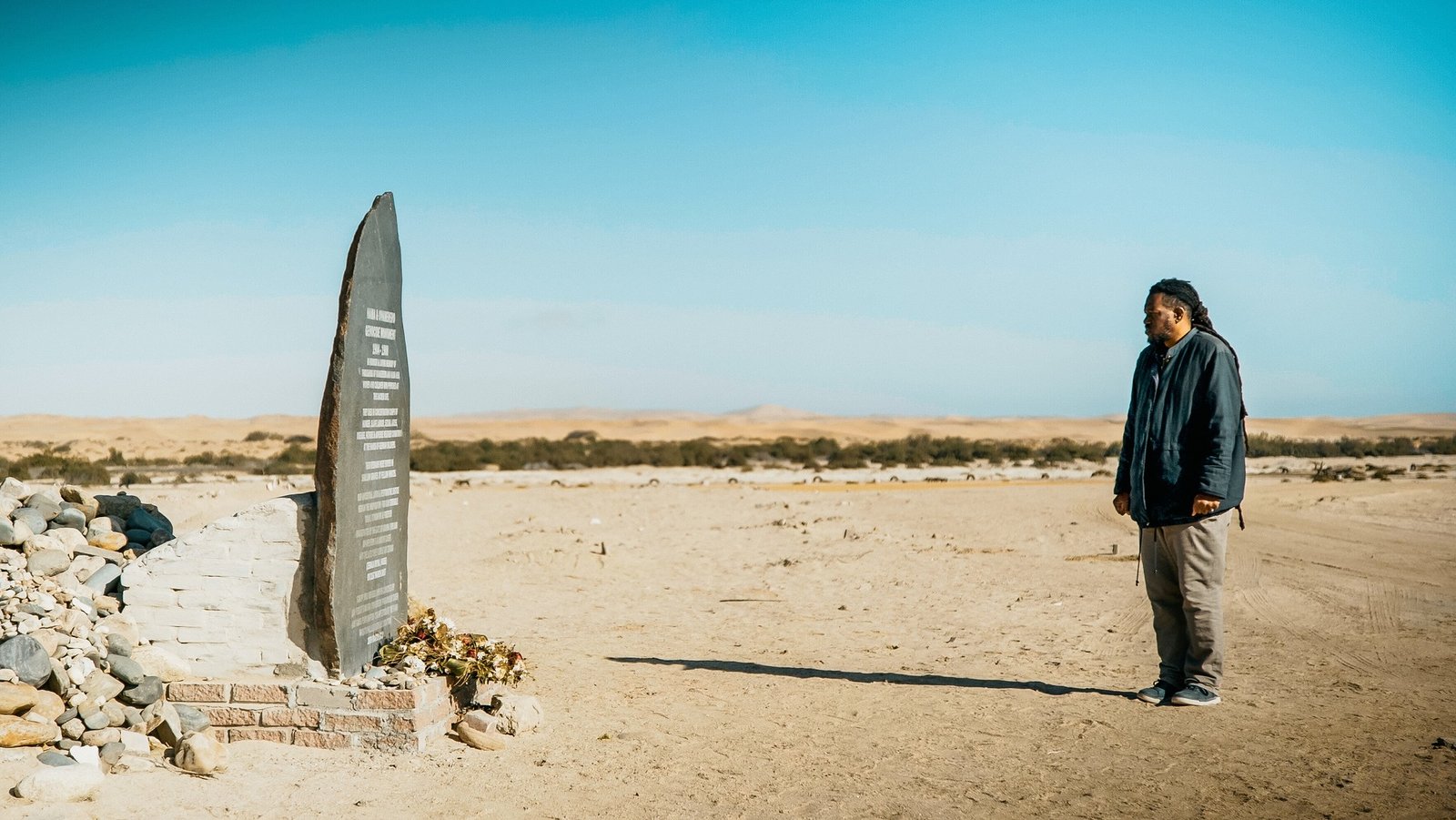
– Theodora Shandé and Matteo Sant’Unione’s documentary about the massacres carried out by German colonisers in Namibia at the beginning of the 20th century is a step on the path towards reconciliation
“In light of Germany’s historical and moral responsibility, we ask for forgiveness from Namibia and from the victims’ descendants. From this day onwards, we will officially refer to these events as what they were: a genocide”. These are the words of former German foreign secretary Heiko Maas who announced an agreement on 29 May 2021, comprising financial aid of over 1.1 billion euros over a 30-year period to fund infrastructure and development in Namibia. But according to activists, these subsidies are not enough to remedy the suffering inflicted. The massacres carried out by German colonisers at the beginning of the 20th century, which killed tens of thousands of Herero, Nama, San and Damara people, and the consequences of this transgenerational trauma which can still be felt today, are at the heart of the documentary Sorry for the Genocide, which world premiered in Berlin’s international Doxumentale Festival.
Directed by Theodora Shandé and Matteo Sant’Unione in league with Elmarie Kapunda and Lisa Ossenbrink, the documentary takes an open approach, presenting many different viewpoints and perspectives. A variety of films on German colonial crimes in what we now call Namibia have seen the light of day over the years. Besides Kate Schoenbach’s recent documentary, Herero, focusing on Veraa Katuuo, who’s a key figure in the global struggle for recognition of the genocide of the Herero and Nama peoples, Lars Kraume presented Measures of Men at the Berlinale in 2023 ahead of its theatrical release, while Egon Günther’s Morenga was the first film to bring the genocide back to the forefront after the UN’s Whitaker Report resurrected it from oblivion.
Shandé is the founder of Wave In Motion, a multimedia production company which handles 3D animation, videography, photography and marketing, and the modern dynamism and freshness of Sorry for the Genocide is its real strength. The film reveals the many facets of the subject in question through the voices of traditional leaders, academics, German-Namibian families and descendants of these communities, with no need for a narrator or voiceovers. “Recognising something begins with telling the truth. And I don’t think we’re quite there yet”, explains Sima Luipert, a human and social rights activist and vice-president of the Nama Genocide Technical Committee. Her great-grandmother was held in concentration camps like Shark Island and Okawayo. “We weren’t even taught that a genocide took place here. Family cohesion, access to the land, names, language and culture were all lost”. Laidlaw Peringanda, the founder of the Museum of Genocide in Swakopmund, criticises the reconciliation agreement between Namibia and Germany, whose white colonisers are the only ones who really stand to benefit from it: “People say we have to try to forgive what happened in the past, but they don’t understand our emotional pain”.
Daniela Schramm Moura’s excellent editing alternates hard-hitting archive footage of brutality with the many first-hand accounts on offer here, such as that of Gaos Juliane Gawa!nas, the only woman leader of the Damara community; Mutjinde Katjiua, the traditional head of the Herero people who’s also a zoologist and botanist; Charles Eiseb, a negotiator for genocide reparations; Rupert Hambira, a theologist and descendant of Herero genocide survivors who found refuge in Botswana; sociologist Ellison Tjirera, and political analyst Marius Kudumo. A number of interviews take place in historically significant locations, such as next to the victims’ unmarked graves, or on Shark Island, a one-time concentration camp which is now a tourist destination, a dramatic mutation foregrounded by Stefan Heilmann’s photography. These testimonies paint a picture showing that, for thousands of years, the indigenous groups of Namibia created a culture which was fascinating for its diversity and uniqueness, long before the arrival of the European colonial powers. This documentary is a step on the path to healing.
Sorry for the Genocide was produced by Wave In Motion, in co-production with cineMars and Namibia’s Obsessive Media.
(Translated from Italian)
