
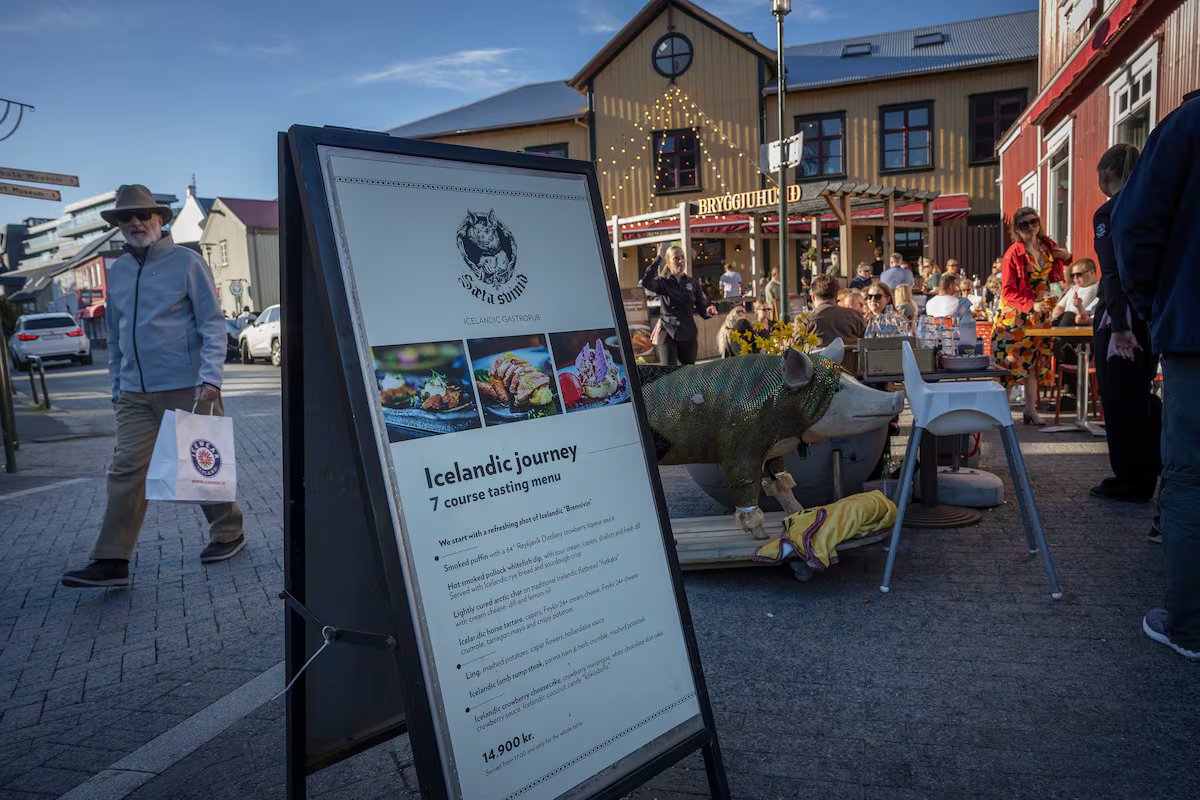
Six small tomatoes, 980 krona, almost €7 (around $8.15) at the current exchange rate. A hamburger at a very basic eatery, €28. A plain pepperoni pizza to go, over €22. A postcard of the unmistakable — and beautiful — Icelandic fjords, almost €5. Visiting Reykjavik in 2026 — and, needless to say, Iceland’s most touristy spots — is a risky activity for your wallet. The remote, wealthy island, which will hold a key referendum on joining the European Union on August 29, has since last spring carried the label of the most expensive country in the world. Not Switzerland, Norway, or those Caribbean islands where some of the largest U.S. fortunes have settled: the highest prices on the planet are found on this remote isle in the middle of the Atlantic, according to calculations by the Icelandic trade union Víska. Over the past half century, no wealthy nation has been battered more by inflation.
“We’ve had years of price increases, but in the last three years it’s been especially noticeable: everything is much more expensive,” says Thorunn Davidsdottir as she comes out of a “discount” supermarket in Breiðholt, a working-class district in the eastern part of the capital. “Food, restaurants, clothing… And shoes, especially shoes,” the 55-year-old woman adds. She says, however, that she suffers the effects less than others around her: “My children have already left home, so it’s just my husband and me left…”.
Accumulated inflation and the referendum in which voters among the country’s 400,000 inhabitants will decide whether to take a giant step toward becoming the EU’s 28th member state might seem unrelated. But they are closely linked: if, according to the latest polls, just over half the population wants to join the bloc, it is largely because of the damage to their bank accounts.
Many of those interviewed by EL PAÍS during a bright early-summer week in Reykjavik and on the Snæfellsnes peninsula believe that adopting the euro in a second step after accession — which would not be immediate: there would be a later, separate vote — would calm an inflationary fever that is already Icelanders’ top concern in polls. Little wonder: so far this year, prices are rising at a 5% year-on-year pace, double the central bank’s target of 2.5%.
Icelanders’ wages are high; very high compared with most continental European countries. Although the country lacks a formal minimum wage, the lowest pay levels exceed €3,000 ($3,500) gross per month at current exchange rates. But the cost of living is rising even faster. “You get paid a lot more, but you have to be more careful with spending,” says Marcin Błasik, a 50-year-old Polish truck driver who has spent more than half his life in the land of ice and fire, while unloading goods at the port of Rif, in the northwest.
“High prices are due mainly to lack of competition: here, oligopoly is almost a national sport,” says economist Thorvaldur Gylfason, emeritus professor at the University of Iceland. To this crucial factor he adds another equally important one: the high transport costs for most products. “We import half of what we consume, mostly from continental Europe.” And although the Icelandic krona, blamed by many, “does not by itself play a major direct role in high prices, Iceland does have a long history of currency crashes, events that are usually accompanied by inflation.”
The word “inflation,” and its close cousin “prices,” are the two most repeated terms in the latest Article IV Consultation with Iceland, the IMF’s annual country review. In the opening lines of that text, published at the end of July, the Washington-based institution issued a warning — the shadow of a “de-anchoring of inflation expectations,” every economist’s nightmare, is already hanging over the island — and a recommendation: “The policy priorities now are to return inflation sustainably to target.”
Aurora Pelier Cady, a 37-year-old Frenchwoman, moved in 2019 from very expensive Paris to today’s even more expensive Reykjavik. “Back then everything cost a lot, but it was still manageable. Now everything is insane,” she says from the pastry shop she opened four years ago. At the time she still shared an apartment: even with her own business, she says she could not afford to rent alone. Today, despite the economy’s good performance, she notices weaker local spending: “What I sell isn’t a basic necessity and you can tell.” Part of that drop, however, she offsets with the tourism boom in a country that receives more than six visitors per inhabitant, compared with two in Spain.
The country’s official statistics agency has just put numbers on the inflationary spiral. With a per capita income one-third higher than the EU-27 average and consumption per person 15% higher, the jump in prices is staggering: 84%. Food is on average 58% more expensive than in its potential future EU partners. Private healthcare and education cost more than double what they do on the continent. And alcohol, heavily affected by taxation as in other Nordic countries, is almost three times as expensive.
“Everything has risen enormously, but it’s most noticeable in housing,” Błasik complains. A reality common to the rest of Europe — and the West — that here is turbocharged by sky-high interest rates. He is clear, however, that he will vote no on EU entry. The euro, he says, would not be a panacea either.
Jon Steinsson, a professor at the University of California, Berkeley and one of the most respected economists on Iceland, disagrees. “One of the benefits of joining the EU is that trade barriers would be reduced and competition would increase. That would help lower prices,” he writes by email. “The possibility of joining the euro, furthermore, would allow interest rates to be reduced [they have just risen to 8%, versus 2.25% in the euro area], making life cheaper. That would be an important benefit,” he argues. On August 29, Icelanders will also put their wallets on the line at the ballot box.
Sign up for our weekly newsletter to get more English-language news coverage from EL PAÍS USA Edition
