
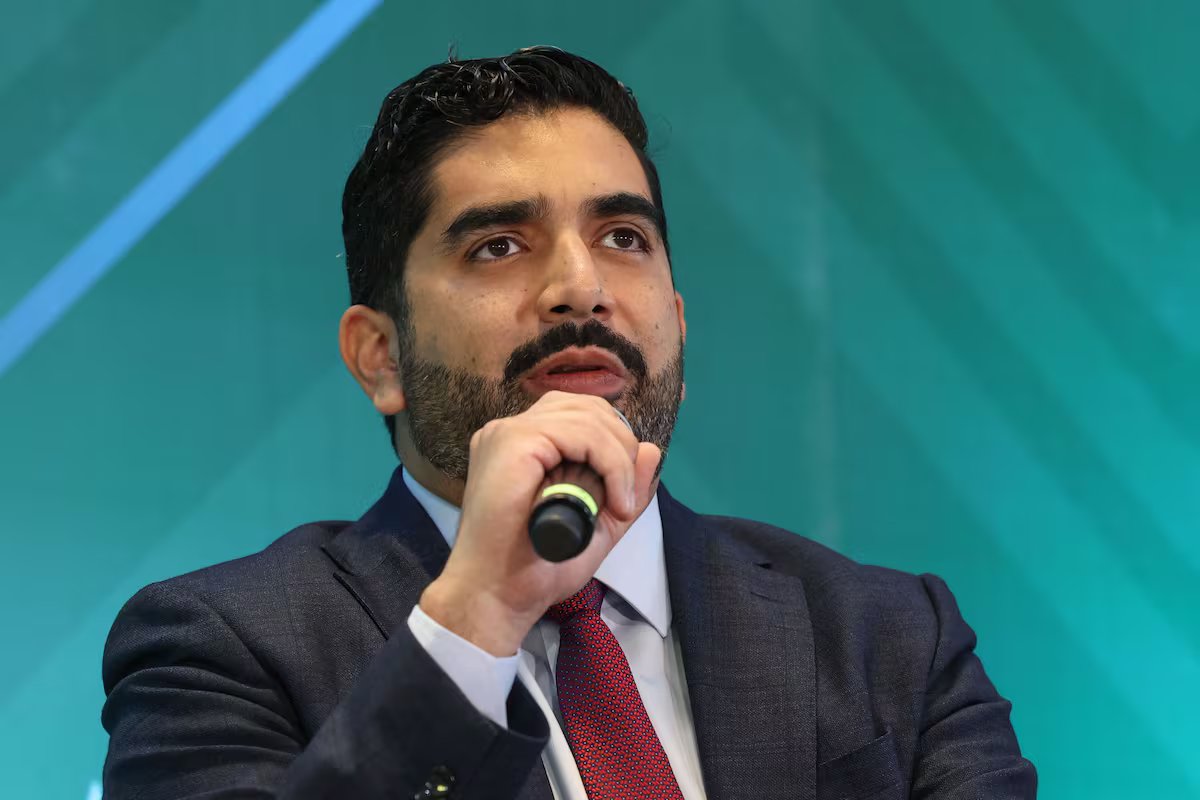
At the start of her term, Mexican President Claudia Sheinbaum gave members of her financial team a copy of the book Mission Economy by the Italian academic Mariana Mazzucato. In it, the author argues that rebuilding capitalism requires considering social benefit and placing the state at the center, as the executor and main investor in innovation, the economy, and the markets. Roberto Lazzeri, chosen by the president to lead relations with the United States, Mexico’s main — and most demanding — trade partner, also received a copy.
Described as a technocrat with extensive financial experience and strong ties to Washington, Lazzeri is seen as an asset in the lead-up to the review of the USMCA, the free trade agreement that has become the backbone of the Mexican economy. In the market, he is viewed as an implementer, capable of resolving minute, fine-print issues such as debt structuring, the design of financial vehicles, and the review of business clauses.
The president has positioned him as the architect of the modernization of public development banking, where he serves in a dual role as director general of the National Bank of Foreign Trade (Bancomext) and Nacional Financiera (NAFIN). Observers consider him a key appointment at a time when the United States is seeking to alter the treaty’s footnotes with stricter rules of origin and jurisprudence that would give advantages to U.S. companies in the energy, industrial, and telecommunications sectors.
“While Roberto Lazzeri doesn’t come from the traditional foreign service, the bilateral dynamic between Mexico and the United States has changed radically and now demands backgrounds with practical experience in specific issues, rather than in classic diplomacy,” says Álvaro Vertíz, a partner at the consulting firm DGA Group. “His career stands out precisely in three key areas: trade, the fight against money laundering, and security.”
The financial services specialist points out that, during his time at the Ministry of Finance, Lazzeri assisted in managing the crisis generated by the sanctions imposed by the U.S. Treasury Department and the Financial Crimes Enforcement Network (FinCEN) against Cibanco, Intercam, and Vector, lenders accused of allegedly facilitating money laundering for organized crime cartels such as Sinaloa, Jalisco New Generation, and the Gulf Cartel. “He negotiated and maintained a fluid dialogue with the U.S. counterparts,” adds Vertíz, who has followed his career due to his connection with the banking sector.
The official, who still needs the approval of the Trump administration to replace current ambassador Esteban Moctezuma, held positions at the Ministry of Finance related to debt and budget execution. In his last role at the ministry, he held a position of trust under former Secretary Rogelio Ramírez de la O, where he assumed key responsibilities in major operations such as the government’s purchase of approximately $6 billion in electricity assets from the Spanish energy company Iberdrola, managing financial diplomacy with the United States through liaisons with the Treasury Department, and representing the country before the International Monetary Fund (IMF), the World Bank, and the Financial Action Task Force (FATF).
Lazzeri is an economist from the Center for Economic Research and Teaching (CIDE), a state institution known for its technical training of public officials. As a sign of his priorities, this week he joined the group appointed by the president to strengthen the USMCA negotiations and met on Monday with Trump’s trade representative, Jamieson Greer. With less than three months to go until a decision is made on whether and under what conditions the North American trade agreement will continue, the federal government opted to reinforce the negotiating team with the addition of Secretary of Agriculture Julio Berdegué; Lazzeri; and Diana Alarcón, Mexico’s representative to the World Bank and former international affairs adviser to Sheinbaum when she was mayor of Mexico City. The move has been widely interpreted as the president asserting control over priority areas ranging from the ruling party’s leadership and foreign policy to the delicate relationship with the United States.
“The president arrived with a somewhat unusual team,” notes Matías Gómez Léautaud of Eurasia. “There were people ‘inherited’ from [former president Andrés Manuel] López Obrador, people she brought in from her own team, figures from [the governing party] Morena. Now, as she enters the most important part of her six-year term, she wants to strengthen her own control over the Cabinet with people she trusts and whom she considers more technically capable.” Moctezuma, for example, was appointed by the former president.
Furthermore, he emphasizes that Lazzeri has been building rapport with Washington and that the decision is also part of a broader shift in foreign policy, reflected in the recent appointment of Foreign Minister Roberto Velasco. “He has good connections in Washington, and a more technical profile will be essential for negotiations with the Treasury Department,” he adds.
The U.S. and Mexico began gauging trade tensions weeks ago, with the first bilateral meetings ahead of the joint review in July of the treaty that protects up to 80% of Mexico’s trade with its northern neighbor, its main buyer of goods. The Mexican government has indicated that its ideal scenario is to preserve the agreement without triggering the more complex option of annual reviews, which could further slow the flow of investment, pending a clear resolution on the rules governing trade, including with Canada.
Bringing the agreement to a successful conclusion will be crucial for the Mexican economy, which is experiencing a combination of accelerating inflation and weak GDP growth. In the coming months, the three parties must unanimously decide whether to extend the USMCA, opt for annual reviews without immediate extension, or move toward cancellation — currently the least likely scenario.
In this context, the lingering question is whether the approach associated with economist Mazzucato — who is emerging as Sheinbaum’s chief economic influence, and by extension a guiding voice for Lazzeri — will be enough to navigate a relationship with the United States defined by structural asymmetries and disputed rules.
Sign up for our weekly newsletter to get more English-language news coverage from EL PAÍS USA Edition
