
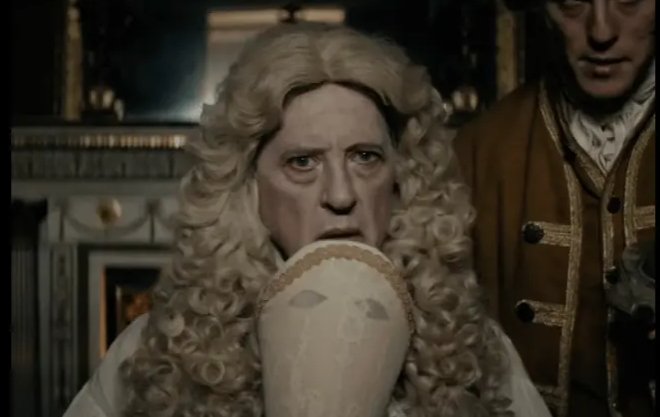
Following in the thematic ambition of Jonathan Swift’s 1700’s novels Gulliver’s Travels and A Modest Proposal, as well as Alexander Pope’s The Dunciad and Henry Fielding’s Tom Jones, Savage House is the latest period piece which explores and critiques its contextual setting, written and directed by Peter Glanz.
Starring the talented Richard E. Grant and Claire Foy, the film reads successfully as a dark yet amusing satirical assessment of 18th-century social hierarchy and class, with disgraced faux nobles Sir Chauncey and Lady Savage thriving shamelessly and illogically for the highest social approval when they are informed a duke and duchess wish to dine and sleep at their home as the Jacobite uprising and a pox plague loom outside. There is also an endless web of betrayals on top of betrayals and schemes on top of schemes plaguing events.
From the moment the film lands on our screen, its style and messaging are front and centre. The film knows itself unapologetically and consistently from the jump and throughout the runtime, and only presses the gas pedal on its antics and thematic tapestry. Thanks to cinematographer Adriana Goldman and editors Guilhem Coulibaly and Antonio De Paol, Savage House maintains a fantastic rhythm to the editing and camera composition, interestingly creating a pace which juxtaposes the artistic, grand visual palette and assumed tone to manifest something unique for the viewers.
Additional visuals and iconography praise lead to handing credit to an art team led by art director Andrea Matheson, set director Alison Harvey, and key make-up artist Alex King; the decor and design complementing Glanz’s film hits the spot. The costuming and makeup are terrific in their initial presentation of signalling esteemed nobles, wealth, privilege and bourgeois, proposing one positive, respectable index.
To achieve a sense of illusory and verisimilitude, these elements later combine with the performances and narrative to depict how the characters don’t align with the expected synonyms of what the visual composition represents, illustrating the key thematic value of appearances versus reality. Essentially, we expect such period pieces to burst with sophistication and an esteemed, more covert sense of power.
However, Savage House ripples and tumbles intentionally with a somewhat stressful fast pace; even when a sequence is seemingly slow and controlled, you can sense the underlying tension and incoming chaos like the faint yet ongoing sound of ticking, anticipating a demolishing explosion.
Thanks to some solid, rich writing and directing from Glanz, the film’s plot pulls you in by the collar and refuses to let go, maintaining momentum and keeping you second-guessing consistently and building surprise on top of surprise. You have no idea who to align with in the film, and your emotional support wavers from character to character based on key scenes.
Linking back to contradictions and layers, an additional highlight of Savage House is how it makes humour out of the grizzly realities of its time, such as gun duels, plagues, poverty and much more. A fair amount of the historical details addressed in the film should correspond to trauma, tragedy and emotional drama; however, Glanz’s work steers you to laugh, rather uncomfortably or in disbelief, but laugh nonetheless.
The shining highlight among all of this has to be Grant’s stellar performance as Sir Chauncey, one of deep emotional complexity, humour, pain and divisiveness. Foy spoke of her co-star in an interview with Screen Daily, stating, “[working on Savage House] was genuinely fun from start to finish. Richard is a total one-off.” As much as you come to dislike Chauncey, you are eventually driven to feel some half-tossed sympathy for his startling predicament by the conclusion, mostly due to Grant’s powerhouse work. You are also prompted to reflect and wonder to what extent Chauncey and his wife are attempting to stay afloat and make what they can of a society which favours materialism and wealth.
Glanz’s handling of the subject matter is indeed a successful, intriguing one. We completely register and understand the messaging of society’s narrow-mindedness and ill-fated, forged paths creating monsters, characterised by shallowness and a greed-filled black hole that consumes and consumes relentlessly, yet is never fulfilled.
★★★★
In cinemas 5th June / Richard E. Grant, Claire Foy, Jack Farthing, Bel Powley, Kila Lord Cassidy / Dir: Peter Glanz / Paramount Pictures UK / 15
Discover more from
Subscribe to get the latest posts sent to your email.
