
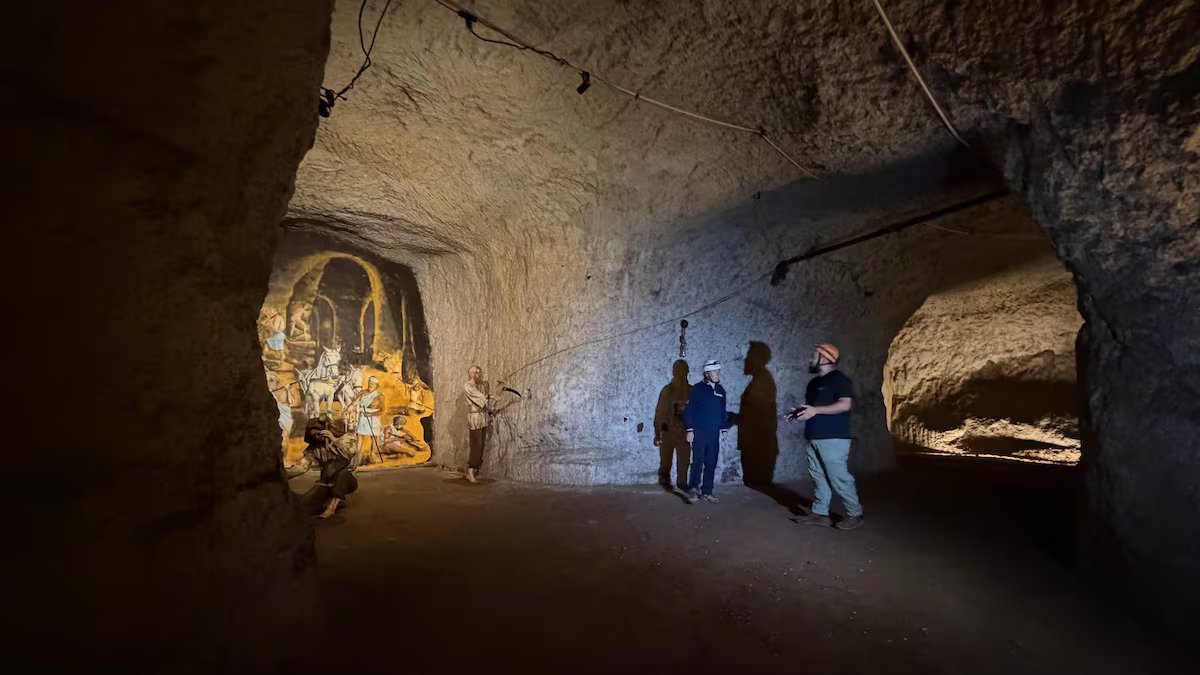
One answer to the hotter summers of the future could be hidden beneath centuries of history. Rome has begun turning its attention to the extensive network of underground spaces beneath its streets to study whether some might one day serve as shelters from extreme temperatures. When the heat on the surface becomes intense, the coolness naturally preserved underground takes on unexpected value. The idea has potential, but first authorities must determine which sites are safe and how to adapt them for public use.
A few meters below the streets of Italy’s capital lies another city. An extensive network of old quarries, galleries, catacombs, archaeological sites, and other cavities runs through Rome’s subsoil, excavated over centuries to, among other things, extract the stone used to build many surface structures. Some archaeological remains that stood above ground 2,000 years ago now sit five or six meters below the surface.
The abundance of cavities is also explained by Rome’s geology: its volcanic materials, such as tuff and pozzolana, were easy to excavate and for centuries were used for construction.
Rome has been putting this hidden city to various uses for centuries. From mithraea, where ancient Romans worshiped the god Mithras, and the catacombs where early Christians were buried, to railway tunnels and air-raid shelters used during World War II.
Now, climate change could give that underground world a new function: sheltering residents from increasingly extreme heat.
The idea is still at a very preliminary stage. For now, Rome’s city government and the Higher Institute for Environmental Protection and Research (ISPRA) are analyzing existing cavities and the possibilities they might offer. In fact, ISPRA has been producing maps of Rome’s underworld for years to create a database to improve knowledge of those spaces.
The interest is no coincidence. While surface temperatures can widely exceed 35 degrees Celsius, a few meters underground the picture changes dramatically. Francesco La Vigna, an ISPRA geologist and chair of the Urban Geology Expert Group at EuroGeoSurveys, explains that from about 3.5 meters deep the ground stops experiencing much of the surface’s thermal swings and maintains relatively constant temperatures year-round, generally between 10ºC and 17ºC. “In Rome, during some summer measurements when outside temperatures exceeded 37 degrees, the cavities registered barely 16 degrees,” he notes.
This is not a new discovery. “In Antiquity, cellars — that is, the deepest spaces of buildings — were used to store wine and some foods,” La Vigna says. What has changed is the deliberate possibility of using them as a tool to adapt to climate change.
The full extent of Rome’s underground is still not completely known. The latest mapping carried out by ISPRA together with the National Research Council (CNR) and the University of Tuscia found thousands of cavities beneath more than 100 square kilometers of the capital. That, La Vigna says, could allow potential spaces to be found in almost every neighborhood of the city, especially in areas of volcanic origin.
But finding a cool cave is not enough. Many ancient cavities have been abandoned for decades or even centuries. Before allowing citizens in, the stability of ceilings and walls would have to be checked and, where necessary, consolidation work carried out. There is also another problem: humidity is often very high and volcanic rocks can emit gases such as radon, harmful with prolonged exposure.
La Vigna believes, however, that none of these obstacles is insurmountable. “These are perfectly solvable problems. Ensuring the structural safety of an underground space is technically feasible and, without a doubt, less costly than building one from scratch, while humidity issues and the presence of harmful gases can be easily addressed with appropriate ventilation systems,” the geologist explains.
For that reason he proposes starting with the largest, best-preserved spaces or those that already receive visitors, such as certain archaeological sites. It would also be, he says, a way for citizens to experience the temperature difference and overcome the fear of going “underground.”
The city government sets two conditions: safety and free access. “Safety, including air renewal, and free access, as with other climate shelters,” says Edoardo Zanchini, director of the City Hall’s Climate Change Office.
The underground spaces would join a network of climate shelters made up of 178 indoor sites — including libraries, museums, civic centers and senior centers that offer air conditioning and a protected place free of charge during the hottest hours — and more than 400 outdoor spaces, mainly parks and gardens.
Adapting Rome to heat is an increasingly urgent need, Zanchini says. According to city data, temperatures have risen nearly two degrees over the past four years compared with the 1990–2020 average and, moreover, the number of tropical nights — nights when the thermometer does not drop below 20 degrees Celsius — has tripled.
This summer, Rome unveiled its first “Heat Plan” with a €50 million investment for the next five years. It includes climate shelters, free potable water points and free movie screenings during the hottest hours, as well as larger-scale interventions to transform urban space with more shade and vegetation and the removal of paved surfaces to reduce heat accumulation.
There are plenty of reasons to seek refuge. Italy has experienced a summer marked by an almost uninterrupted succession of heat waves, with ever-shorter respites and thermometers topping 40ºC in different parts of the country, especially in the south — Sicily, Calabria, Campania and Apulia. In early August, the 27 cities included in the national heat monitoring system of the Ministry of Health were simultaneously on red alert, the highest level.
The idea of looking at cities’ subterranean world arose at the European level within the urban geology group of EuroGeoSurveys, which brings together experts from different countries and is currently chaired by La Vigna. The aim is to explore how subsurface characteristics can help tackle climate change and to seek common solutions for cities facing similar challenges.
There are precedents. Toronto and Montreal have networks of underground spaces to protect against Canada’s freezing winters, while Helsinki even has a specific plan to regulate uses of its subsoil. In the Mediterranean, by contrast, the adversary is increasingly heat. “Rome’s experience could serve as an example of how to make the most of existing underground heritage — which is currently largely inaccessible — from the perspective of climate adaptation,” says La Vigna.
Zanchini agrees that the challenge goes beyond Rome’s borders. The Italian capital exchanges ideas on climate adaptation with Barcelona and Athens and other major cities through the C40 network, which groups together about 100 cities fighting climate change. “We face an unprecedented but shared challenge for all cities in the world,” he says. “For us it’s essential to share ideas and projects, but above all to learn from others’ experiences.”
Sign up for our weekly newsletter to get more English-language news coverage from EL PAÍS USA Edition
