
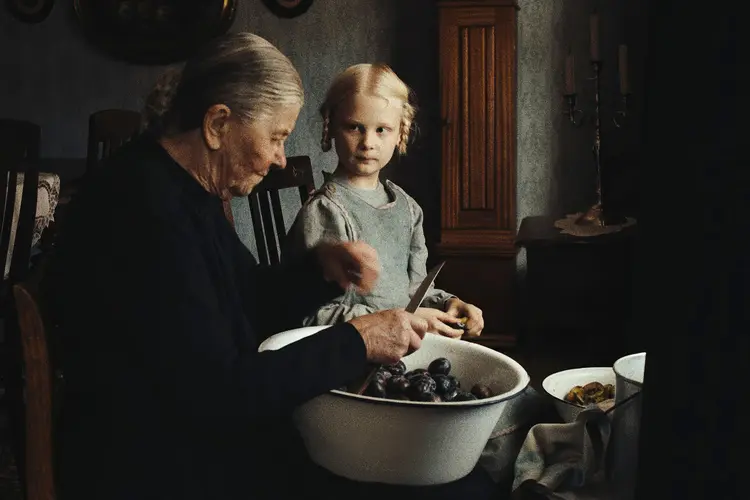
Across four generations, a series of young women learn things about themselves, their mothers, and the world around them. Through what feels at times a voyeuristic lens, Mascha Schilinski‘s Sound of Falling takes us through the history of a German farmhouse and its inhabitants in a sprawling, occasionally muddled, multifaceted saga. The film examines how things people don’t remember, or can’t remember, still impact them. On one level, it focuses on pivotal moments that alter an individual’s understanding of themselves. On another, it’s a study in generational trauma, a much-used buzzword of the times, tracking how actions can echo for decades to come.
Context, both of who these characters are and of the world outside this farmhouse, is sparse. There are two distinct references to World Wars and their implications, but aside from that, there’s little to ground the story in the world. Despite the film’s expansive runtime, it’s difficult not to leave its world wanting to know more about who the people we’ve just spent 155-minutes with really are. There are so many threads left untied, depths unplundered – what feels tonally like an intricate portrait of a family is made shallow by the scope of its ambition. Voice-overs occasionally add some context, making up for the sparse dialogue elsewhere; this is where the majority of information is transmitted to the audience. It’s occasionally confusing, given the number of characters we meet, to be certain of who is speaking.
Maybe that’s the point: most of these lives are so connected, their experiences running in parallel to one another, that it hardly matters. But it contributes to the sense that everything happening on screen is just out of reach, despite the intimacy of the filmmaking. There are shared human experiences on display here – particularly shared female experiences – and audiences are left to imprint their own memories and experiences onto them.
Hanna Heckt is particularly striking as Alma, the youngest of the main cast. At just 10 years old, the quiet intensity of her performance suggests an understanding of the world beyond her years and great things for the actor’s future. Later, Claudia Geisler-Bading gives a brief but heartbreaking performance as Irm, Angelika’s (Lena Urzendowsky) mother, whose deep sadness seeps through the screen. The lives of the older women in Sound of Falling warrant a film of their own – the sizable cast means that individual characters’ time in the spotlight is limited.
Several themes and motifs recur throughout the film. The presence of a fly is an indicator of death; several characters confront deathwish or die by suicide; mothers are both present and absent, contending with their own demons. Sometimes these are a little too on-the-nose, at odds with the dreamy, unspoken landscape that carries through each element of the story. Sound of Falling covers a lot of heavy topics, and the relentless pain and suffering characters go through could be construed as misery porn. Yet the frank way it approaches the subjects comes across as more clinical and perhaps easier to digest. There aren’t any emotional outbursts – instead, we are confronted with the impassive, sometimes guarded gazes of the young leads.
Visually, this film is a work of art. Switching from home movie-type snapshots to long, horror-esque tracking shots and first-person perspectives, it’s nothing short of beautiful, and its scratchy soundscape is hauntingly hypnotic. The non-linear structure is challenging at times, fragments of different eras slipping into each other as if to remind us, somewhat directly, of how interlinked these generations are. It also means that the viewer is frequently torn from one narrative to another, potentially limiting engagement with each story.
Sound of Falling is a hugely ambitious project, and while not every big swing lands, the overall impact is affecting. A slow, tough-at-times watch, but one that’s effect lingers like a camera flash behind the eyes.
★★★
In cinemas March 6th / Hanna Heckt, Lea Drinda, Lena Urzendowsky, Laeni Geiseler, Susanne Wuest, Luise Heyer / Dir: Mascha Schilinski / MUBI / 18
Related
Discover more from
Subscribe to get the latest posts sent to your email.
