
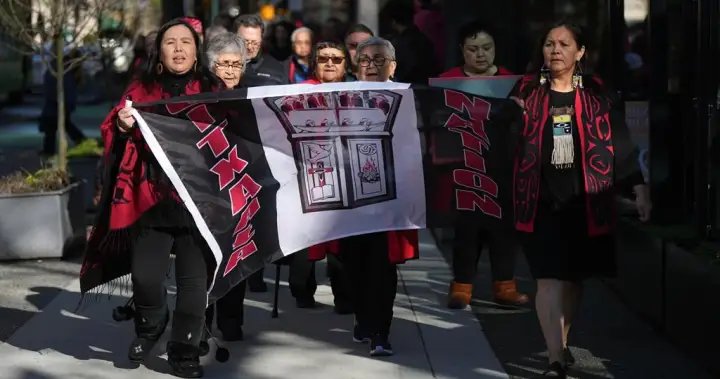
The Supreme Court of Canada has decided it will hear the B.C. government’s appeal of a precedent-setting lower court ruling on Indigenous mineral rights and the legal enforceability and interpretation of BC’s Declaration on the Rights of Indigenous Peoples Act (DRIPA).
In December, the B.C. Court of Appeal ruled in favour of the Gitxaała and Ehattesaht First Nations, who argued that the province’s mining claims system impacts Indigenous rights and is inconsistent with DRIPA.
This will be the first time that Canada’s top court will weigh in on B.C.’s controversial DRIPA legislation.
“Gitxaała brought our mineral tenure case because B.C.’s out-of-date, colonial mineral tenure regime is inconsistent with Canadian, international and Gitxaała law,” Gitxaała elected and hereditary leadership said in a statement on Thursday.

Get daily National news
Get daily Canada news delivered to your inbox so you’ll never miss the day’s top stories.
“The BC Court of Appeal agreed with us, and we are confident that justice will prevail at the Supreme Court of Canada.”

First Nations say the case carries major consequences for how DRIPA is applied, not only in B.C., but across the country.
B.C. Premier David Eby said the case affords the province two avenues to resolve the issues around DRIPA.
“So we’re open to other ways to delivering that certainty and what is the piece that we have to deliver though, is that answer to how we move forward, how we deliver that certainty, maybe through the court, maybe through negotiations,” he said.
“We’re not closing any doors. The goal here is just to find that certainty.”
The Supreme Court gives no reasons for agreeing to hear cases.
Oral arguments are expected within months, with a decision likely later next year.
Until then, uncertainty remains over how far DRIPA reaches in B.C. law.
© 2026 Global News, a division of Corus Entertainment Inc.
