
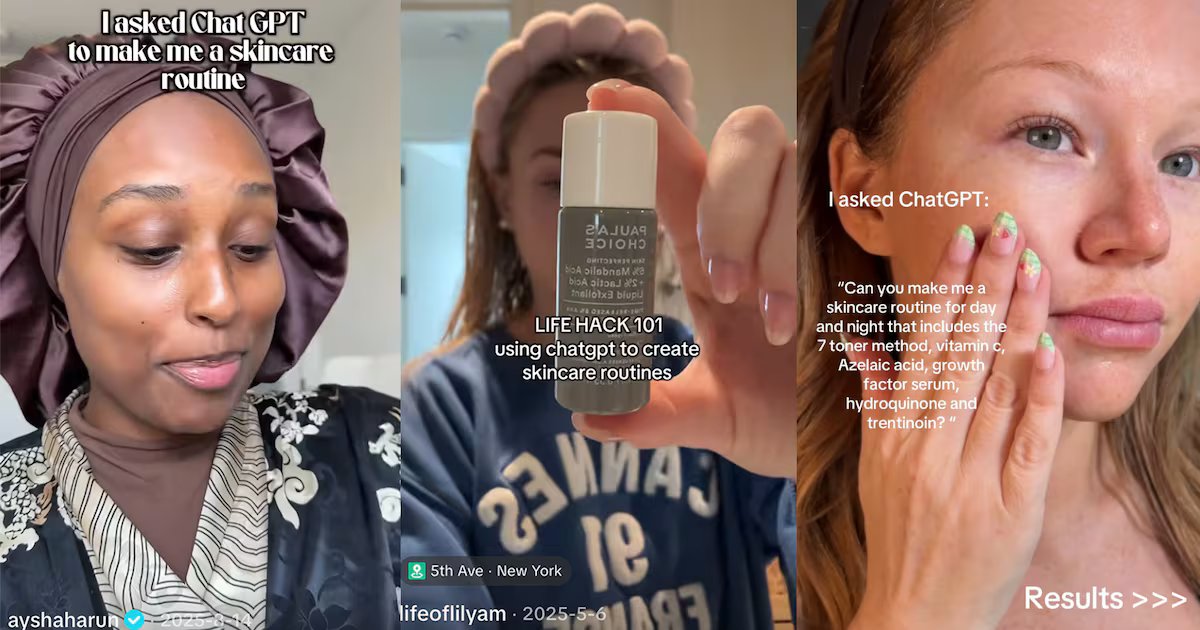
When influencer Aysha Harun found her skin breaking out on a trip to New York, she didn’t call her dermatologist or schedule an emergency appointment. She simply asked ChatGPT. The AI response told her to swap her Summer Fridays skin mist for Laneige’s hyaluronic acid- and ceramide-rich formula. It said she could keep her Glow Recipe toner, but recommended switching from daytime to nighttime use and limiting it to three times a week to prevent skin irritation.
Her TikTok video is part of a growing trend of beauty influencers asking ChatGPT to generate their skincare routines, describing the very specific prompts they put in to receive a full list of products with detailed use instructions. Hours of online research are now being compressed into a few seconds thanks to large language models (LLMs) powering tools like OpenAI’s ChatGPT, Google’s Gemini or Microsoft’s Copilot.
LLMs are also increasingly being used by shoppers. “Consumers are beginning to think of LLMs as a genuine resource and an expert,” said Tara Loftis, the global president and chief brand officer of skincare brand Byoma. Shopify, which has partnered with ChatGPT, Gemini and Copilot, has seen 15-fold growth in AI-driven searches, said president Harley Finkelstein on its earnings call in February 2026. This has motivated brands to invest in generative engine optimisation (GEO) tactics like bulking up blog post content and pitching to be included in “best of” product lists.
But tracking GEO’s return on investment is complicated. While there are plenty of tools that exist to measure search engine optimisation, and some of them work for LLMs, shoppers can write in long prompts rather than merely use keywords or phrases. LLM companies, for their part, have created features like ChatGPT’s product listing-filled “shopping research mode” introduced for Black Friday 2025 to ensure product listings show up like they would on an e-commerce site with photos rather than in text format.
Brands need to adapt quickly. Emily Rose Campbell, head of performance at digital marketing firm Iced Media, which works with brands such as La Roche-Posay on their GEO strategies, said that shopping research mode is already driving significant traffic, as LLMs become better at directing users to product pages — and making sales.
Prompting Is the New Searching
When it comes to measuring visibility on search engines, simple keywords and phrases, with reliance on Google Trends, have long been the hallmark of analysis. A consumer looking for a good vitamin C serum might type “best vitamin C serum” into Google; anticipating this, brands bolster their SEO performance on individual keywords and bid for ads to show up when people searched them.
But the myriad queries posed to AI chats calls for what has become known as “prompt volume,” experts explained. In other words, a search related to vitamin C on an LLM may expand into a description of a user’s skin type, the climate where they live, their ingredient sensitivities or even packaging preferences.
“Keywords are still very important. It’s just a matter of expanding those keywords — looking at long-tail, very detailed, specific questions,” said Katarina Christoffersen, the senior director of digital growth at digital commerce agency Front Row, which acquired performance marketing agency Socium Media in February 2026 to expand its GEO tracking capabilities.
Brands and agencies must generate thousands of possible relevant prompts to determine how often a certain brand name is showing up. In data based on 12,000 relevant searches conducted by Quilt.AI, the top skincare brands appearing in US-based searches were dermatological brands Paula’s Choice, Cerave and La Roche-Posay. Large conglomerate-owned labels made up the majority of top 10 lists for both skincare and makeup visibility, while Rare Beauty and Anastasia Beverly Hills were the only independent brands on either list.
Many brands are working to ensure LLMs not only associate their names with specific keywords, but have broader access to content on what the products do, and how they are distinct from competitors.
Determining which keywords and topics are actually trending on LLM platforms remains a challenge without a publicly available database like Google Trends. Some agencies offer this “clickstream” data, as it’s known, based on third-party sources, and must be anonymized and collected via sources where users opt in to be compliant with data protection laws. Firms that collect such data, such as Profound, do not disclose their exact sources. Each provider uses a different data set, said Campbell.

Focus groups are also part of the equation for brands with the budget, said Loftis, who noted they are useful to get a sense of how a brand’s specific customer base is using AI tools to research skincare.
But rank alone is not enough – brands need also stay vigilant about the accuracy of the product information being served up, according to Loftis.
In Harun’s video, for example, she said that ChatGPT had told her that the Summer Fridays facial mist did not have ceramides, which was inaccurate but also served as its argument for recommending another brand.
“It’s less about traffic and more about answer presence,” said Loftis. “Traffic’s no longer the only currency, which is a huge shift for us.”
The Expertise Advantage
As with SEO, there is no exact scientific formula to guarantee a brand will show up organically. But experts have identified several key factors. According to Quilt.AI, high-authority coverage in credible publications is a key advantage.
Experts say this is likely connected to why dermatological brands, rich in product education and not uncommonly cited in published clinical studies, rank so highly. A focus on specific ingredients and problem-solving language is also regarded as a major factor.
“A general product like ‘night cream’ isn’t going to be enough,” said Campbell. A product’s marketing has to go “deep on ingredients, results and benefits,” she added.
Thanks to source citation, brands can track exactly where their visibility is coming from, indicating where they can place their efforts when coming up with a GEO strategy. Experts have found that for beauty product recommendations, top sources include consumer media outlets, Reddit, YouTube, brands’ DTC sites and retailers like Sephora and Ulta Beauty. Brands have been increasingly investing in GEO strategies, ensuring that all their ingredient lists and website content can be read by the platforms and their claims are backed by clinical trials that can be picked up by LLMs.
As with traditional search, a world in which brands can spend on visibility is on its way. While Anthropic’s Claude took a strong stance on AI advertising in its recent Super Bowl ad, monetisation efforts are underway by others. On Feb. 9, ChatGPT launched its ad pilot program with big-box retailer Target among the initial participants. An announcement by Target stated that ads are activated by specific keywords and clearly differentiated from standard answers.
For now, organic performance is the priority for most brands, as ads are both experimental and expensive, said Christoffersen. But brands are preparing, equating the rollout of ads in LLMs to their introduction in Google.
“We know that LLMs are preparing for strong ad infrastructure, and the brands that are going to be late to the game are going to face the consequences,” said Loftis.
