
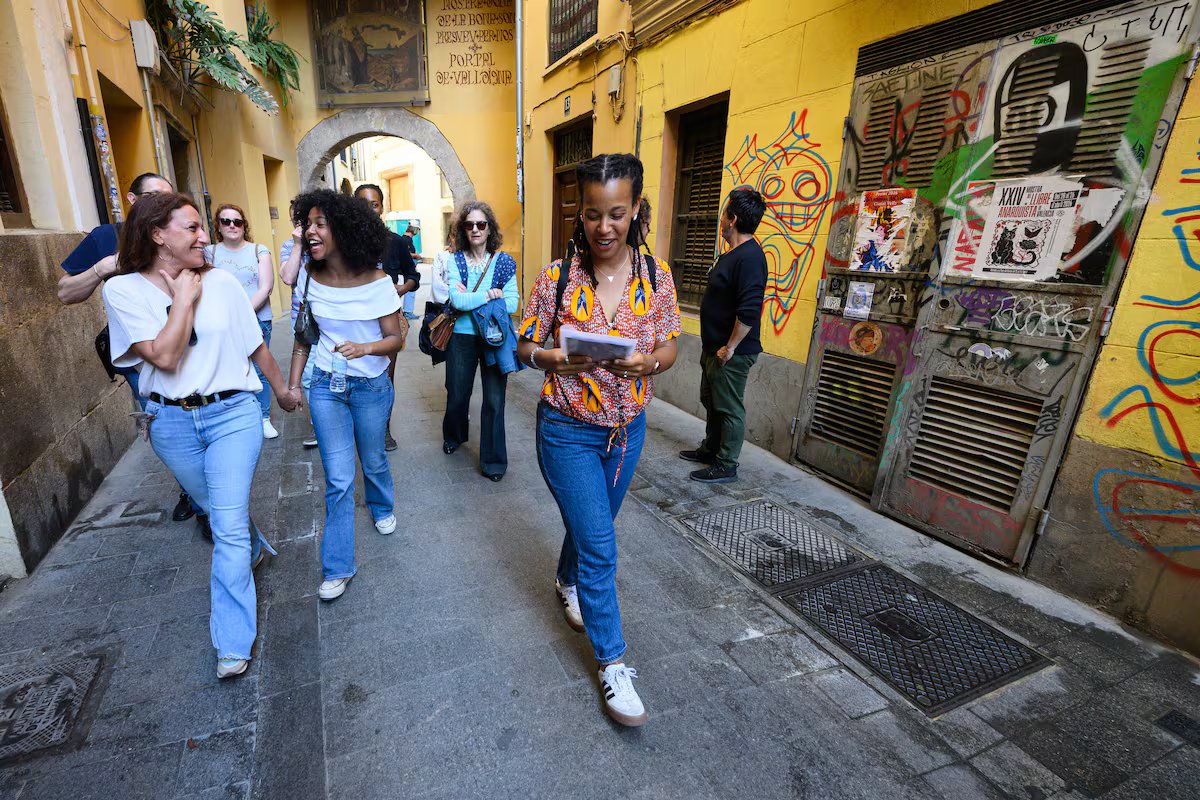
The Central Market Square in Valencia, now filled with outdoor cafes and tourists photographing its modernist dome, was for centuries one of the main sites of the slave trade in the Spanish city. This is clearly documented by archival documents: from the late 15th century, this was one of the entry points for enslaved Africans. Just a few meters away, in the now-demolished Posada del Camell, more than a hundred people were sometimes crammed together in chains, waiting to be auctioned off. And yet, there is not a single plaque to commemorate it.
“We’ve walked past these places our whole lives without knowing what happened there,” explains Deborah Ekoka, a Valencian cultural manager and the driving force behind Cartographies of Black Memory, a series of routes and activities that aims to recover the historical presence of Black and Muslim people in Valencia. The project has the support of the Trade Union Institute for Development Cooperation (ISCOD) and works in collaboration with the Valencian Museum of Ethnology (l’ETNO).
Ekoka was born in Valencia, but her father was from Equatorial Guinea. She says that growing up, she had to constantly answer the same question: “Where are you from?” Her father arrived in mainland Spain when Equatorial Guinea was still a Spanish overseas colony, with a Spanish national identity document. Even so, that origin — “with a Spanish mother and father” — has never been fully acknowledged because of the color of her skin.
Valencia is no exception. In recent years, cities such as Madrid, Barcelona, Seville and Cádiz have begun revisiting their Black and slave‑trading past through urban routes, cultural projects and academic work — a history extensively documented in public and private archives, notarial records, censuses and even Inquisition accounts of autos‑da‑fe, yet absent from the national narrative. Miguel de Cervantes, for instance, described Seville as “a chessboard,” a reference to its mixed Black and white population, recalls Ana Grau, project manager at ISCOD.
That past is inscribed in the very fabric of the city, even if it’s not always visible. Madrid, for example, still has Calle de las Negras (Street of the Black Women). But in Valencia, the street that for centuries was called Carrer dels Negres (Street of the Black People in the Valencian language) is now called Calle de las Almas (Street of the Souls). It was, Ekoka explains, one of the centers of Afro‑descendant life in the city — a place where families lived and built community for generations. “There’s no sign to remind us of it; the erasure also extends to the urban space, to the names, to what we choose to preserve and what we don’t,” says Ekoka.
For the historian José Antonio Piqueras, who heads the UNESCO Chair on Slavery and Afro‑descendence at the Jaume I University in Castellón — the only one in Spain devoted to both issues — that void is not the result of a lack of reliable sources but of a historical choice. “There is a lack of interest because there is a basic premise: denying the contribution of Black people to the very existence of the country,” he says, describing it as an effort to align more closely with white Europe.
That exclusion from the national narrative has concrete effects today. “I’ve always known the Manchegan side of my family, but not the African one,” says Esther Ejome — whose first surname is García — a Valencian Afro‑descendant teacher, speaking at one of the stops on the Valencia tour. “I was born in this city, and yet my whole life I have felt that my body has been treated as foreign,” she says, echoing Ekoka.
For Ejome, the problem lies in how the narrative has been constructed. “In the Universal History of Art, for example, Africa didn’t exist, so it wasn’t a universal history, but a Western history. But there have always been Black people on the Iberian Peninsula.”
Support networks
The documentation supporting the presence of Black people in Spain is neither minor nor marginal. José Antonio Piqueras says Valencia was one of the main slave-trading cities on the Iberian Peninsula in the late 15th and early 16th centuries. “Between 1490 and 1520, more enslaved Africans arrived here than in all of the Americas during those same years,” the historian explains. He notes, based on the research of historian Vicenta Cortés, that “one in three merchants in Valencia was involved in the slave trade” around 1500, when the city was the most populous one in the peninsula.
At certain times, he continues, around 14% of the city’s population were enslaved, and approximately half of those people were Black. “It was impossible not to see them. They were everywhere,” he says. They worked in noble households, artisan workshops, urban commerce, and public spaces.
Piqueras also insists on dismantling a common assumption. “Until the 15th and early 16th centuries, slavery was not racialized,” he points out. For centuries, he explains, enslaved people were not predominantly Black, but rather came from the Caucasus or the areas that now comprise Bulgaria and Greece. The shift occurred “from the end of the 15th century onward,” when the mass influx of people from Africa lowered costs and transformed the system. That is when the identification between enslaved person and Black person took hold — an association that, as the historian points out, would have lasting consequences.
But the archives don’t just record sales or censuses. They also document support networks and community organizations. Just a few minutes from Valencia’s Central Market, in what is now San Agustín Square, stood the Cofradía de los Negros de la Sagrada Virgen María de la Misericordia, founded in 1472, “by 40 freed Black men,” according to Ekoka. “It is one of the oldest documented Black brotherhoods in Europe, and it wasn’t just a religious institution; it was a mutual aid network, an emergency fund, a safe haven.”
The archives record cases like that of Ursola, a Black enslaved woman who was brutally beaten by her owner, Francesch Martínez. The brotherhood took her in, nursed her back to health, brought her attacker to justice, and raised the money needed to buy her freedom. Stories like this challenge the image of enslaved people as passive. “There was agency, there were support structures, and even a figure known as the procurador de los miserables — something like a public defender — who helped them report abuses or breaches of contract,” says Ejome.
There were also Black people who achieved recognition in the arts, the military, or the courts. Piqueras notes that the archives document biographies such as that of Juan Latino, a humanist and professor at the University of Granada in the 16th century, or that of Juan de Pareja, a painter and former slave who worked in Velázquez’s studio and later pursued a career of his own.
“Current racism is sustained precisely by the erasure of the Black presence in this country’s history,” says Yeison F. García López, an activist with Conciencia Afro and one of the organizers of Madrid Negro, a route similar to the one in Valencia, in the Spanish capital. “This country has tried to project a homogeneous, white image, denying its own historical diversity,” he argues.
That’s why he argues that reparative measures are needed — not just symbolic gestures. They should involve Afro‑descendant communities and lead to a thorough rethinking of the national narrative, from school curricula to urban signage, as well as access to archives and cultural production. “When that presence is erased, it creates the idea that the presence of Black people is a recent and external phenomenon,” he adds.
This is why initiatives like Valencia’s are not merely cultural exercises but interventions in the present. For those who take part in these routes, the effect is immediate: the Central Market is no longer just a modernist landmark, and Calle de las Almas is no longer just another street. Ekoka puts it simply: “Your perspective changes, and the city is no longer the same.”
Sign up for our weekly newsletter to get more English-language news coverage from EL PAÍS USA Edition
