
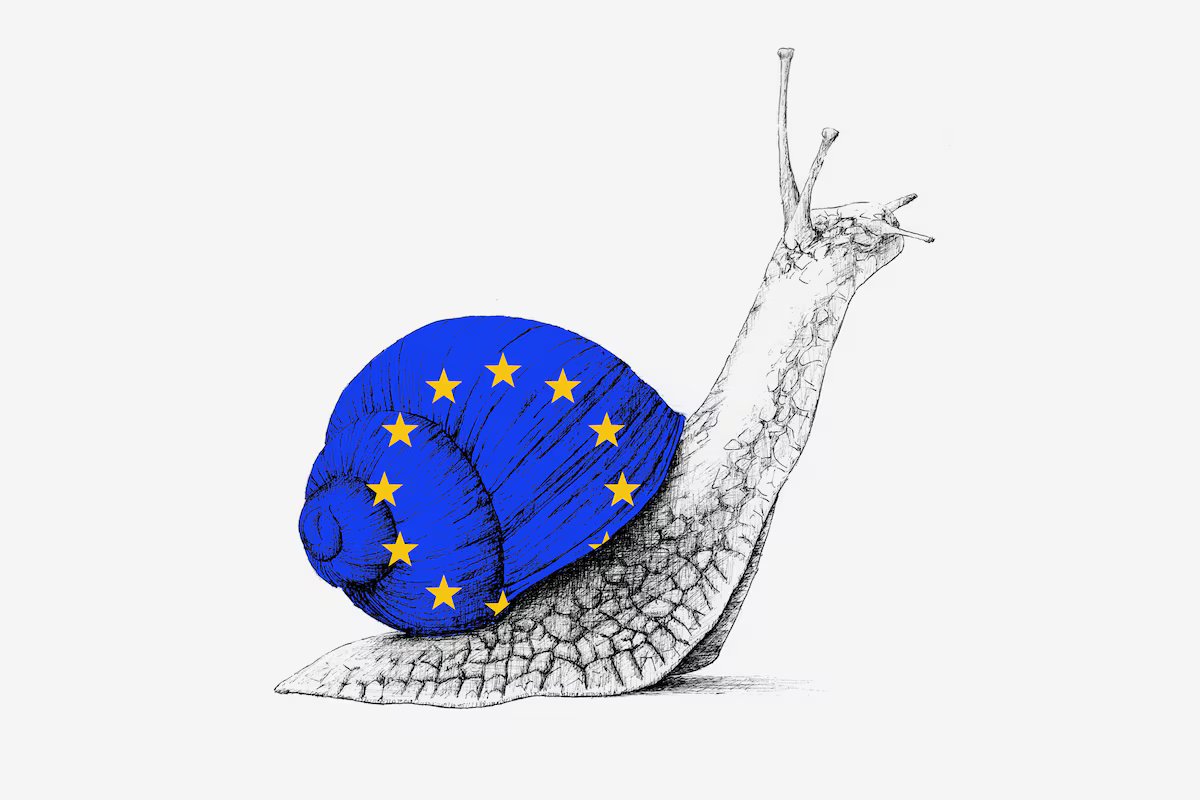
The footballing catenaccio was a strategy, originally developed in Switzerland and popularized in Italy, that prioritized airtight defense and strict man-marking. The idea was that there was no need to have the ball and build the play; it was enough to protect your own goal, counterattack, and hope to catch the opponent by surprise. It is a passive strategy, now largely obsolete, used only by teams that see themselves as inferior. Teams that see themselves as superior want to be aggressive and keep possession so they can dictate the pace of the game. Catenaccio is a strategy for not losing, not a strategy for winning.
European economic policy is a version of catenaccio, revealing either a sense of inferiority — or, even worse, a political preference for being inferior — relative to the United States and China. Playing constantly on the defensive makes progress very difficult.
China’s economic strategy, which the United States has largely begun to emulate in recent years, has been clear over the past decade: invest whatever public and private resources are necessary to become a global leader in strategic sectors. Of course, this has been accompanied by a strategy of protecting the domestic industry — but without massive investment, protection alone would have achieved nothing. This investment has benefited from a huge internal market, where companies can grow and develop until they reach the scale required to become world leaders, as well as fierce competition that encourages innovation. All of this has been supported by subsidies and public infrastructure aimed at strategic industries.
The Made in China 2025 plan, designed in 2015, established the guidelines, which have since been updated and expanded through successive five-year plans. The result has been a total public-sector deficit estimated, depending on how the public sector is defined, at between 8% and 15% of GDP, and public debt around 100% of GDP.
The outcome is well-known: China has become a leader in cutting-edge industries and increasingly dominates high-value-added sectors, where it competes directly with European exports.
About a decade ago, the United States realized that China would become a formidable competitor and tried to counter this strategy through containment measures, including import restrictions, sanctions, and more recently tariffs. But it did not work. Chinese imports, measured in value-added terms and including indirect imports, fell by only about 2%, while the containment measures actually encouraged even more Chinese investment.
For example, after restrictions were imposed on the technology sector in 2018, China designated technology as a national-security sector, and today it competes head-to-head with Silicon Valley in artificial intelligence and semiconductors. The more restrictions that were imposed, the more determined China became to achieve self-sufficiency in strategic sectors.
When the United States launched a tariff war with China in 2025, it took only a few weeks to discover China’s superiority in negotiation. China threatened to cut off supplies of rare earths, the 17 chemical elements essential to modern technology and the energy transition. The United States quickly realized that within weeks it could be left without essential components for computers, batteries, and medical and military equipment.
At that point, the United States changed strategy, deciding to imitate China and invest whatever resources were necessary to become independent in the supply of strategic materials. The Project Vault for rare-earth investment, subsidies to the production of semiconductors, public investment in technology firms, and the Defense Department’s private-equity group are all manifestations of the U.S. desire to strengthen its economy through investment so as to become less dependent on China.
The United States concluded that catenaccio did not work and that it had to strengthen itself before engaging in another trade war with China. Since then, the tone of relations has changed. Negotiations are underway to facilitate mutual investment, and Trump and Xi are scheduled to meet three times this year.
Europe, however, remained complacent in the face of China’s rise — particularly Germany’s automobile industry — and European countries remain more concerned with monitoring their neighbors’ fiscal policies than with investing to close the technological gap with the United States and China.
In 2024, the Draghi Report recommended increasing European investment by 5% of GDP annually for a decade, financed in part through eurobonds, in order to close the productivity gap with the United States. Two years have passed; only about 20% of the recommendations have been implemented, and the increase in investment has been minimal.
The same has happened with the recommendations of the Letta Report on removing barriers within the single market. Barely 10% have been implemented, and Europe still has a nationally fragmented internal market that severely limits business growth and productivity.
Even worse, negotiations over the next European budget are moving in the opposite direction. The debate is not about how much to increase the budget to provide Europe with the public goods needed to advance in cutting-edge technologies, but rather about how much to reduce it. The European budget is a clear political statement that Europe does not want to compete with China or the United States.
Most European countries, especially the so-called “frugal” ones, still prefer to be small countries in a world dominated by large powers. Politically, that is more comfortable and avoids the need for ambitious decisions. But it condemns European citizens to remain behind the United States in productivity, behind China in industrial capacity, and behind both in military and technological capabilities.
Of course, Europe must defend itself when the United States or China adopt commercial measures that harm it. But if we do not invest in strengthening ourselves, and if we do not have a genuine European single market to offer as leverage, our negotiating power is limited. A trade war with China could deprive us overnight of essential materials. A trade war with the United States could cut us off from defense supplies or access to advanced artificial-intelligence models by executive decree.
Let’s not forget: trade wars are never won, consumers ultimately pay the tariffs.
European policy remains anchored in the past and still believes that savings, trade surpluses, and adherence to fiscal rules are sufficient. Complaints that the Chinese currency is undervalued are merely a way of avoiding the reforms and investments that are actually needed.
The reality is that four years have passed since Russia’s invasion of Ukraine and there is still no European defense project. We have made no meaningful progress on banking union, capital-markets integration, eurobonds, or the European public goods required to deal with this new geoeconomic reality. It is certainly not for lack of ideas or recommendations.
The political rhetoric speaks of strategic autonomy in response to the breakdown of the international order, but the reality is that European leaders do not seem to believe that the current situation requires greater effort or policies different from those of the past.
It is the catenaccio of a small team whose ambition is simply not to lose.
Sign up for our weekly newsletter to get more English-language news coverage from EL PAÍS USA Edition
