
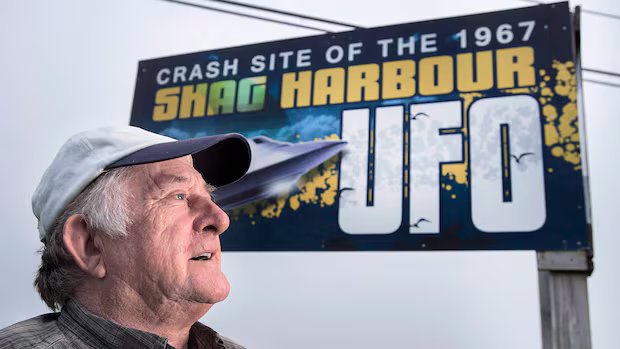
As 17-year-old Laurie Wickens drove some friends home from a dance on a clear October 1967 night, he spotted lights in the sky.
As he travelled on Highway 3 in an isolated, coastal part of southwestern Nova Scotia, he saw four lights in the sky that flashed in sequence, then all together at the same time.
All of a sudden, the object crashed into the waters off the fishing village of Shag Harbour.
Wickens drove to a phone booth and called the RCMP. He was initially met with skepticism and was asked if he’d been drinking. Shortly after the call ended, the payphone started ringing.
“When he answered, it was the RCMP,” said his daughter, Stephanie Wickens. “And they’re like, ‘Mr. Wickens, stay where you’re at. We’ve got officers coming because we’ve just got more phone calls.’ He said, ‘I told you I wasn’t lying.'”
In what came to be known as the Shag Harbour UFO incident, Wickens became its public face. It was a role that continued until his recent death at 76.
The Oct. 4, 1967, event is considered Canada’s most famous UFO incident, said UFO researcher Chris Styles, who has written books on the topic — in part because of the large witness pool, what authorities said at the time, and the subsequent paper trail left behind.
“I don’t think we’d all be talking about this today to the extent we do if it wasn’t for Laurie Wickens,” Styles said.

One of the RCMP officers who responded, Const. Ron O’Brien, described seeing a light floating about 800 metres offshore.
“It was being carried out to sea by the tide and disappeared before we could get a boat to it,” he was quoted as saying by The Canadian Press.
Styles said RCMP officers commandeered two fishing boats to see what was in the water and if there were any survivors, assuming a plane had crashed. They were joined on the boats by local fishermen and other residents, including Wickens.
“When they go out upon the water, they find a trail of odd yellow foam that’s bubbling to the surface … some say it smelled of sulphur,” said Styles, noting the foam was described as being 24 metres wide and 800 metres long.
He said depending on who you talk to, the object either disappeared or submerged.
No planes were reported to be operating in the area at the time of the incident, Styles said.
The day after the incident, Thursday, Oct. 5, the search continued. Archived CBC News footage of the day shows Wickens was part of it.

On Friday, Oct. 6, a naval diving team was brought in, and seven divers searched through the weekend.
The Canadian Press reported the depth of the water searched ranged from nine metres to 20 metres, and “visibility was good over a flat sand sea bottom.”
“They claimed to find nothing, although some local residents claimed — and it was recorded in the weekly papers — that some debris was brought up,” said Styles.
The investigation reached the highest levels of National Defence.
An Oct. 6, 1967, memo by Col. W.W. Turner, the director of operations at National Defence headquarters, noted “The Rescue Co-ordination Centre conducted [a] preliminary investigation and discounted the possibilities that the sighting was produced by an aircraft, flares, floats, or any other known objects.”
Another memo written by Turner later referred to the sighting as an unidentified flying object, but that does not mean its origins were extraterrestrial.
Styles said UFO researchers often call the events of Oct. 4, 1967, “The Night of the UFOs” because there were multiple sightings in Nova Scotia, including in Wedgeport, Sambro and Halifax, but what happened in Shag Harbour eclipsed the others. (Styles said he saw an orange orb over Halifax harbour that same night.)
Stephanie Wickens said her dad wasn’t always comfortable telling his story.
“Some people were like, ‘Oh, that didn’t happen. It’s not true,’ even though there was so many witnesses,” she said. “And I think he just kind of got out of [telling] it.”

When she was growing up, her dad was vague about what he saw. But when she was around 16, she remembers being at the family’s hunting camp when he finally shared his story.
“For a long time when I was little, he’d be like, ‘Oh, it was a plane crash,’ but then as I got older, he’s like, ‘I don’t know what it was,'” said Stephanie Wickens.
Laurie Wickens spent much of his working life in the fishing industry, mostly as a fisherman.
In his later years, he was heavily involved with the Shag Harbour UFO Incident Society, the non-profit that runs a museum and an annual UFO conference.

She said her dad could come across as gruff, but had a heart of gold and would make friends wherever he went.
Stephanie Wickens said her father would often get calls from strangers when the museum was closed or during the off-season.
“He’d be like, ‘Yeah, give me five minutes,’ and he’d go open it up for them,” she said.
In 2018, the Royal Canadian Mint started a coin series called Canada’s Unexplained Phenomena. The first was for the Falcon Lake incident in Manitoba.

Styles said Wickens contacted the mint and told them they needed to do a coin for Shag Harbour, which was released in 2019.
Styles first interviewed Wickens as a researcher, but the pair grew to become close friends. He said Wickens saw the Shag Harbour incident as an important part of the community’s history.
“His effort was to make it a living, breathing thing again, that people would drive down there and they’d let the story seep into their bones,” said Styles.
“And I think he accomplished that in spades.”
MORE TOP STORIES
