
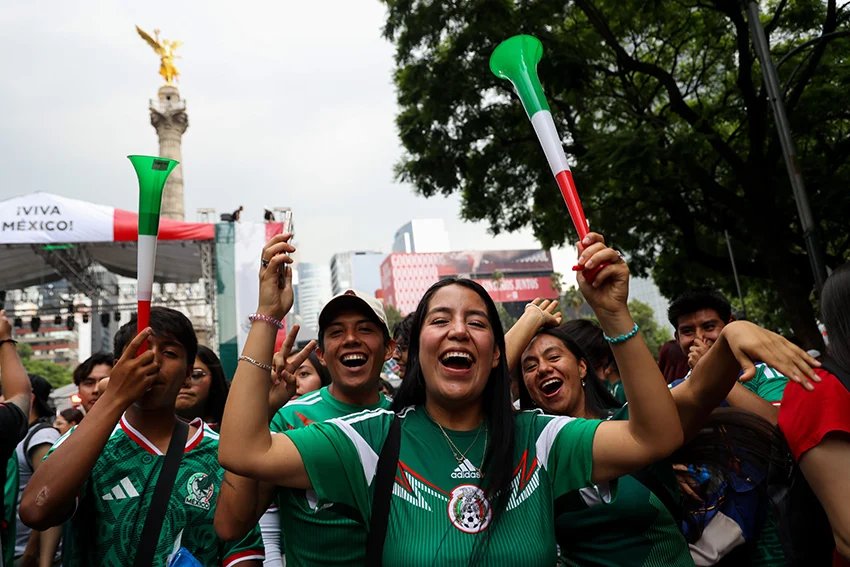
In the months leading up to the World Cup, much of the international conversation about Mexico focused on what might go wrong. Even now, with the tournament well underway, questions about security, governance and Mexico’s ability to host the event continue to surface in political rhetoric and media coverage.
The storyline has become familiar. And honestly? Exhausting.
U.S. television networks have aired images of cartel violence, armed security forces, and crime scenes while discussing the tournament. Travel advisories and news segments have warned fans about security concerns. Commentators have questioned whether visitors would feel safe attending matches, while politicians have pointed to organized crime as evidence that Mexico is still unprepared to host one of the world’s largest sporting events.
Just two weeks before kickoff, Fox News published an article warning that travel routes connected to the World Cup could carry risks related to crime and kidnapping, citing State Department advisories and emphasizing security concerns in parts of Mexico.
For anyone who follows coverage of Mexico from abroad, none of this is particularly surprising.
The country is often reduced to a familiar list of themes. Violence, cartels, corruption, crisis. What visitors, journalists and supporters have encountered during this World Cup, though, looks considerably different from the picture many were shown.
🚨 WATCH: The streets of Mexico are buzzing with World Cup fever. 🇲🇽🔥
This is what the World Cup is all about. 🏆pic.twitter.com/ihYEuij2ZC
— World Cup 2026 (@WorldCupMedia_) June 19, 2026
Mexico’s opening World Cup week delivered packed stadiums, crowded fan zones and thriving local businesses. Rather than exposing an inability to organize a major international event, the tournament has showcased a country capable of coordinating security, transportation, hospitality and logistics on a global scale.
The question isn’t whether Mexico has challenges. Every country does. But there’s a real difference between acknowledging a problem and allowing that problem to define an entire nation.
The question is whether the narrative surrounding Mexico matches the reality unfolding before millions of people during this World Cup.
And so far, the evidence suggests that it doesn’t.
According to the Confederation of National Chambers of Commerce, Services and Tourism (Concanaco Servytur), Mexico City’s opening World Cup weekend generated approximately 1.2 billion pesos (nearly US $70 million) in economic activity. Hotels, restaurants, bars, cafes, transportation services and retailers all benefited from the influx of visitors.
Far from staying away, fans arrived in force. It turns out people vote with their feet, and millions of visitors have made their choice.
Mexico City got a US $70M boost from first World Cup weekend
Reuters reported that more than 50,000 people attended the official fan zone in the Zócalo during opening festivities, while matches and related events proceeded successfully despite several planned demonstrations elsewhere in the capital.
The atmosphere hasn’t been one of fear. It’s been one of celebration.
Even the organizational side of the tournament has been revealing.
Under the security strategy known as Plan Kukulkán, authorities deployed approximately 100,000 security personnel across host cities. When an unauthorized drone approached South Korea’s training camp in Guadalajara, Mexican military personnel detected and neutralized it without disrupting preparations.
That incident received little international attention, but unfortunately, problems that are prevented rarely become headlines.
And that brings us back to the larger conversation.
At the G7 summit this week, U.S. President Donald Trump declared that Mexico had “lost control” of the country and that “the cartels control Mexico.” Later in the week, Vice President JD Vance stated that the United States reserves the right to take military action against cartels inside Mexico if Washington deems it necessary, while also saying cooperation remains the preferred approach.
These comments weren’t made before the World Cup, when questions about Mexico’s readiness were still hypothetical. They were made during the tournament, while Mexico is actively hosting one of the largest sporting events on Earth.
🚨#Ahora | Donald Trump insiste: “Los cárteles gobiernan México, es triste”.
“La presidenta es una mujer muy buena”, dice sobre Claudia Sheinbaum desde el G7. “Pero es una mujer muy asustada”.
pic.twitter.com/XBKs2cO86D— Azucena Uresti (@azucenau) June 17, 2026
And that raises a simple question. What exactly is the purpose of that message?
If cooperation is the preferred path, why lead with the suggestion of unilateral military action? What does it add to the conversation besides reinforcing the same image of Mexico as a country defined by instability?
Security concerns deserve serious discussion, of course, but there’s a difference between discussing a challenge and presenting an entire nation through its worst-case scenario.
Every time Mexico hosts a major event, attracts visitors, or demonstrates institutional competence, there seems to be a rush to explain why none of it counts. The conversation quickly returns to the same images and the same talking points.
No serious person argues that Mexico is free of problems, but it’s also a country of modern infrastructure, capable institutions, vibrant communities, and people who are welcoming the world.
The fight against transnational criminal organizations is serious and ongoing. But it’s not Mexico’s burden alone. Fentanyl trafficking, weapons smuggling, money laundering and organized crime networks operate across borders, and the United States is also part of the equation. Addressing those issues requires cooperation and serious policy, not narratives that reduce a nation of more than 130 million people to its worst headlines.
What the first week of the World Cup has demonstrated isn’t that Mexico has no challenges. It’s that many assumptions about Mexico’s inability to host this tournament were overstated.
Perhaps that’s the real story. Not that Mexico is perfect. But that it continues to be judged through a lens that often struggles to see anything else.
Mexico deserves to be judged by evidence rather than assumptions, and on the reality people are seeing, not the fears projected onto it.
Charlotte Smith is a writer and journalist based in Mexico. Her work focuses on travel, politics, and community. You can follow along with her travel stories at www.salsaandserendipity.com.
