
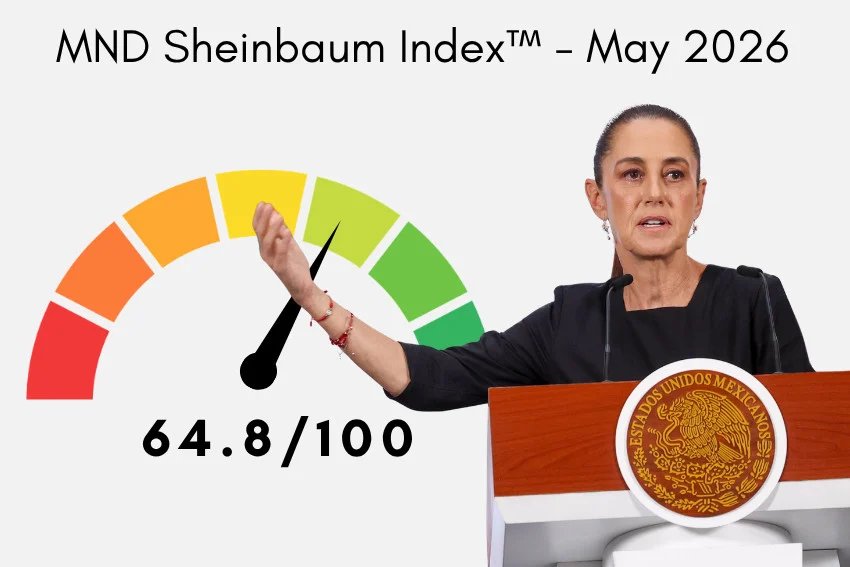
THE MND SHEINBAUM INDEX™
Measuring Mexico’s president beyond the polls
MND Intelligence · Third edition
Welcome to the third edition of the MND Sheinbaum Index™, an eight-pillar index designed to give our readers balanced, data-driven insight into the current situation in Mexico across a range of areas under the leadership of President Claudia Sheinbaum.
As we wrote in our inaugural Sheinbaum Index article, most of what you hear anecdotally about Claudia Sheinbaum fits into one of two buckets: breathless admiration or reflexive dismissal, often without a lot of evidence or data to support the opinion expressed.
Neither tells you much about how Mexico is actually doing on her watch. The MND Sheinbaum Index™ was built to fill that gap.
In this third edition of the index — which mainly uses data from the month of May — the headline number is 64.8, representing an improvement of 4.8 points compared to the previous score. A detailed summary of the latest results appears below.
If you need a reminder on how the index works and how each of the eight equally weighted pillars is scored, please read the second edition of the MND Sheinbaum Index™.
Before we look in detail at the latest results and examine the index trend in early 2026, here is a short guide to the significance of a Sheinbaum Index score:
- 85–100: Exceptional — administration performing at a high level across nearly all indicators.
- 75–84: Excellent — administration performing well across most indicators.
- 60–75: Quite good, but room for improvement — meaningful strengths, some areas of concern.
- 50–60: Mixed — passing marks overall.
- Below 50: Broad underperformance — more indicators below benchmark than above.
* MND acknowledges that President Sheinbaum does not directly control outcomes in all eight pillars. For example, global commodity prices and tariff decisions in Washington can affect Mexico’s inflation and growth rates. The Index measures what is happening in Mexico on Sheinbaum’s watch.

** We note that for this edition of the MND Sheinbaum Index™ we made a slight tweak to our index methodology, and consequently, the overall index score is 1.1 points higher than what it would have been. Instead of scoring unemployment based on the year-over-year change in the unemployment rate, we are now measuring the unemployment rate — which constitutes 50% of the employment pillar — against a 3% benchmark. A rate of 3% yields a score of 60, whereas a rate of 2% (or any number below that rate) gets a perfect 100. Thus, four points are subtracted for every 0.1 percentage point that the unemployment rate rises above 2%. We note that this change makes a comparison between the latest index score and the previous one imperfect. However, we believe that this is a fairer way of scoring Mexico’s unemployment rate, which is one of the lowest among the 38 OECD countries.
The MND Sheinbaum Index™ trend in 2026
The MND Sheinbaum Index™ score is now back to where it was in February after dipping to just above 60 in March and 60 flat in April. Factors such as inflation of around 4.5% in each of March and April, as well as annual economic growth of 0.5% or lower in those months, caused the deterioration in the index score compared to February, when inflation was very close to 4% and economic growth was above 1%.
The 4.8-point, month-over-month improvement in the index score in May was mainly due to inflation falling below 4%, homicides declining at a faster annual pace and economic growth improving. Scores for five of the eight index pillars increased in May compared to the previous month. More detail on the performance of each of the pillars in May is provided below.

MND Sheinbaum Index™ pillars for May 2026
Each pillar is given a stoplight color indicating a strong performance (green), an average performance (yellow) or a poor performance (red). An upward-pointing arrow ⬆️ indicates that the pillar score improved compared to April. A downward-pointing arrow ⬇️ indicates a deterioration in the pillar score. A pause icon ⏸️ means there was no change in the pillar score compared to the previous month.
🟢 ⬆️ INFLATION (10.15 out of 12.50)
In May, the inflation pillar replaced the labor poverty pillar as the top contributor to the overall index score. Mexico’s annual headline inflation rate eased from 4.45% in April to 3.94% in May, the lowest reading since January and just 0.94 percentage points above the Bank of Mexico’s 3% target. The inflation pillar score consequently rose to 10.15 from 8.88 in April — a gain of 1.27 points.
🟢 ⏸️ LABOR POVERTY (10.10 out of 12.50)
The labor poverty pillar score was unchanged from April at 10.10. The labor poverty rate decreased 3.2 percentage points annually in the first quarter of 2026 — the same reading as April, as this pillar runs on a quarterly lag. Real incomes increased 7.4% year-over-year, also unchanged from last month.
🟢 ⬇️ TOURISM (8.78 out of 12.50 — This pillar has a one-month lag)
International arrivals increased 8.1% year-over-year in April, the data period used for May’s index. That represents a slowdown from the 11.9% rise recorded in March, pulling the tourism pillar score down from 9.97 in April to 8.78 in May.
🟡 ⬆️ SECURITY (8.58 out of 12.50)
The pace of homicide reduction accelerated in May after three consecutive months of slowing. The year-over-year decline in homicides was 27.6% in May, per data presented at Sheinbaum’s June 16 press conference, up from 20.3% in April. The security pillar score consequently rose from 7.30 in April to 8.58 in May.
🟡 ⬆️ APPROVAL RATING (8.56 out of 12.50)
Sheinbaum’s average approval rating edged up slightly to 68.5% in May from 68.2% in April. Thus, the approval rating pillar score nudged up from 8.53 in April to 8.56 in May. At the time of publication, Mitofsky/El Economista had not published poll results for May, so we substituted the Enkoll/El País/W Radio poll in its place. That poll detected a 68% approval rating for the president. Per El Financiero, Sheinbaum’s approval rating was 69% in May.
🟡 ⬆️ EMPLOYMENT (7 out of 12.50)
Mexico’s unemployment rate, at 2.8% in May, was unchanged compared to a year earlier. This component of the pillar was scored at 68 out of 100, as the unemployment rate was slightly better than the neutral 3% benchmark (60 points). The informality rate increased 0.3 percentage points year-over-year in May, an improvement on the 0.5-point rise recorded in April. As both sub-components improved — the unemployment component in accordance with the tweaked methodology — the employment pillar score increased from 5.63 in April to 7 in May. While unemployment in Mexico is quite low, the percentage of workers employed in the informal economy is very high — 55.2% in May.
🟡 ⏸️ BUSINESS CONFIDENCE (6.36 out of 12.50)
Mexico’s business confidence score, as measured by a monthly INEGI survey, was 48.2 in May, unchanged from April. The FDI component also held steady at +10.4% year-over-year, as the latest available data is once again the Q1 2026 figure reported by the federal Economy Ministry in late May. With no movement in either sub-component, the business confidence pillar score was unchanged at 6.36.
🔴 ⬆️ ECONOMIC GROWTH (5.25 out of 12.50)
Year-over-year economic growth in May was 1.1%, according to preliminary data from INEGI — an improvement on April’s 0.3% preliminary reading — which was revised upward to 2.2% — but still well below the 2% anchor that earns a neutral score of 60. The economic growth pillar score rose from 3.25 in April to 5.25 in May, though the pillar remains the worst-performing of the MND Sheinbaum Index™.

What to watch
The next MND Sheinbaum Index™ will focus on the month of June.
Here are three things to look out for in the June Index, which we will publish in early August.
- Inflation: Data for the first half of June indicates that the score for the inflation pillar will continue to improve. INEGI reported last week that the annual headline rate was 3.55% in the first 15 days of June, a significant improvement from the 3.94% reading for May as a whole.
- Employment: When we publish our next MND Sheinbaum Index™, we will be able to directly compare the overall index score, and the employment pillar score, to those of this edition as for a second time we will have used the slightly-tweaked methodology. In each of our three focus months to date — March, April and May — Mexico’s stubbornly-high informality increased from a year earlier. A better performance in this component of the employment pillar is much-needed and would help lift the overall index score.
- Economic growth: Mexico hosted 12 FIFA men’s World Cup games in June, and according to business group Concanaco, there was a tournament-related economic windfall of US $1 billion in the first 13 days of the tournament (June 11-24). It will be interesting to see whether this spending gives a boost to Mexico’s annual growth rate in June.
Mexico News Daily
