
Trickledown economics sets the stage
With the election of British Prime Minister Margaret Thatcher in 1979 in the UK, and President Ronald Reagan in 1980 in the US, the progressive era ended. Ushered in was the beginning of a regressive era, where both pre-war and post-war progressive laws and regulations protecting the public interest and the environment were steadily eliminated.
Enabled by their politician servants, Capitalism broke out of its cage and over the next two decades dismantled the cage bar by bar and resumed its quest for unfettered profits and the power and control to guarantee deregulated free markets. Their narrative of tax cuts, deregulation and privatization, promised prosperity for all.
In the UK it was called Thatcherism. In the US it was called Reaganomics. Decades of progress were dismantled and the wealthy received big tax cuts.
Reagan cut taxes from 73 per cent to 28 per cent on the wealthy. Reagan cut the corporate tax rate from 46 per cent to 34 per cent. Thatcher cut the corporate tax from 52 per cent to 35 per cent.
Politicians and governments of every stripe have forwarded this narrative. It was particularly Conservative politicians who promised this trio of policies would bring in prosperity for all, by incentivizing investment.
Politicians promised the wealthy and their corporations would reinvest their profits creating more jobs. They also promised that these policies would create more competition, more innovation and lower costs through “increased efficiencies”. It became known as “trickledown economics” on the belief that profits and money would eventually trickledown to everyone.
Both Reagan and Thatcher championed privatization of public owned industries and assets. It was George HW Bush who called it “voodoo economics.”
Governments in more than 100 countries were convinced to sell thousands of businesses to the private sector, including airlines, railroads, electrical utilities, water and postal services. As of 2015, the value of this transfer of public wealth to capitalist interests was valued at more than $3.3 trillion.
The narrative of deregulation and eliminating regulations that protected the public interest and our health and the environment quickly evolved into the deliberately derogatory term “red tape.” Red tape was touted as bad and some kind of barrier to prosperity, restricting innovation and growth. It is as ridiculous as Monty Python’s “the ministry of silly walks.” In Canada there is even a national red tape office and in Ontario the “ministry of red tape reduction” with very serious consequences.
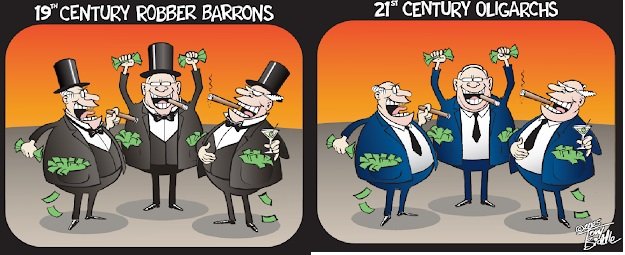
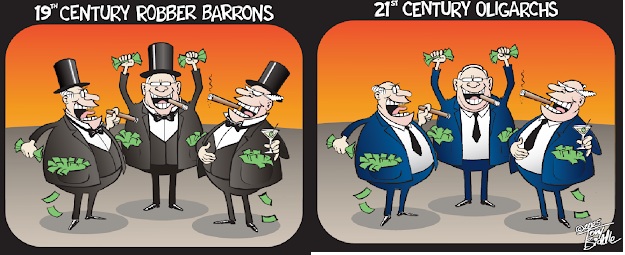
This set up the conditions enabling today’s oligarchs to massively increase their total wealth.
Capitalism keeps on repeating the big lie over and over again until it is believed. This narrative put out by wealthy friendly media continues the narrative of tax cuts, cutting red tape and the increased efficiencies of private ownership continuously today.
Out of its cage, capitalism went back to attacking and weakening unions with the narrative that unions were no longer necessary, and belonging to a union was somehow an infringement on your rights as a person who wanted to work. This resulted in the creation of “right to work” laws claiming the automatic collection of union dues from paychecks was a violation of rights and the freedom to work was being given.
The 1990s saw an increase in right to work laws in the US. Twenty-six states have now enacted right to work laws prohibiting mandatory union membership and the payment of union dues as a condition of employment was made illegal.
Working conditions, wages and benefits in those states have severely deteriorated. The wealthy went back to manipulating markets and even committing corporate fraud through corporations like Enron and World Com as well as banker and investor fraud.
The elimination of banking and investor regulations caused four financial meltdowns that hurt the public and ordinary working people.
The recession of 1981, the recession of 1991, the Savings and Loan scandal in 1989, where excessive lending, speculation deregulation, and insider fraud, caused more than 1,000 Savings and Loan institutions to fail. It cost American taxpayers $132 billion in a bailout initiated by the federal government. Capitalism went back to the same pump and dump schemes that caused the great depression in the dot com market crash in 2000. Capital markets, venture capitalists, investment banks and brokerage houses publicly hyped up and then sold shares at a profit. All backed up by the Federal Reserve.
The 2008 financial crisis was arguably the biggest corporate fraud in history. Banks and financial institutions gave mortgages to just about everyone who applied whether they qualified or not. Thanks to financial deregulation, lenders were willing to take the risk of nonpayment because they simply packaged up these loans into an instrument they sold, passing the risk onto investors.
These worthless instruments crashed. The 2008 financial crisis is one of the five worst financial crises the world has ever seen. It led to a loss of more than $2 trillion dollars from the world economy. “Too big to fail,” was the cry from capitalists. Support for AIG (America International Group) cost the US government approximately $182 billion.
Trickledown policies were the center piece of Ontario Premier Mike Harris’ “Common Sense Revolution” that Ontarians lived through from 1995-2003. Tax cuts for the wealthy, deregulation and privatization figured prominently. In 2000, Hwy 407 was privatized in a 99-year lease. In a far worse deal, the Bruce nuclear plant was privatized through a long-term lease. The profits were privatized but the debt, risks and pollution remained public.
In 1998, Harris turned every municipal and provincial utility from a public non-profit hydro commission into artificially created for-profit corporations.
Today, Premier Doug Ford is strictly adhering to trickledown policies, implementing big tax cuts for corporations under the cover of small tax cuts to ordinary citizens. Ford is eliminating rules and regulations in every bill as well as deliberately cutting and underfunding public services to create privatization opportunities.
Both Trump and Conservative leader Pierre Poilievre are presenting the “common sense” policies of tax cuts, cutting red tape, and privatization as irrefutable and indisputable facts. They continuously promise prosperity by saying things like, “all boats will be lifted by the rising tide.”
In the UK in September of 2022, Conservative Prime Minister Liz Trust tried to bring in a 45-billion-pound unfunded tax cut for the wealthy promising it would spur economic growth. It caused stock market chaos and a huge backlash. Liz Truss was forced to drop her tax cut plan and resigned. The shortest prime minister’s term in British history.
Even though trickledown economics has been repeatedly discredited and debunked, conservatives everywhere keep on promising more of the same. Their think tank, the Fraser Institute, even made the false claim that the Mike Harris tax cuts brought in an era of prosperity. The facts are clear:under trickledown policies, the rich got much richer and will continue to get richer while more and more people, suffer deprivation.
Disaster capitalism
A new form of capitalism rose during the 1990’s. Disaster capitalism is where capitalism either takes advantage of natural disasters, wars, and economic crises.
Standard operating procedure for corporate friendly governments is creating a crisis, with tax cuts and underfunding, or just claiming a fictitious crisis to privatize public assets and services.
Disaster capitalism is also used to implement deregulation and austerity measures, drastically cutting public spending. Disaster capitalism has been brilliantly outlined by Naomi Klein in her book, The Shock Doctrine.
Ontario Premier Doug Ford used the crisis of the COVID-19 pandemic to suspend the “Environmental Bill of Rights.” Former Ontario Premier Mike Harris’ education minister John Snobelen spilled the beans when he said, “first you have to create a crisis.”
In her book, Klein argues that disaster capitalism is not a natural outcome of crises, but a deliberate strategy employed by powerful corporations to reshape societies and economies, to increase profits from disaster relief, resource extraction and infrastructure development. The consequences of disaster capitalism are clear. There is an ever-widening inequality gap of haves and have nots, weakened privatized public services, and environmental damage.
United States especially under certain Republican state administrations, have embraced versions of this strategy for decades. In places like Texas, natural disasters like Hurricane Harvey and the 2021 winter storm were met not with strengthened public infrastructure but deregulation and further privatization of the energy grid, which had already been separated from federal regulation. In education, some states have underfunded public schools to the point of crisis, then promoted voucher systems and charter schools as a lifeline with clear benefits to private operators. New Orlean’s public housing was privatized after hurricane Katrina.
Greece offers a dramatic example, particularly during the Eurozone Crisis. When public debt spiraled, austerity measures imposed by the European Union and the International Monetary Fund demanded massive sell offs of public assets, airports, ports and energy utilities at depressed prices. These moves were justified as necessary to restore fiscal health, but in practice they gutted public control over critical infrastructure. The Greek people bore the brunt of a crisis they did not create, while multinational investors reaped the benefits.
Chile, once the original laboratory for Shock Doctrine economics under Pinochet, has continued to exhibit this logic in democratic form through successive administrations, especially regarding pensions, water rights, and education. Even after the end of the dictatorship, Chile’s deeply privatized model, particularly in healthcare and retirement has been maintained under the guise of “efficiency” and “market innovation.” Protests in 2019 revealed the social costs of this model, but Chile’s wealthy still frame any attempt to reinvest in public systems as economically reckless or unsustainable.
France, under President Emmanuel Macron, one can observe a skilled and shrewder form of crisis leverage. Pension reforms, presented as fiscally necessary amid demographic pressures, have been pushed forward even amid massive public resistance. The framing relies on the language of crisis economics, generational, or demographics to justify a weakening of public guarantees in favor of private alternatives, despite France’s strong tradition of social welfare protections.
Australia, a country very much like Canada and is seen as a stable democracy. The pandemic became an occasion for rapid expansion of surveillance technologies and the outsourcing of public functions, such as quarantine enforcement and contact tracing, to private firms with little oversight. Critics pointed out that the militarization of pandemic response and the privatization of quarantine hotels created both public health risks and transparency concerns.
Iraq after the US invasion under false pretenses, in March of 2003, called “Operation Freedom,” Iraq’s resources were privatized.
Turkey, after the 2016 coup attempt, President Erdogan declared an emergency and pushed through mass privatizations, weakened labor protections and redirected public funds to loyalist business conglomerates under the guise of national security.
Britain is the closest parallel to Ontario with similar conservative governments. After the 2008 financial crisis and with increasing fury during the COVID crisis, witnessed deep cuts to public services under the justification of fiscal prudence. The National Health Service, once the crown jewel of British public infrastructure, saw creeping privatization through outsourcing, private finance initiatives like, P3’s Public Private Partnerships, and contract handovers to corporations with close ties to the governing party. During the pandemic, emergency procurement laws were used to award billions in contracts to firms with no transparency and often no relevant experience. A typical crisis capitalism maneuver. The crisis was real but the government’s response was engineered to prioritize deregulation and profits.
The Philippines, Serbia and South Africa have also used crisis capitalism to bring in tax cuts, deregulation and privatization.
In Part 4, we discuss oligarch actions and influences as well as Canadian oligarch influenced provinces.
The post The Oligarch Chronicles Part 3 appeared first on rabble.ca.
