

Read the latest version of The State of Fashion report by McKinsey & Company and BoF Insights here.
This article first appeared in The State of Fashion: Technology, an in-depth report co-published by BoF and McKinsey & Company.
It’s no secret that fashion brands need to make highly personalised customer experience a cornerstone of their digital businesses. Their customers expect nothing less. Consumers have had their personalisation expectations redefined by the likes of Netflix, Spotify and Amazon. Shoppers expect brands to provide them with product choices and experiences that are tailored to their individual preferences. Indeed, 71 percent of global consumers want companies to deliver personalised communications and products, and 76 percent are unhappy when this is not offered.
Not so long ago, a personalised experience in fashion was something only very high-end, luxury shoppers could receive. Luxury boutique associates would lavish attention on key customers, manually recording an individual’s personal tastes and shopping habits in notebook after notebook to help them tailor their service. Building a long-lasting rapport with these shoppers was an exclusive, elaborate, not to mention inefficient, exercise.
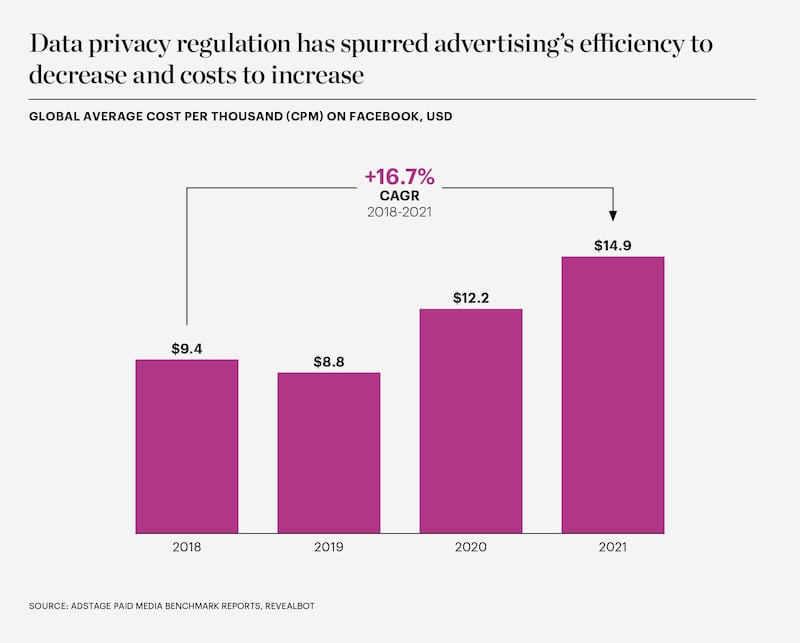
Fast forward to today and brands are facing a convergence of factors that make personalisation a priority. Declining brand loyalty among customers and increased competition for attention from social media platforms, along with tightening regulations and moves by Apple and Google to modify access to third-party data, are all impacting the ability of brands to connect with customers online. Now more than ever, personalisation can hold the key for brands to capture market share.
Shoppers expect brands to provide them with product choices and experiences that are tailored to their individual preferences.
That said, the fashion industry today generally confines personalisation to marketing recommendations for customer sub-segments, based on past purchases or online browsing history, held back by talent and technology constraints. There’s scope to go further. For the first time, businesses have tools that enable them to work with all types of data across channels in real time.
This is evident in e-commerce, where platforms powered by cloud-based technologies could run AI or machine learning algorithms to accelerate the processing and analysis of Big Data on customer behaviour. The result of these analytical capabilities would mean brands are equipped to provide hyper-personalised, one-to-one experiences — similar to those of the sales associate in an exclusive boutique, but available to customers across all fashion segments, from high street to luxury.
Offering hyper personalisation will require companies to reimagine how e-commerce operates. Search-based shopping is likely to shift to the individualised discovery of products and styles offered in the right size and fit. All customers will have a curated experience on their own versions of brand websites and marketplaces, from landing page to payment, akin to their experience on social media feeds. With this, companies will use personalisation technology to build experiences that drive customer engagement and, ultimately, loyalty.
Fashion retailer Zalando has taken steps towards this vision. It uses data analytics to offer its customers millions of tailored “Zalando interfaces.” By incorporating preferences into its algorithm, product displays are automatically tailored to each customer, from size to their favourite brands. The retailer is also exploring 3D body scanning technology to enhance size and fit selections.
Another company embracing this opportunity is The Yes. The fashion marketplace has built an extensive product taxonomy while also deploying machine learning and computer vision to synthesise hundreds of data points for each product. The algorithm then translates shopper preferences into a personalised exploration feed.
Meanwhile, styling service Stitch Fix tailors products to customers’ tastes and needs and uses a discovery tool called “style shuffle” to help users indicate designers they like. Fast-fashion player Shein offers each customer a scrollable feed of products powered by a real-time recommendation algorithm informed by myriad data points across social media and other channels.
Offering hyper personalisation will require companies to reimagine the way that fashion e-commerce operates across platforms — a potentially complex, fast-evolving challenge.
Looking ahead in the luxury segment, hyper personalisation is set to also play out in physical stores. Store associates can leverage first-party data to provide customers with a unique experience no matter which store they enter, taking in-store clienteling to the next level. What’s more, as technologies advance, it is feasible that brands will be able to create digital wardrobes for each customer along with personalised styling recommendations.
Offering hyper personalisation will require companies to reimagine the way that fashion e-commerce operates across platforms — a potentially complex, fast-evolving challenge that can overwhelm brands. This can be managed by:
Accelerating first-party data collection
- Challenge: Changes to data privacy laws and restrictions on third-party data collection in various jurisdictions have rendered data management platforms and third-party cookies less relevant.
- Solution: Brands need to maximise their first-party data collection to enable personalisation across platforms and channels. This can happen, for example, through loyalty programmes that help identify and link customer purchases online and offline. In-store apps can also track offline browsing behaviour, and brands can create campaigns that collect data in exchange for loyalty points or discounts. In these efforts, brands need to be mindful of adhering to data privacy regulations (e.g. GDPR in Europe).
Creating a 360-degree customer view
- Challenge: When shopping for fashion, customers can generate a vast amount of data across channels and platforms — ranging from location data to website or app engagement time. This data tends to be unstructured, in multiple formats and scattered across different databases. In isolation, this provides little or no insight.
- Solution: Brands need to establish a complete customer profile connected to a unique ID across data sources and channels. A customer data platform is needed to host all data assets and consolidate the customer view, as are rigorous data standardisation and cleaning processes. The result is brands could create a single dataset that joins up customer preferences and behaviours at a granular level across platforms, channels and product categories. For retailers, this could also span data from different brands. Companies should consult current data legislation when creating these customer profiles.
Aligning the ‘human touch’ and AI
- Challenge: Fashion customer behaviour can be difficult to predict, not least because of fashion’s rapid trend cycles and the low levels of repeat purchasing among individual shoppers. Furthermore, a stand-alone personalised algorithm might not align with a brand’s strategic priorities without human intervention.
- Solution: Players need to develop advanced AI models, such as those that display products and photo styles best suited to the individual customer, or models that use advanced size and fit algorithms. These models should incorporate behavioural data, such as login time and add-to-cart behaviours, along with nuances relating to the brand’s market and segment positioning.
Scaling personalisation solutions
- Challenge: A significant platform upgrade is required to deliver sophisticated, hyper-personalised e-commerce content, which is informed by thousands of data points and delivered across multiple channels with ultra-fast loading times.
- Solution: A company’s portfolio of design and distribution tools needs to include content management systems that can standardise, centralise and distribute digital elements to support marketing alongside content delivery networks that help deliver thousands of unique landing and content pages. Their portfolio should also include an e-commerce platform for their website and app, so that brands can deliver personalisation to every customer across all journeys.
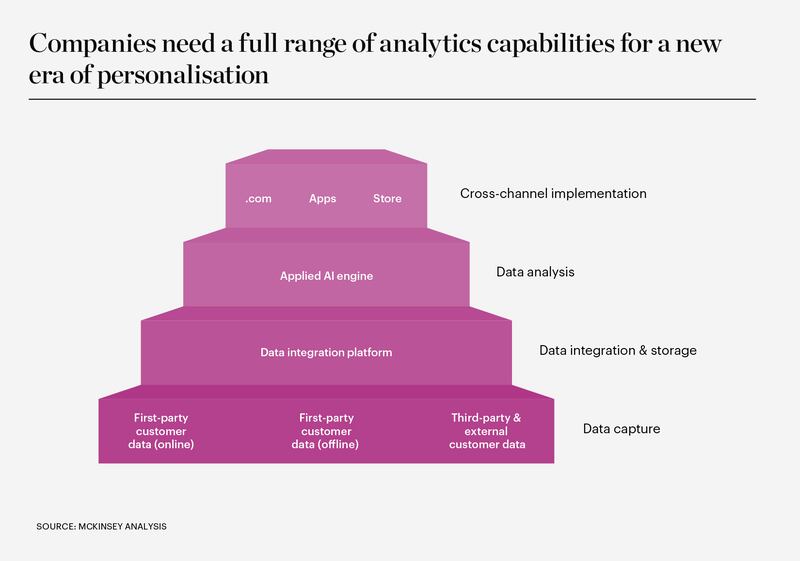
A priority for executives should be to establish hyper personalisation as a core competency. Brands will need to invest strategically across all their data and analytics activations, from collection to cross-channel implementation. In many cases, this will mean setting up a dedicated cross-functional team, comprising product managers, marketing domain experts, software engineers and data scientists. Brands that set themselves up to win will hone their ability to deliver intelligent, targeted marketing and e-commerce solutions for every customer.
 Opens in new window