
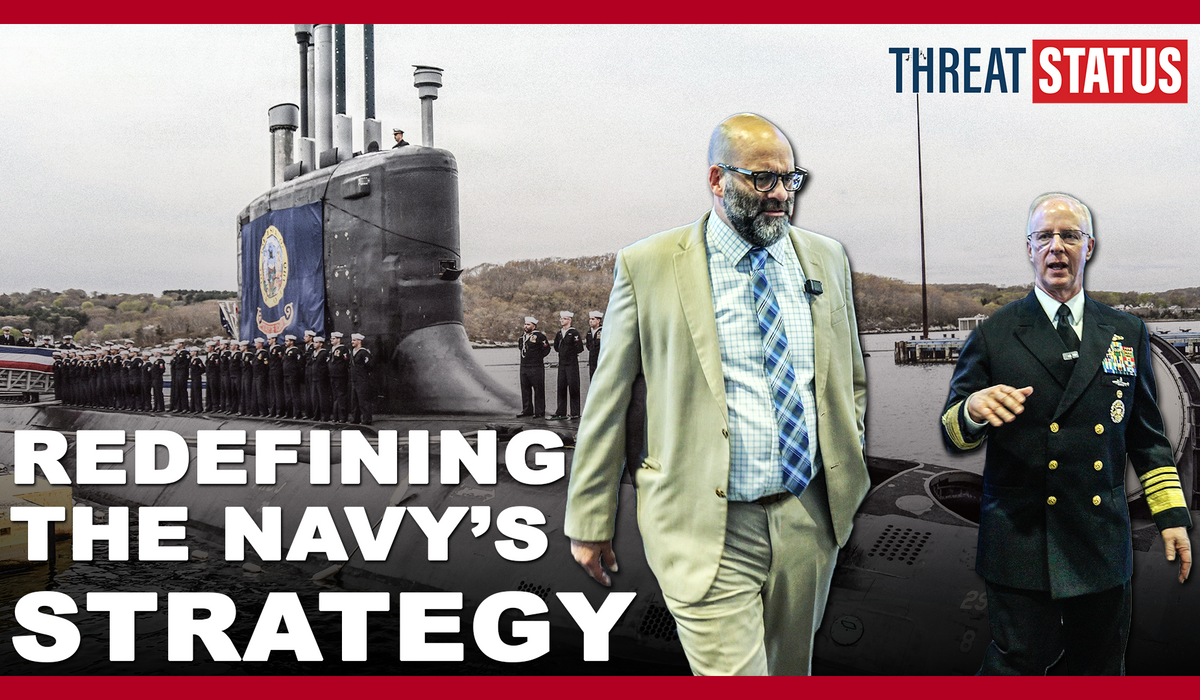
U.S. Naval dominance is being confronted by China and by a surge of disruptive technological change. The Trump administration has responded with its Golden Fleet initiative to address increasingly complex challenges on the world stage.
I’m Guy Taylor, National Security Editor at The Washington Times.
And for this edition of the Threat Status Influencers Series, we’re at National Harbor, Maryland at the Sea Air Space 2026 Expo. And we’re joined by Chief of Naval Operations, Admiral Daryl Caudle. He’s among the U.S. military’s top leaders, and he’s in charge of shaping the U.S. Navy’s strategic future.
[TAYLOR] You’ve had a storied Navy career. You commanded three different submarines over the years. Your resume of top flag officer assignments is nearly unmatched.
Let’s start on the issue of war-fighting posture. In February 2026, you published what are called Fighting Instructions to the fleet. From what I understand, the core message was to stop thinking like it’s peacetime — the U.S. is in a shift to wartime footing. What does that mean in practical terms for a sailor on watch today? And why did you feel it was necessary to send that message?
[CAUDLE] One of the things that I think is a responsibility of a Chief of Naval Operations is to have a defining document so that we can rally behind the vision of where our Navy needs to go, our fleet, how it needs to be designed, and how we confront the problems that we face globally. And we had issued the Navy war-fighting concept and working on a Navy deterrence concept. And those are very much documents that can be used tactically from our Navy component commanders and fleet commanders globally. But there needed to be a little bit more behind the theory of where the Navy’s going. And so I worked with this underpinning document that we ended up calling the U.S. Navy Fighting Instructions, to try to get the new paradigm of how we actually fight well-established.
It’s built on two core principles and then a lot of subordinating principles. First, it defines what the Navy’s differentiated value is to not only the joint force, but to the nation. These are things like delivering sovereign options from sea, our persistency and sustainability, our mobility, our ability to mass at our timing and tempo, and our expeditionary nature — these core attributes of what makes the Navy unique to the Joint Force.
And so I don’t want to lose anything in those areas for sure. The other thing is a new concept that we introduced called the hedge, an idea of hedging. Through our analysis, realized that the Navy historically has been geared to actually deliver strike groups — carrier strike groups, expeditionary strike groups — as our unit of force. But often that, you know, there’s problems that combatant commanders have globally that can use force packages where a strike group can be overkill, or it’s just not right. It’s not the right force package.
[TAYLOR] Let me drill into this idea of hedge strategy. What problem does the hedge strategy solve when we’re thinking about the South China Sea, the Strait of Hormuz, perhaps somewhere in the Western Hemisphere? How does it apply to the world as you see it?
[CAUDLE] Well, there’s an old saying — you fight with the navy you have. I have about 300 ships and I’ve got a lot of problems. I’m oversubscribed in my problem set for my navy size. So, is there a way to go optimize what I have in a more sophisticated way than basically just carrier strike groups, expeditionary strike groups, as I mentioned? And I think yes to that. And so the idea is, you know, look at the key operational problem. What is it from a Navy that I can give the combatant commander and the Navy component commander a force package that actually solves that key operational problem?
Let me give you an example so it’s not just esoteric. If you think of our Navy strategic forces — our sea-based deterrent — those are 14 SSBNs that every day, you know, several of those are out at sea on patrol and form our strategic deterrence leg. Representing about 8% of the Navy, carries the entire strategic force mission that protects the United States from being under strategic attack. You see that outweighed output compared to the size of the force. So that’s an example of that. You could take special operators, you know, where we integrate our special task forces. It’s a small cadre of people, but they could go in and insert themselves in a special way and, again, deliver outsized threats.
[TAYLOR] You’re using this mix of assets to hedge and stay in front of the threat.
[CAUDLE] Correct. I can’t outbuild, certainly China — I can’t outbuild the rest of Navy’s problems. You know, that’s just not a strategy that I think is even a viable one. We do want to regenerate our Navy and get shipbuilding back. But I knew I had to actually start basically tailoring the way I create force packages.
Watch the video for the full conversation.
See more Threat Status Influencers videos.
SPECIAL
COVERAGE: Threat Status Influencers Videos
Click here to receive the daily Threat Status newsletter delivered directly to your inbox.
