
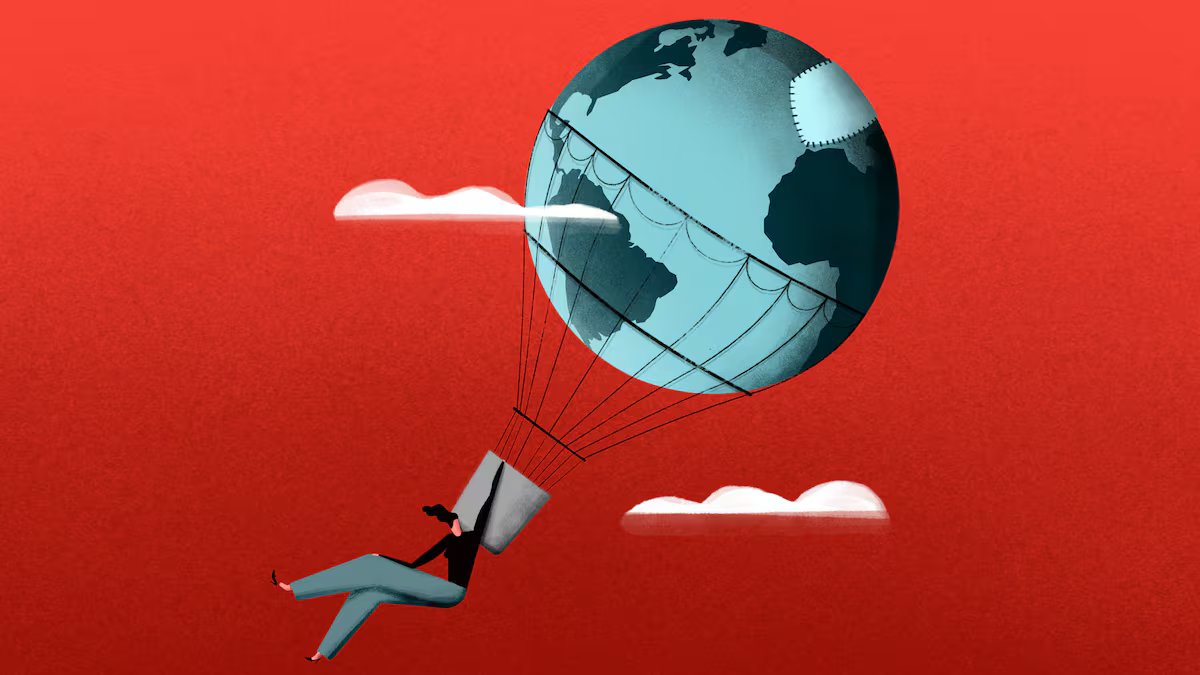
When did Europe go wrong? For decades, we thought the European project would disappear due to external threats… but we never imagined that this would happen because of the irresponsibility of its leaders, nor because of the inaction of its citizens. Nobody thought that Europe would cease to be the horizon that the rest of the world aspires to reach.
If we had to choose a specific date, it would be the day Russian troops entered Kyiv. Ukraine surrendered. With the complicity of the U.S. and China, Russia emerged as the hegemonic, revisionist power in Eurasia.
It was 2027 when the United States lifted its sanctions against Russia. This was spurred on by a ruthless industrial competition, which was taking place between Trump and Xi Jinping. European industry — led by Germany — demanded the reopening of the Nord Stream gas pipeline. No member state had the courage to justify a policy of de-industrialization to its citizens simply in order to aid Ukraine. Russian drones equipped with Taiwanese technology (with China having annexed the island), achieved what they had failed to accomplish in February of 2022. Thus culminated the collapse of the liberal international order that emerged after World War II, the one I myself had helped to strengthen since the late 1990s.
It was then that Putin’s neo-imperial dream became a reality… although he didn’t live long enough to witness it.
With much of Ukraine, Belarus, and southern Kazakhstan under direct or indirect control, Russia subsequently conquered territories and resources, taking control of more than 40% of the world’s wheat and grain supply. Today, this Pan-Eurasian Consortium, controlled by oligarchs close to the Kremlin, rations exports according to political criteria. Countries considered to be hostile — such as France, Germany, or Japan — face blockades, while Russia’s allies, such as Iran, Serbia, or Algeria, receive strategic discounts.
Taking advantage of the strategic vacuum left by the West, Russia struck a deal with Syria to establish a permanent naval base in the port city of Tartus, expanding its military presence in the Eastern Mediterranean. But Russian influence didn’t stop there: Moscow signed food security agreements with Egypt and gained political ground in Greece, where an ultraconservative coalition with clear pro-Russian ties has governed since 2030.
The Mediterranean, once a symbol of unity and shared origins, has been transformed into a hostile arena. Adrift among abandoned lighthouses, silent submarines and spy drones, the ramshackle boats filled with migrants and refugees — transported by unscrupulous mafias — are interspersed with state-of-the-art drug-running vessels and opportunistic pirates, who prowl thanks to the complicit silence of Russian Navy captains.
In this dystopia, Africa is the silent battleground, where everyone plays a part. With the continent’s population explosion, strategic reserves of rare minerals and dependence on food imports, Africa has become the epicenter of 21st-century geopolitics. Africa isn’t the silent victim of the new order: it’s an ignored cornerstone. Whoever controls its routes, ports and fields doesn’t need to fire missiles at Europe or Asia — they only have to wait. Because, in this dystopian century, the future isn’t decided where satellites shine, but rather where grain is sown, where lithium and rare earth elements are extracted… and where a loaf of bread is traded under a foreign flag.
In this new world of 2049, China isn’t Russia’s ally, but its silent (and superior) partner. It was decisive in the fall of Ukraine: while the West sent weapons and aid packages, Beijing discreetly increased its imports of Russian gas and wheat, providing the Kremlin with the liquidity necessary to withstand sanctions.
After the Russian victory, China gained exclusive access to strategic resources in Siberia and Ukraine — lithium, gas and grain — on preferential terms. It spearheaded the construction of a direct rail corridor between Beijing and Odessa, managed by Sino-Russian joint ventures, and a maritime corridor across the Arctic. These new Silk Roads have become the axis of 21st-century geoeconomics.
China, indeed, is like silk: smooth, sinuous, enveloping. It acts subtly through its soft diplomacy. The art of war is knowing when to wait for the enemy to make a move (while watching them slowly fall).
Beijing has become the architect of the post-Western world. Over the past couple of decades, the country built an alternative network to the SWIFT system, established an economic arbitration tribunal (based in Shanghai) and imposed the digital yuan as the reference currency in more than 40 countries across the Global South. Its unofficial motto sums it all up: “While others conquer with tanks, we do it with contracts.” China is the invisible empire.
Domestically, the new Chinese leader, Xi Jan Pung, continues his predecessor’s iron grip, with a greater focus on installing video surveillance and preventing global epidemics. The Communist Party has perfected a system of total control, based on biometric surveillance and social re-education. Following the annexation of Taiwan in 2031 — dubbed “Operation Greater China” — any dissent is brutally punished. However, it’s not all smooth sailing for the new empire. With an increasingly aging middle class (the birth rate is at an all-time low of 0.9 children per woman) and an insufficient supply of domestic robots that are expensive to manufacture (and even more expensive to maintain), China has been forced to open its doors to immigrants from Southeast Asia and Africa, in order to fill care giving and basic service roles. This has led to problems of coexistence.
Alongside the rise of the dragon, we’re witnessing the decline of what was once the guardian of the free world. The U.S. has stopped exporting democracy and is now, instead, exporting algorithms, liquefied natural gas… and nostalgia. Route 66 has become the new pilgrimage site for those seeking the essence of yesteryear: cowboys, Chevrolets and Harley-Davidsons, with Dolly Parton’s music playing in the background.
Almost simultaneously with the defeat in Ukraine, and in the face of European inaction, the U.S. seized the crown jewel: Greenland. One day, Trump landed Air Force One in Nuuk and handed out hot dogs to the assembled crowd, who were wearing MAGA hats. Live on the air, he planted the flag, while taking a selfie. Following the event (broadcast live by Tucker Carlson) and the signing of an agreement between the American and Greenlandic governments, which included holding an independence referendum, NATO effectively ceased to exist. Trump deployed the newly created elite DDA (the Donroe Doctrine Army), tasking it with maintaining a presence in the territory. The soldiers didn’t shed a drop of blood in the process.
The Danish prime minister then called a referendum in Denmark, which simply confirmed that the Danish population was more afraid of a “no” vote than a “yes” vote. The easiest thing to do was to relinquish Greenland and make it seem as if the Danes themselves preferred to do so rather than start a conflict with the United States. Denmark was far more concerned with maintaining its status quo — keeping migration and unemployment in check — than with holding on to the frozen island.
Thus, the U.S. killed two birds with one stone: it ended the world’s main international military institution (which it had struggled to get rid of) and became the king of the Arctic, displacing Russia and China to their respective spheres of influence. The Americans secured the vast unexplored arsenal of raw materials on the huge, icy island, along with the new trade route that reduced maritime traffic between Asia and Europe by 10 days.
What did Europe’s leaders do in response? The same thing it did when U.S. Special Forces removed Raúl Castro from Havana in a speedboat: issue statements expressing how deeply shocked they were by the events.
After the reelection of an isolationist president in 2028, the U.S. abandoned its bases in Europe, limiting its presence to remote intelligence operations. Today, in the Pacific, Washington maintains a weak power struggle with China for control of the Philippine Sea and the Strait of Malacca, but without engaging in open conflict. In Latin America, the “Great American Border Wall” has been erected, in order to contain the ever-decreasing waves of immigrants. There’s no longer an American dream to emigrate to.
Domestically, U.S. democracy has become a mere facade. Digital referendums on issues like guns, abortion and education — systematically manipulated by algorithmic disinformation — have become the norm. The majority of citizens no longer vote: instead, they delegate their democratic right to digital systems, which make decisions based on each person’s “emotional affinity.” Political parties are free apps, rallies are streamed online and leaders are ephemeral influencers. The education system has been colonized by disinformation. The “right to one’s own version of events” has been legalized, enshrined in the First Amendment. Science is optional, vaccination is considered to be “woke” and schools teach whatever each state’s governor dictates. Traditional universities have lost ground to “patriotic academies,” privately funded centers of ideological training with a doctrinal agenda.
Five tech conglomerates control 80% of American GDP. They’re fortress corporations, with private armies and their own investment treaties. These firms operate as de-facto federal departments, not subject to congressional oversight. Even the Treasury has been partially privatized: the federal reserves are held by BlackRock.
The Trump style is here to stay. The U.S. no longer aims to change the world: it only aims to prevent the world from changing it.
In this dystopian world, many readers may be wondering: what has happened to Europe? Well, contrary to many dire predictions, the European Union (EU) hasn’t disappeared… but it has ceased to be a powerful force. It has mutated into the European Administrative Confederation: a technocratic, functional, soulless bloc.
Brussels has become a logistics and financial hub. The European Commission administers climate resilience funds, manages digital trade and oversees the common market, but it lacks strategic vision. The European Parliament still exists, albeit with minimal participation — only half of the 826 elected members attend sessions — and marginal power.
The EU no longer acts as a unified entity. When it comes to foreign policy, migration and defense, member states operate independently, or in small blocs. For instance, there’s the Paris-Rome-Athens axis, with a pro-Russian orientation, or the Warsaw-Baltic axis, determined to keep NATO alive.
The Franco-German alliance dissolved after Marine Le Pen’s arrival at the Élysée Palace. Spain, Italy, and Greece, with parts of their territory completely desertified by the advance of climate change, feel abandoned in the face of migratory pressure. Europe has gone from looking east to looking nowhere.
The EU has no army or deterrent capacity. Germany failed to rearm. France acts on its own. Only the Baltic states and Poland invest in defense (and they do so with American aid). The Baltic has become a trench, the Mediterranean a sieve… and the Balkans a powder keg.
The collapse of the European project is now a reality. The dream of integration is dead. The EU survives by managing its own decline. It hasn’t been destroyed, but it has been emptied of its historical will. What was once the most ambitious project of cooperation between peoples has become a network of minimalist offices: well-managed, but without any real influence.
This dystopian scenario isn’t a projection of the future. Not even the most powerful figures in the Kremlin dream of such a scenario (which would be so advantageous to them). But it’s worth considering what could happen if Europe doesn’t react; if Europe allows itself to be driven by national selfishness.
Although Europeans may feel alone in the world today, we must remember that the EU has always gone against the grain of history. And that’s what makes it more valuable than ever: its spirit of resilience and its ability to take great strides precisely when they’re most needed. Because Europe isn’t an accident; it’s a choice. And the time has come to decide again.
And if we’re unable to move forward? Welcome to Europe 2049.
Sign up for our weekly newsletter to get more English-language news coverage from EL PAÍS USA Edition
