
It’s difficult to find a trade that technology hasn’t transformed. Automotive mechanics were aghast when diagnostic machines appeared, accelerating the discovery of faults, and metalworkers and woodworkers now have equipment that cuts with millimeter precision, saving them thousands of hours a year in their workshops. In agriculture, the transformation hasn’t stopped. Drones and self-driving tractors are two examples of how the sector is also embracing automation. However, there’s a human factor — for now, irreplaceable — in traditional trades that brings a smile to the faces of workers like Darío Valera.
“You can’t ask ChatGPT to crouch down and fix a car,” Valera quips. This 29-year-old mechanic is confident about his career prospects. He has several reasons not to worry about job security. The high demand for vehicle repairs in Spain and the severe labor shortage in this sector have left him with an endless list of clients he “sometimes has to turn away.” He simply can’t keep up.
The World Economic Forum’s Future of Jobs 2025 report points precisely to frontline professions and skilled trades as the main drivers of global employment through 2030. In fact, the report estimates that agriculture and traditional trades will lead global job creation in absolute numbers. The WEF notes that “skills instability” has slowed sharply to 39%. In other words, what a technical worker knows today is far more durable — and far more resilient to AI‑driven technological disruption — than the knowledge of a programmer or marketing specialist.
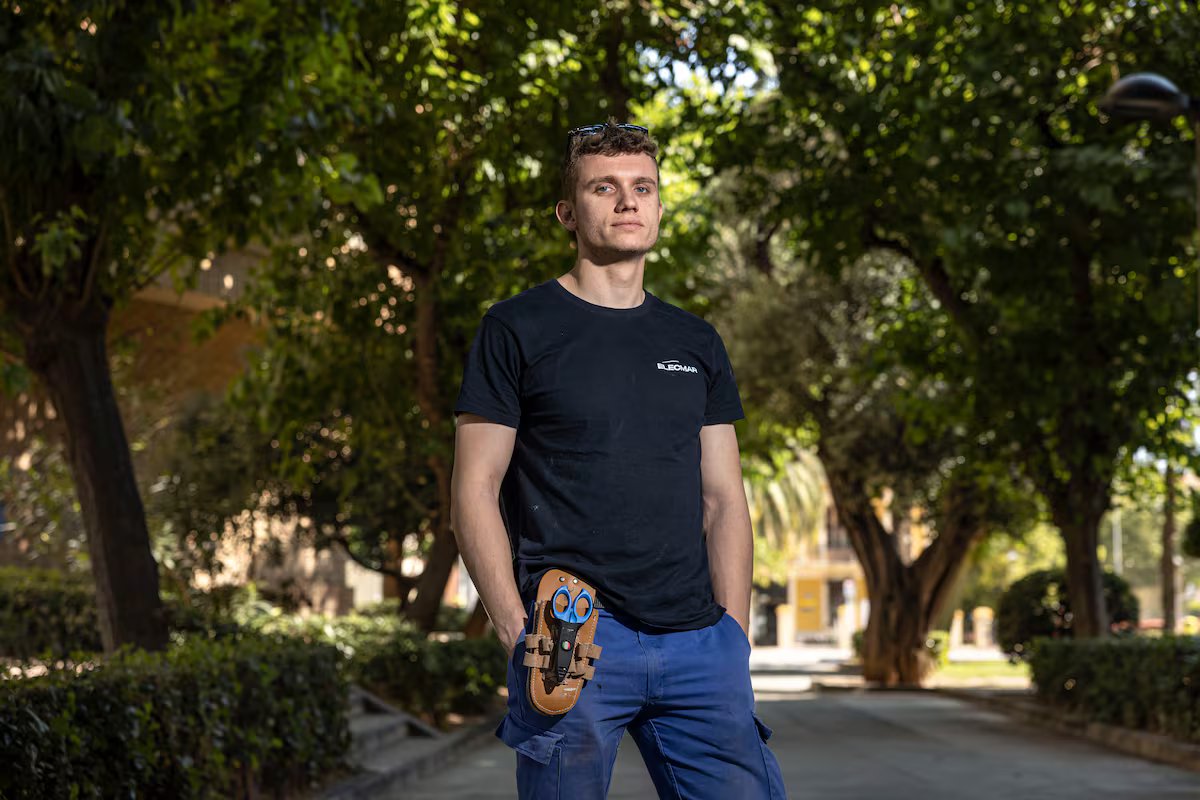
Mario Pastuszak, a 24‑year‑old electrician, recognizes how broad his profession can be and how crucial accumulated experience is. “If we have a complex project, we follow the official regulations and experience; ChatGPT doesn’t have much say here because what counts is skill.”
The Spanish Ministry of Education also notes the increasing number of students choosing to train in these fields. Enrollment in vocational training programs (intermediate and advanced level) has risen by 32.6% in the last five years, according to the ministry. High employment rates and competitive salaries are driving a new generation to rediscover their lost interest in traditional trades. Furthermore, authorities such as José Miguel Guerrero, president of the Confemetal training center, point out that these fields are also integrating AI into their daily operations, “which will open up new professional opportunities for many traditional trades.”
María Amparo Martínez understands what it means to integrate AI into her profession — and she’s excited about it. She has been a farmer for four years and knows how urgently the primary sector needs to attract talent. She believes younger generations must lean on technology to modernize one of the oldest trades in history. In her daily routine, she walks through her orange groves with Claude — Anthropic’s AI — asking it for constant technical assistance. According to the WEF, farmers top the global list of job creation in absolute terms, with a projected increase of 35 million jobs by 2030.
Valera, the mechanic, recalls his mother’s negative reaction when he told her he wanted to spend his life repairing vehicles. “She pictured a job where you spend the day with dirty hands and looking disheveled.” And although that image isn’t far from reality, it was precisely those technical skills that allowed Valera to come to Spain and find work immediately. “As long as intelligent robots don’t exist, someone will need to crouch down and check what’s going on inside a car.”
A major barrier
This disruption still seems distant. The WEF notes that although robots and autonomous systems have been growing steadily (between 5% and 7% annually since 2020), their physical installation requires massive capital investment and is heavily concentrated in just five industrialized countries. According to the report, 80% of installations are in China, Japan, the U.S., South Korea, and Germany.
Ernesto Grimaldo, 50, who has half a lifetime of experience in industrial maintenance, shares the same optimistic outlook. “Now that my children are starting secondary school, I tell them to consider training as renewable‑energy technicians, a field with excellent opportunities.”
Grimaldo is also not worried about his future. He recalls how digitalization already modernized his sector through GPS systems and automated time‑tracking. But he acknowledges that in his field, AI has run up against a barrier it will struggle to overcome: the human factor. For now, he’s confident he has a stable path ahead.
Sign up for our weekly newsletter to get more English-language news coverage from EL PAÍS USA Edition
