
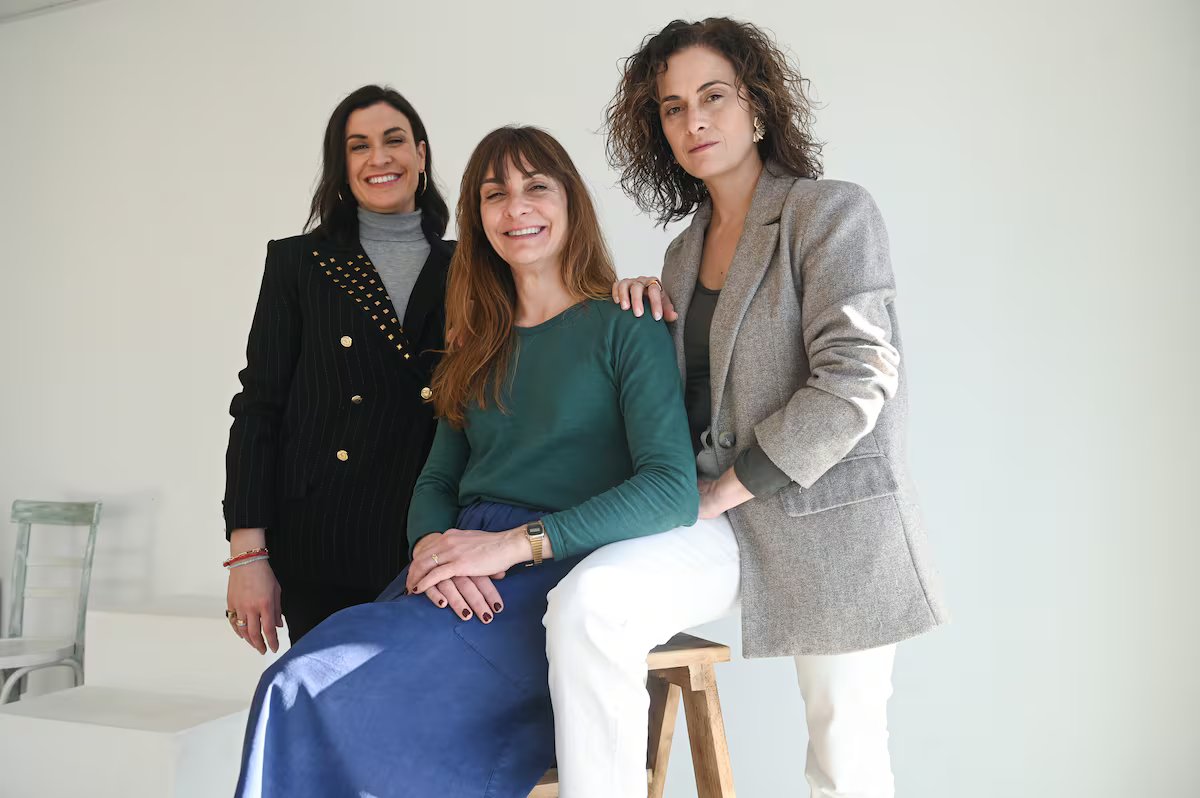
Four years ago, María, Adriana, and Paula López Fontanals received one of those life-changing pieces of news: it would change their bodies, their relationships with motherhood, with their daughters, with their health… A cousin alerted them after she developed a rapidly progressing breast tumor. “In September, she was cancer-free, and in January, she found a lump that had grown very quickly. Her mother had died of breast cancer. They told her, ‘Something’s wrong here,’ and they did a genetic test,” the sisters explain. That’s how she learned she carried a mutated version of the BRCA1 gene, known as the Angelina Jolie gene, whose name comes from BReast CANcer 1.
Carrying this mutation means having a greater than 60% chance of developing breast cancer, between 39% and 58% of developing ovarian cancer, and it is now known to be also linked to prostate, pancreatic, and melanoma cancers. She was also told to tell the whole family. María, Adriana and Paula received a message in their cousins’ WhatsApp group. “She told us, ‘This happened to me, get checked out because if you have it, it can be caught in time.’ She hasn’t died, but she went through a very difficult process. In the end, she lost a breast.”
The three sisters underwent genetic testing, a blood test that cost them €100. Three weeks later the results came in: all three had inherited a pathogenic mutation in the BRCA1 gene, discovered by the scientist Mary-Claire King. María is an optimistic woman and repeated the tests twice, thinking the results might be different, but they weren’t. “Yes, I had it,” she admits. “At that time I wasn’t afraid. As I got older, I was, but not in the same way as if you have cancer, because you live with the possibility that it won’t happen to you. You always count on the possibility that you might avoid it.”
Paula, the youngest of the three, accepted from the beginning that she carried the mutated gene deep within her cells. “I know I’m going to die from this,” she says. “I don’t know when, but I’m going to die of cancer. It’s clear, I have it inside my body.”
Adriana thought she was safe because she’d been told that, statistically, 50% of children are carriers, and her two sisters had already tested positive. Her plan was to have another baby. And the same week she found out she was a BRCA1 carrier, she got pregnant: “I wasn’t feeling well and I thought: Wait, they told you you have BRCA1, not cancer. It turns out it was the pregnancy.”
They say that when they learned of the diagnosis, they cried a lot and that only the women in the family wanted to know if they were carriers. “None of the men have been tested, as if it didn’t apply to them. But it does apply to them. They’re just afraid.”
The geneticist drew them a family tree, placing cancers on it like a detective. “My grandmother’s sister died of breast cancer; one of our aunts had pancreatic cancer and also died—you can’t escape that one. Our father had colon cancer, and the cousin who raised the alarm had cancer,” says María. That’s how they discovered the hereditary trait came down the paternal line, and they believe that their grandmother, who died at over 80 without developing the disease, was a silent carrier of the gene.
Within the same family with the same mutation, there is variability in risk, and not everyone develops the disease. “The gene predisposes you [to develop cancer], but it doesn’t cause cancer. Environmental factors and genetic background also play a role,” explains Rogelio González Sarmiento, coordinator of the genetic counseling and hereditary cancer unit at the Cancer Research Center in Salamanca. And it is precisely this variability that has presented these three women with a dilemma: what to do about a disease that hasn’t yet manifested and perhaps never will, but which poses a significant risk to their lives?
Hereditary cancers are rare tumors, occurring in less than 10% of diagnosed cancer cases. In the last decade, the number of known genes susceptible to mutation and potentially inherited has increased from around 40 to nearly 100.
Since receiving their diagnoses, the sisters have been attending genetic counseling clinics: María at the San Carlos Clinical Hospital in Madrid, Adriana at the Vall d’Hebron University Hospital in Barcelona, and Paula at the San Jorge University Hospital in Huesca. Their options are to undergo intensive monitoring every six months or to have preventive surgeries that would remove a significant portion of their breast tissue (bilateral mastectomy), ovaries, and fallopian tubes (bilateral salpingo-oophorectomy). These operations involve profound changes to a woman’s body, such as breast implants or early menopause, in addition to the inherent risks of the surgeries themselves, and of course, life-altering ones—they would never be able to have children again—but they would likely prevent the need for chemotherapy, radiation therapy, and more extreme surgeries should they become ill. There are also estrogen-reducing drugs that, to some extent, can prevent these hormone-dependent tumors.
“Genetic counseling isn’t about getting your breasts or ovaries removed. It’s about having these options and choosing based on your life circumstances and goals. What do you want? Are you young and want children? Are you breastfeeding? Doctors provide the information, but it’s your decision,” says González. The three sisters made different choices.
Maria, journalist, 47 years old
Just over a year ago, María had both breasts, ovaries, and fallopian tubes removed. She spent more than seven and a half hours in the operating room, where she also received breast implants. She’s not entirely happy with them. Although she was a healthy woman, with no trace of illness, the entire protocol surrounding her operation was that of a cancer patient. She says that from the moment the idea was raised, she was absolutely certain she would have the surgery. She is the eldest of the three sisters.
“I was terrified, and I didn’t want to live with that fear my whole life. When you haven’t had surgery, you have a mammogram, breast and gynecological ultrasound, and tumor marker tests every six months… They even checked my freckles. Even so, I postponed the surgery for a year. One night, I dreamt I was being skinned alive. I called them and told them no, and they were a little angry. The following year, I had the surgery,” she explains. Although they were able to save both nipples and the ducts that supply them, she hasn’t finished her breast reconstruction yet and is on the waiting list to have her nipples tattooed.
Since the surgery, she has gone through early menopause. “It’s shocking. They remove your ovaries one day, and the next you start having insomnia. I realized that the emotional low I was feeling wasn’t so much because of the surgery as because of the menopause, so I started medication.” María has a nine-year-old daughter who cried a lot when she found out her mother had to have her breasts removed. “I had breastfed her for a long time… she would fall asleep with her hand on them,” she recalls.
Paula, fashion designer, 40 years old
“My daughter asks me why I have to have the surgery. I tell her, because Mommy is in danger,” says Paula, the youngest of the three. A mother of a seven-year-old girl, she was 35 when she was told she carried a pathogenic version of BRCA1 and she still wanted to have another child. Since then, she has had several miscarriages, but she has now made her decision and will have a mastectomy this year. “My doctor told me it’s more important that I’m alive for the daughter that I have than dead for the one I might have.” She prefers to have the two surgeries separately and plans to have her ovaries removed in a couple of years to avoid going through menopause too early.
“I knew that sooner or later I’d have to have surgery, but I saw it as something further off.” She also says that she now finds the tests every six months difficult; the CT scan makes her want to vomit, the Pap smears hurt, the injections in her breasts… “But what am I supposed to do?” she says. “Put up with the pain or find out if something has grown, given my genetics? Because they never just give me a mammogram and send me home. They always find something with me: ‘You can all go home except Paula López.’ And that time feels like an eternity.”
Adriana, photographer, 44 years old
Adriana has two daughters and is still breastfeeding, so for now she has checkups every six months. Until her second daughter turned two, she participated in a breast milk study program to determine if breast cancer can be detected at an earlier stage in breast milk, even before imaging techniques or blood tests.
She hasn’t decided to have the surgery yet. “Because of long breastfeeding periods and my job, where I spend all day surrounded by babies, I’m still more connected to childbirth than to menopause. And that’s a big deterrent to surgery. It’s such a big undertaking for my body, and I still don’t know if I’ll develop [cancer]. But I’m very grateful for the gene because it makes me happier, allows me to enjoy my daughters and life more. It makes me aware of how lucky I am to be here, that it’s a gift.”
Interestingly, all three have had daughters and hope that, by the time they grow up, they will face less definitive dilemmas than their own.
Sign up for our weekly newsletter to get more English-language news coverage from EL PAÍS USA Edition
